

Beginners often underestimate ₹5000 SIP Returns, but even a small monthly investment can grow into a significant amount over time. Understanding 5,000 rupoees SIP returns helps you see how consistency and compounding build real wealth.
₹5000 SIP returns in 10 years depend on the assumed rate of return, the consistency of monthly contributions, and actual market performance.
If you think ₹5000 is too small to invest, this guide will change your perspective.
Check Your Own SIP Growth
Don’t rely on examples.
Calculate YOUR returns:
- ₹3000 / ₹5000 / ₹10,000
- 5, 10, 20 years
Start SIP with ₹5000 Today
- No need for big money
- Start instantly
Open an account here
₹5000 SIP RETURNS IN 10 YEARS
Let’s look at a realistic example of a 5000 rupees SIP return:
- Monthly SIP: ₹5000
- Duration: 10 years
- Illustrative annual return assumption: 12%
Total investment: ₹6,00,000
Estimated value: ₹11–12 lakh
At a hypothetical 12% annual return, the ₹6 lakh invested over 10 years would grow to approximately ₹11.5 lakh. Actual returns can be higher or lower because mutual fund returns are market-linked and not guaranteed.
If you delay by 5 years, you lose compounding.
How a ₹5,000 SIP Can Grow Over Time
₹5000 SIP returns grow because of:
- Compounding effect
- Regular investing
- Market growth over time
A ₹5,000 monthly SIP grows through regular contributions and the potential returns generated by the underlying investment. When investment gains remain invested, they can themselves generate further returns over time. This is the compounding effect.
The longer the investment remains invested, the more time there is for potential compounding. However, mutual fund returns are market-linked, and actual results can differ significantly from any illustration.
WHAT HAPPENS IN 20 YEARS?
If you continue a ₹5000 SIP for 20 years:
Total investment: ₹12 lakh
Estimated value: ₹49.5 lakh
At a hypothetical 12% annual return, a ₹5,000 monthly SIP for 20 years would grow to approximately ₹49.5 lakh. The total amount invested would be ₹12 lakh.
This is an illustration, not a guaranteed outcome. Actual returns may be higher or lower.
₹5,000 SIP Growth Over Different Investment Periods
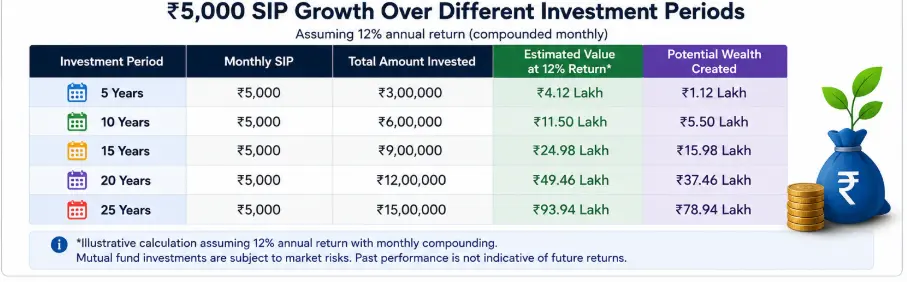
The table below illustrates how a ₹5,000 monthly SIP could grow over different investment periods, using a hypothetical 12% annual return assumption.
| Investment Period | Total Amount Invested | Illustrative Value at 12% Return* |
|---|---|---|
| 5 years | ₹3,00,000 | ₹4.12 lakh |
| 10 years | ₹6,00,000 | ₹11.50 lakh |
| 15 years | ₹9,00,000 | ₹24.98 lakh |
| 20 years | ₹12,00,000 | ₹49.46 lakh |
| 25 years | ₹15,00,000 | ₹93.94 lakh |
Illustrative calculation assuming a 12% annual return with monthly compounding. Mutual fund returns are market-linked and actual results may be higher or lower.
Expected Result
- Total invested: ₹6,00,000
- Final value: ₹11–12 lakh
Growth Explanation
This growth happens because:
- Returns are reinvested
- Money compounds over time
The difference between 10 and 20 years illustrates why time matters. The monthly contribution doubles from ₹6 lakh over 10 years to ₹12 lakh over 20 years, while the potential investment value can increase much more because earlier returns have more time to compound.
See how much your SIP can grow in real numbers.
Try SIP Calculator →Common Mistakes That Can Reduce Your Investment Outcome
- Stopping an SIP purely because markets fall
- Assuming a fixed return every year
- Investing without a clear goal
- Increasing the SIP beyond what you can realistically maintain
A SIP does not guarantee returns, and increasing the SIP is not mandatory. The investment amount should remain affordable for your financial situation.
Check Your ₹5000 SIP Returns Now
Don’t rely on estimates.
Use the SIP Calculator to:
- Calculate exact returns
- Adjust duration
- Plan your goals
Complete SIP investment guide in India
- ₹10000 SIP for 1 crore calculation
- SIP mistakes to avoid for better returns
- What is SIP in India? Explained simply
- Calculate your SIP returns here
Why Small SIPs Work Better Than You Think
A ₹5,000 monthly SIP may seem modest, but regular investing over a long period can build a meaningful investment corpus. The eventual outcome depends on the amount invested, investment duration and returns generated by the underlying investment.
Starting with an affordable amount can also make it easier to develop an investing habit. As income increases, investors can consider increasing their SIP if it remains appropriate for their goals and budget.
Read our guide on SIP vs Lump Sum to compare strategies.
Starting earlier can provide more time for potential compounding. However, the benefit depends on the investment period and the actual returns achieved. A later investment with a larger contribution can produce a different outcome, so there is no universal rule that a smaller early SIP will always outperform a larger later investment.
SIP Returns Are Not Fixed
A SIP calculator uses an assumed rate of return to estimate a future value. Mutual fund returns are market-linked and do not arrive at a fixed rate every year. For example, an investment may earn 15% in one year, fall in another year and produce a different long-term return. Therefore, calculator results should be treated as illustrations rather than promises.
Conclusion
A ₹5,000 monthly SIP can grow into a meaningful amount over time, but the final value depends on the returns generated by the underlying investment. At a hypothetical 12% annual return, ₹5,000 invested every month for 10 years would grow to approximately ₹11.5 lakh, compared with ₹6 lakh of total contributions.
If the same SIP continues for 20 years, the illustration grows to approximately ₹49.5 lakh under the same 12% assumption. These figures are mathematical illustrations, not guaranteed returns.
The important lesson is not to assume a particular return, but to start with a realistic goal, choose an appropriate investment, invest an affordable amount consistently, and review your plan as your financial circumstances change.
Start Your SIP Today
Now that you understand SIP, take action and start investing.
Open Free Demat Account →*Affiliate link. No extra cost to you.
FAQs
Q1. How much will a ₹5000 SIP grow in 10 years?
At a hypothetical 12% annual return, a ₹5,000 monthly SIP for 10 years would grow to approximately ₹11.5 lakh. The total contribution would be ₹6 lakh. Actual returns may differ because mutual fund returns are market-linked.
Q2. Can ₹5000 SIP make me rich?
A ₹5,000 monthly SIP can build a meaningful corpus over a long period, but whether it is enough for your financial goals depends on your target amount, investment horizon, inflation, and actual investment returns.
Q3. What return rate should I assume for SIP?
There is no guaranteed or universally appropriate return assumption for an equity mutual fund. For financial planning, consider testing multiple scenarios rather than relying on a single return figure. The calculator should clearly identify the assumed return as an illustration.
Q4. Is ₹5000 SIP enough to start investing?
₹5,000 can be a reasonable starting amount if it is affordable and appropriate for your financial situation. The right SIP amount depends on your income, expenses, emergency savings, existing investments, and financial goals.
Q5. How to increase SIP returns?
You cannot control the return generated by the market. You can, however, increase your investment amount when your financial capacity allows, remain invested according to your plan, and choose investments appropriate for your goals and risk tolerance.
