

Gold ETFs offer investors a way to gain exposure to gold without storing physical gold. They are traded on stock exchanges, so investors can buy and sell ETF units through a demat and trading account.
If you are searching for the best Gold ETF in India in 2026, the right choice is not necessarily the fund with the highest recent return. Investors should also compare tracking error, expense ratio, liquidity and assets under management (AUM).
In this guide, we compare five major Gold ETFs in India and explain what makes each one different. We also cover Gold ETF taxation, how to buy Gold ETFs, Gold ETF vs physical gold and Sovereign Gold Bonds, and the risks you should understand before investing.
Important: Gold ETF returns are market-linked and can rise or fall. Fund data such as AUM, expense ratio, tracking error and returns can change, so check the latest AMC factsheet before investing.
Looking for the best Gold ETF in India? Here are the top Gold ETFs for 2026, selected based on returns, expense ratio, liquidity, and tracking accuracy.
Based on the comparison framework used in this guide:
- Nippon India ETF Gold BeES – strongest choice for investors who place high importance on liquidity and fund size.
- ICICI Prudential Gold ETF – stands out for its relatively low tracking error in the data compared.
- HDFC Gold ETF – attractive for investors who give greater importance to a competitive expense ratio.
These are not universal recommendations. The most suitable Gold ETF depends on the factors that matter most to you, including liquidity, costs, tracking performance and investment objective.
How to Choose the Best Gold ETF in India?
Before choosing a Gold ETF, compare more than just its recent return. The following factors can help you evaluate different funds:
Expense ratio: This is an ongoing cost charged by the fund. All else being equal, lower costs can reduce the drag on long-term returns.
Tracking error: This shows how closely the ETF has followed its benchmark or underlying gold performance. A lower tracking error generally indicates closer tracking.
Liquidity: Higher trading activity can make it easier to buy or sell units and may help reduce the impact of bid-ask spreads.
Assets under management (AUM): A larger fund can provide useful context about its size and market presence, but AUM alone does not make an ETF better.
Fund history and consistency: Look at how consistently the ETF has tracked gold and how its costs and other characteristics compare with peers.
How We Ranked the Best Gold ETFs
Not every Gold ETF is suitable for every investor.
Instead of ranking funds based only on recent returns, we evaluated each ETF using objective factors that directly affect long-term investment performance.
Our ranking methodology focuses on cost, liquidity, tracking efficiency, and overall investor experience rather than short-term market movements.
The following factors were considered while preparing this list.
| Ranking Factor | Weight | Why It Matters |
|---|---|---|
| Tracking Error | 35% | Lower tracking error means the ETF closely follows domestic gold prices, reducing performance differences over time. |
| Liquidity | 25% | Higher trading volume makes buying and selling easier while reducing bid-ask spreads. |
| Expense Ratio | 20% | Lower annual costs help investors retain more returns over the long term. |
| Assets Under Management (AUM) | 10% | Larger funds generally have better liquidity and greater investor confidence. |
| Fund House Reputation & Consistency | 10% | Established fund houses with a consistent record provide additional confidence for long-term investors. |
No single Gold ETF is the best choice for every investor. Our ranking is based on the above FinanceRead comparison framework and should be treated as an analytical comparison, not an official industry ranking. Fund data can change over time, so investors should verify the latest factsheet before making an investment decision.
Our Recommendation Framework
FinanceRead does not rank Gold ETFs based only on recent returns. We evaluate each fund using a balanced methodology that considers tracking accuracy, costs, liquidity, fund size, and consistency to help investors make informed long-term decisions.
Why Gold ETFs Are Popular in 2026
Gold ETFs can appeal to investors who want gold exposure without dealing with physical storage, purity verification or making charges. Because ETF units trade on a stock exchange, investors can also buy or sell them through their demat and trading account during market hours.
Gold ETFs allow you to invest in gold digitally without worrying about:
- Purity
- Storage
- Making charges
They track domestic gold prices and can be bought like stocks on the stock exchange.
Best Gold ETFs in India 2026 – 5 Funds Compared

| Gold ETF | AUM (₹ Cr) | Expense Ratio | 5-Year CAGR | Tracking Error | Best For |
|---|---|---|---|---|---|
| Nippon India Gold ETF | 55,540 | 0.81% | 24.6% | 0.38% | Highest Liquidity & Largest AUM |
| SBI Gold ETF | 24,898 | 0.65% | 24.7% | 0.39% | Beginners & Balanced Investing |
| HDFC Gold ETF | 24,534 | 0.59% | 24.8% | 0.40% | Lower Cost |
| ICICI Prudential Gold ETF | 26,381 | 0.50% | 24.8% | 0.22% | Lowest Tracking Error |
| Kotak Gold ETF | 14,340 | 0.52% | 24.6% | 0.38% | Budget-Friendly |
Data note: The fund metrics shown in this table are based on the latest available data used for this comparison and may change over time. Always check the latest AMC factsheet for current AUM, expense ratio, tracking error and returns before investing.
1. My view on Nippon India ETF Gold BeES
Fund profile (as of May 2026):
- AUM: ₹55,540 crore (largest gold ETF in India by far)
- NAV: ₹128.51 (29 May 2026)
- 1Y Return: ~53.8%
- 5Y CAGR: ~24.6%
- Expense Ratio: 0.81%
- Tracking Error: 0.38%
- NSE Ticker: GOLDBEES
Why does it rank highly in our comparison?
Gold BeES stands out primarily for its large fund size and trading liquidity. For investors who expect to trade Gold ETF units regularly or value a highly liquid fund, these characteristics can be important.
Its expense ratio is not the lowest among the funds compared, so investors focused primarily on cost may prefer another ETF. The final choice should therefore depend on the combination of liquidity, tracking performance and cost rather than AUM alone.
FinanceRead Tip: Tracking error and expense ratio are important, but they should be considered together with liquidity, fund size and the ETF’s overall trading characteristics.
2. SBI Gold ETF – Large and Established Option
Fund profile (as of May 2026):
- AUM: ₹24,898 crore
- 1Y Return: ~53.2%
- 5Y CAGR: ~24.7%
- Expense Ratio: 0.65%
- Tracking Error: 0.39%
NSE Ticker: SETFGOLD
Why does it rank 2nd?
SBI Mutual Fund is the AMC arm of State Bank of India – India’s largest public-sector bank. For a large section of Indian investors, that brand association means something real. The fund has consistent performance, a tight tracking error of 0.39%, and a respectable ₹24,898 crore AUM.
It’s widely available across all major broker platforms – Zerodha, Groww, Angel One, HDFC Securities, and every bank-linked demat account.
The expense ratio at 0.65% sits in the mid-range. Not the cheapest, but not the most expensive either.
Consider this ETF if: You prefer a large, established Gold ETF and want to balance fund size, liquidity, cost and tracking performance rather than selecting a fund purely on recent returns.
3. HDFC Gold ETF – Competitive Expense Ratio
Fund profile (as of May 2026):
- AUM: ₹24,534 crore
- 1Y Return: ~52.8%
- 5Y CAGR: ~24.8%
- Expense Ratio: 0.59%
- Tracking Error: 0.40%
NSE Ticker: HDFCGOLD
Why does it rank 3rd?
HDFC Gold ETF has a lower expense ratio than Nippon India Gold ETF and SBI Gold ETF in the comparison above, although other Gold ETFs may have lower costs. Over a 10-year horizon, even a 0.20% difference in annual costs compounds meaningfully. On a ₹10 lakh investment, that’s real money.
Its 5Y CAGR of ~24.8% is among the best in the peer group, and the tracking error of 0.40% is tight – meaning it closely mirrors the domestic gold price. HDFC AMC is one of India’s most respected fund houses, regulated by SEBI, with a long track record of operational discipline.
The fund’s 3Y CAGR of 40.69% (as of April 2026) is also the strongest in the low-tracking-error peer group.
Consider this ETF if: You want to compare a large Gold ETF with a competitive expense ratio and are comfortable evaluating it alongside other funds on tracking performance and liquidity.
4. ICICI Prudential Gold ETF – Low Tracking Error
Fund profile (as of May 2026):
- AUM: ₹26,381 crore
- 1Y Return: ~53.8%
- 5Y CAGR: ~24.8%
- Expense Ratio: 0.49%
- Tracking Error: ~0.22%
- NSE Ticker: GOLDIETF
Why does it rank 4th?
Investors who place greater importance on tracking accuracy may want to consider ICICI Prudential Gold ETF. Its relatively low tracking error in the comparison data indicates that it has closely followed its underlying gold benchmark over the period measured.
5. Kotak Gold ETF – Competitive Cost and Tracking
Fund profile (as of May 2026):
- AUM: ₹14,340 crore
- 1Y Return: ~54.3% (highest 1Y return in the top 5 by market cap)
- 5Y CAGR: ~24.6%
- Expense Ratio: 0.52%
- Tracking Error: 0.38%
- NSE Ticker: KOTAKGOLD
Why does it rank 5th?
Kotak Gold ETF has the best 1-year return among the five largest gold ETFs as of May 2026 (~54.3%), and its tracking error of 0.38% is among the tightest. The expense ratio of 0.52% is competitive.
Kotak Gold ETF has a competitive expense ratio and a tracking error that is among the lower figures in the comparison. However, its fund size is smaller than the larger ETFs listed above. Investors should therefore compare its cost and tracking characteristics with its liquidity before choosing it.
Consider this ETF if…: First-time gold ETF investors, younger investors starting with small amounts, and anyone who wants a well-run fund without the complexity of comparing 15 options.
Largest Gold ETF by assets 2026
Assets Under Management (AUM) is one of the most important indicators when comparing Gold ETFs.
A higher AUM indicates that a fund has a larger asset base, but it does not automatically mean that the ETF has the highest trading liquidity or is the best choice. Trading volume, bid-ask spreads and tracking performance should also be considered.
While AUM alone should not determine your investment decision, it is an important factor when evaluating liquidity and the overall stability of a Gold ETF.
Based on the latest available data, the largest Gold ETFs in India are:
| Feature | Gold ETF | Physical Gold | SGB |
|---|---|---|---|
| Storage | No physical storage | Physical storage required | No physical storage |
| Liquidity | Exchange-traded | Depends on buyer/seller | Lower liquidity than ETFs |
| Returns | Linked to gold prices, less costs | Linked to gold prices, less costs | Gold-linked returns plus interest, subject to scheme terms |
| Demat | Required for exchange-traded units | Not required | Not required for all holding methods |
| Taxation | Capital-gains tax rules apply | Capital-gains tax rules apply | Interest is taxable; maturity tax treatment is subject to applicable conditions |
Gold ETFs are treated as specified mutual funds for capital-gains taxation. For units transferred on or after July 23, 2024, the general long-term holding period for gold and similar assets is more than 24 months, and long-term capital gains are generally taxed at 12.5% without indexation. Short-term gains are generally taxed at the applicable income-tax rate. Investors should verify the tax rules applicable to the year of sale.
Does a Higher AUM Mean a Better Gold ETF?
Not necessarily.
A larger AUM usually improves liquidity and investor confidence, but it should be considered along with:
- Expense Ratio
- Tracking Error
- Trading Volume
- Fund House Reputation
- Historical Performance
For most long-term investors, choosing a Gold ETF with a healthy AUM and low tracking error is often a better approach than selecting a fund based solely on recent returns.
Gold ETF vs Physical Gold vs SGB
| Feature | Gold ETF | Physical Gold | SGB |
|---|---|---|---|
| Storage | No | Yes | No |
| Liquidity | High | Medium | Low (lock-in) |
| Returns | Market-linked | Market-linked | +2.5% interest |
| Taxation | LTCG with indexation | Similar | Tax-free (on maturity) |

Note: AUM, expense ratio, and other fund metrics are based on the latest available data from the respective AMC fact sheets and may change periodically. Investors should verify the latest figures before investing.
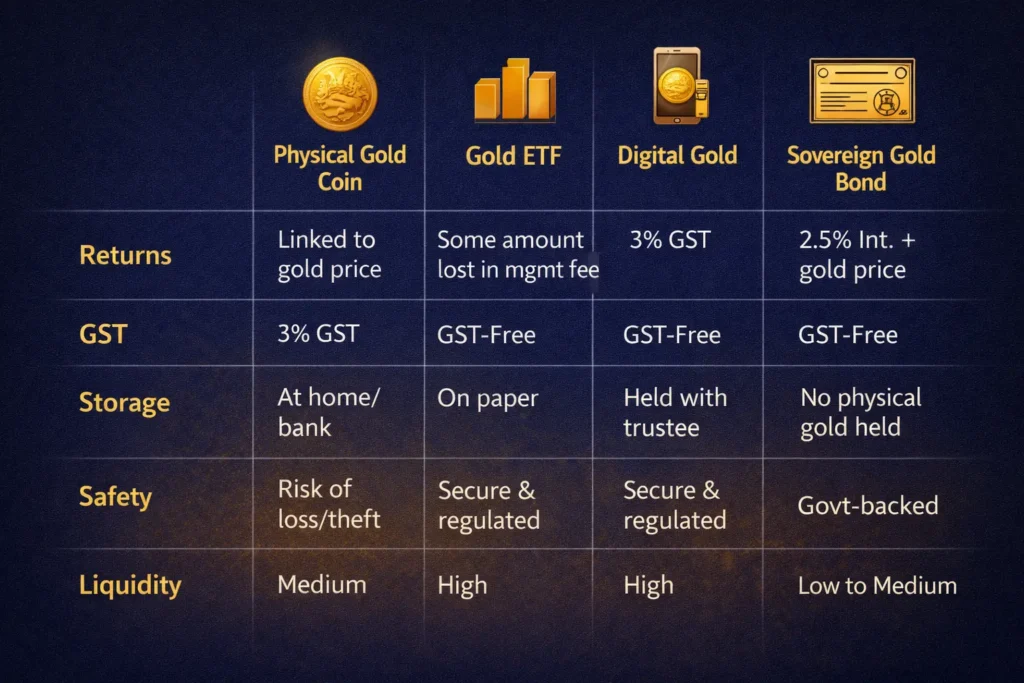
Which option is suitable depends on your objective. Gold ETFs may suit investors who want exchange liquidity and electronic gold exposure. Physical gold may be relevant when jewellery or physical possession is the objective. SGBs have different liquidity, interest and tax characteristics and should be evaluated separately.
Gold ETF Taxation in India
Gold ETF taxation depends on the holding period and the capital-gains rules applicable at the time of sale.
Gold ETFs are treated as specified mutual funds for capital-gains purposes. For units transferred on or after July 23, 2024, the general long-term holding period for gold and similar assets is more than 24 months. Long-term capital gains are generally taxed at 12.5% without indexation, while short-term gains are generally taxed at the applicable income-tax rate.
Tax rules can change, so investors should check the latest Income Tax Department guidance or consult a qualified tax professional before selling Gold ETF units.
Why Do Different Websites Recommend Different Gold ETFs?
If you search for the best Gold ETF in India, you may notice that different financial websites recommend different funds as their top pick. This can be confusing for investors, but it does not mean that one recommendation is right and the others are wrong.
The reason is simple: every website uses different criteria to evaluate Gold ETFs.
Some rankings focus on the lowest expense ratio, while others give more importance to tracking error, assets under management (AUM), market liquidity, or the reputation of the fund house. Depending on which factor receives the highest weight, the final ranking can change.
| If the Ranking Focus Is… | The ETF That Often Ranks Higher |
|---|---|
| Highest Liquidity | Nippon India Gold BeES |
| Largest AUM | Nippon India Gold BeES |
| Lowest Tracking Error | ICICI Prudential Gold ETF |
| Lower Expense Ratio | HDFC Gold ETF / Kotak Gold ETF |
| Balanced Long-Term Investing | SBI Gold ETF |
At FinanceRead, we do not rank Gold ETFs based on a single metric. Instead, we evaluate each fund using a balanced approach that considers liquidity, tracking accuracy, expense ratio, AUM, and long-term consistency.
This helps investors choose a Gold ETF that matches their investment goals rather than simply selecting the fund with the highest recent return or the lowest annual cost.
FinanceRead Tip: There is no single “best” Gold ETF for every investor. Active traders often benefit from higher liquidity, while long-term investors may place greater importance on lower tracking error or lower annual expenses. Choose the ETF that best aligns with your investment strategy.
Should You Invest in Gold Now?
Gold ETFs may be useful for investors who want exposure to gold as part of a diversified portfolio. However, gold prices can rise or fall, and past performance does not guarantee future returns.
Consider your overall asset allocation, investment objective, and risk tolerance before investing. Avoid buying Gold ETFs solely because gold prices have recently increased or because of short-term market forecasts.
You can also refer to SEBI guidelines on gold investments for a better understanding of risks and regulations.
How to Invest in Gold ETFs in India

Buying a Gold ETF is similar to buying shares on a stock exchange. Instead of purchasing physical gold, you buy units of a Gold ETF through a demat and trading account. This allows you to get exposure to gold without dealing with physical storage, purity or making charges.
Step 1: Open a Demat and Trading Account
To buy a Gold ETF listed on the NSE or BSE, you need a demat and trading account with a stockbroker. If you already use a broker for shares or other exchange-traded investments, you can generally use the same account.
Step 2: Complete Your KYC
Your broker will require KYC verification before you can trade. The information and documents required may include your PAN, Aadhaar, bank account details, mobile number and email address.
Step 3: Search for the Gold ETF
Log in to your broker’s trading platform and search for the Gold ETF you want to buy.
Some examples are:
- Nippon India ETF Gold BeES – GOLDBEES
- SBI Gold ETF – SETFGOLD
- HDFC Gold ETF – HDFCGOLD
- ICICI Prudential Gold ETF – GOLDIETF
- Kotak Gold ETF – KOTAKGOLD
Check the ETF name and exchange symbol carefully before placing an order because different funds may have similar names.
Step 4: Check the Market Price, Liquidity and Spread
Before placing your order, check the ETF’s current market price, recent trading activity and bid-ask spread. The market price can trade at a small premium or discount to the ETF’s NAV, so it is useful to compare the two rather than looking at the market price alone.
Also check the latest expense ratio and tracking error before choosing an ETF. These factors can affect how closely your investment follows gold over time.
Step 5: Place Your Buy Order
Select the number of units you want to purchase and choose the type of order:
- Market order: Attempts to execute the purchase at the prevailing market price.
- Limit order: Allows you to specify the maximum price you are willing to pay.
A limit order can give you greater control over the purchase price, particularly when an ETF has lower trading activity or a wider bid-ask spread.
Step 6: ETF Units Are Held in Your Demat Account
Once your order is successfully executed and settled, the Gold ETF units are credited to your demat account. You can then hold them as an investment or sell them through the exchange when you decide to exit.
Can You Invest in Gold ETFs Through a SIP?
Gold ETFs do not have a traditional mutual-fund SIP structure. However, some brokers may provide recurring investment features that can be used to purchase ETF units periodically.
The availability and functionality of such features vary between brokers. If you want to invest regularly, check how your broker handles recurring ETF purchases before starting.
What Is the Minimum Amount Required?
There is no universal fixed minimum investment amount for all Gold ETFs. Since Gold ETFs are traded in units, the amount required generally depends on the current market price of one unit and the number of units you purchase.
You should also consider brokerage, exchange charges, taxes and the bid-ask spread when calculating the actual cost of buying and selling ETF units.
FinanceRead Tip: Don’t choose a Gold ETF only because its unit price is lower. Compare tracking error, expense ratio, liquidity, AUM and the bid-ask spread before investing.
How to buy a Gold ETF in India
Buying a Gold ETF is similar to buying a listed security through a stock exchange. Instead of purchasing physical gold, you purchase ETF units through a demat and trading account. The ETF’s market price can move during trading hours and may differ from its NAV.
Step 1: Open a Demat and Trading Account
A Gold ETF is listed on the National Stock Exchange (NSE) and Bombay Stock Exchange (BSE). To invest, you need a demat account with a registered stockbroker.
Popular brokers include:
- Zerodha
- Groww
- Upstox
- Angel One
- ICICI Direct
If you already invest in stocks or mutual funds through these platforms, you can use the same account.
Step 2: Complete KYC
Complete the mandatory Know Your Customer (KYC) verification by submitting:
- PAN Card
- Aadhaar Card
- Bank Account Details
- Mobile Number
- Email ID
Most brokers complete this process online.
Step 3: Search for the Gold ETF
Log in to your trading app and search for the ETF name.
Examples include:
- Nippon India ETF Gold BeES
- SBI Gold ETF
- HDFC Gold ETF
- ICICI Prudential Gold ETF
- Kotak Gold ETF
Check the current market price before placing your order.
Step 4: Place Your Buy Order
Choose the number of ETF units you want to purchase.
You can place:
- Market Order – Buy immediately at the current market price.
- Limit Order – Buy only when the ETF reaches your chosen price.
Once executed, the ETF units are credited to your demat account.
Step 5: Monitor Your Investment
Track your Gold ETF just like any other stock.
Review periodically:
- Gold price movement
- Expense ratio
- Tracking error
- Fund liquidity
- Portfolio allocation
Avoid buying and selling frequently unless your investment strategy changes.
Can You Invest in Gold ETFs Through a SIP?
Unlike mutual funds, Gold ETFs do not offer a traditional SIP directly.
Gold ETFs do not have a traditional mutual-fund SIP structure. However, some brokers may offer recurring investment features that place periodic ETF purchase orders. Availability and functionality depend on the broker.
However, many brokers provide a recurring investment feature that automatically purchases ETF units every month.
This can help investors build long-term exposure to gold through disciplined investing.
Minimum Investment Required
You do not need a large amount to begin investing.
Since one ETF unit represents a small amount of gold, you can usually start with the price of a single unit, which varies with the market.
Pro Tip
Before choosing a Gold ETF, compare expense ratio, tracking error, liquidity, and assets under management (AUM) instead of selecting a fund based only on recent returns. Lower costs and better liquidity often have a greater impact on long-term performance than short-term return differences.
Risks of Investing in Gold ETFs
Gold ETFs provide convenient exposure to gold, but they are not risk-free.
Gold price risk: The value of your investment can fall if gold prices decline.
Tracking difference: An ETF may not exactly match the performance of gold because of expenses and other factors.
Liquidity and spread risk: Less actively traded ETFs can have wider bid-ask spreads, which can affect the price at which you buy or sell.
No fixed income: Gold ETFs do not provide a guaranteed interest income like a fixed deposit.
Currency and market factors: Indian gold prices can also be influenced by movements in the rupee and international gold prices.
Gold ETFs should therefore be considered as part of an overall investment strategy rather than a guaranteed-return product.
Who Should Consider Gold ETFs?
Gold ETFs may be worth considering for investors who:
- Want exposure to gold without storing physical gold
- Prefer exchange-traded investments
- Want the ability to buy or sell during market hours
- Want to diversify an investment portfolio
- Already have a demat and trading account
Gold ETFs may not be suitable for everyone. Consider your investment objective, risk tolerance, liquidity needs and overall asset allocation before investing.
What Should You Not Use to Choose a Gold ETF?
Avoid selecting a Gold ETF based only on one number.
Don’t choose only by recent returns: Gold prices can change significantly over time.
Don’t choose only by NAV: A lower NAV does not automatically make an ETF cheaper or better.
Don’t choose only by AUM: A large fund can be useful for liquidity, but fund size alone does not determine investment quality.
Don’t choose only by expense ratio: A slightly lower expense ratio does not automatically compensate for differences in tracking performance or liquidity.
A better approach is to compare several factors together and check the latest fund data before investing.
Other Ways to Invest in Gold in India
Gold ETFs are not the only way to gain exposure to gold. Investors can also consider physical gold, Sovereign Gold Bonds where available/applicable, and gold mutual funds.
Physical gold: Suitable when physical possession or jewellery is the objective, but investors need to consider storage, purity and transaction costs.
Sovereign Gold Bonds: These have different features from Gold ETFs, including interest and specific maturity, redemption and taxation rules. Availability and applicable terms should be checked before investing.
Gold mutual funds: These may provide gold exposure through a fund structure without requiring the investor to directly trade an ETF on the stock exchange.
The right option depends on your investment objective, liquidity needs, costs, and tax situation.
Gold prices and trends can be tracked on global financial platforms like the World Gold Council.
Who Should Invest?
For beginners, selecting the best gold ETF in India is a simple way to start investing in gold without physical risks. Gold ETFs are best for:
- Investors looking for liquidity
- Those who want to avoid storage risk
- Beginners starting with SIP
Final Verdict: Which Gold ETF Should You Choose?
The best Gold ETF in India is not necessarily the one with the highest recent return. A better comparison looks at tracking error, expense ratio, liquidity, AUM and the ETF’s overall characteristics.
Nippon India ETF Gold BeES stands out for its large AUM and liquidity. ICICI Prudential Gold ETF stands out for its relatively low tracking error in our comparison. HDFC Gold ETF offers a competitive expense ratio among the larger funds considered.
However, these characteristics can change over time. Before investing, check the latest AMC factsheet for current expense ratio, AUM, tracking performance and other fund details.
Gold ETFs can be useful for investors seeking gold exposure without holding physical gold, but they should be considered as part of a diversified investment strategy rather than as a guaranteed-return investment.
FAQs
Q1. Which Gold ETF is best in India in 2026?
There is no single Gold ETF that is best for every investor. The right choice depends on factors such as tracking error, expense ratio, liquidity and AUM. In our comparison, Nippon India ETF Gold BeES stands out for fund size and liquidity, while ICICI Prudential Gold ETF stands out for its relatively low tracking error.
Q2. Which Gold ETF has the lowest tracking error?
Tracking error changes over time, so there is no permanent winner. In the data used for this comparison, ICICI Prudential Gold ETF has the lowest tracking error among the five ETFs listed. Always check the latest AMC factsheet before investing.
Q3. Is Gold ETF better than physical gold?
Gold ETFs can be more convenient for investors who want electronic gold exposure without physical storage, purity concerns and making charges. Physical gold may still be appropriate when jewellery or physical possession is the objective.
Q4. Is Gold ETF better than SGB?
Neither is automatically better. Gold ETFs provide exchange liquidity, while SGBs have different features such as interest, maturity and specific tax treatment. Compare liquidity, investment horizon, interest and taxation before choosing.
Q5.How can I buy a Gold ETF in India?
You generally need a demat and trading account. Search for the ETF using its exchange ticker, check the current market price, liquidity and spread, and place your buy order through your broker.
Q6. Are Gold ETFs safe?
Gold ETFs are regulated investment products, but they are not risk-free. Their value can fall when gold prices decline, and their returns can differ from the underlying gold price because of expenses and tracking differences.
Gold ETF information on this page is for educational purposes only. Gold prices can move up or down depending on market conditions. Always compare latest fund details, expense ratio and your financial goals before investing.
Author Note
FinanceRead created this article to help Indian investors understand gold investment options in simple and practical terms.
