

The key is not choosing “the fastest fund,” but choosing a fund you can hold calmly for 10-20 years through different market cycles. To build a retirement portfolio, starting early and investing consistently can matter more than chasing the fund with the highest recent return.
In this guide to the best large-cap funds for retirement in India, we compare a shortlist of funds worth considering for long-term retirement investing. The goal is not to predict which fund will deliver the highest future return, but to understand the factors that can help you make a more informed choice.
5 Large-Cap Funds Worth Comparing for Retirement
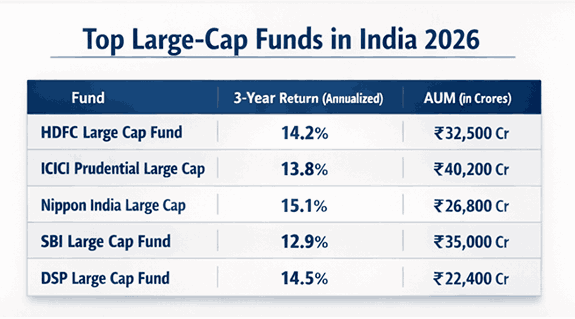
The five funds below are a comparison shortlist, not a ranking that guarantees which fund will deliver the highest future return.
Investors do not need to own all five. Holding multiple large-cap funds can also create portfolio overlap because different funds may own many of the same large companies.
Before selecting one, compare the latest factsheet, portfolio concentration, costs, performance consistency, benchmark, and Riskometer.
How Many Large-Cap Funds Do You Need?
Most investors do not need to hold several large-cap funds simply because more options are available.
One well-chosen large-cap fund may be sufficient as the large-cap component of a portfolio. A second fund should have a clear purpose rather than being added only for diversification.
Before adding another large-cap fund, compare the portfolios because two funds in the same category can hold many of the same companies.
How These Large-Cap Funds Were Selected
The shortlist is based on factors that matter when evaluating a large-cap fund for a long-term retirement portfolio:
- Long-term performance consistency rather than one unusually strong year
- Performance relative to the fund’s benchmark and category
- Expense ratio and other applicable costs
- Portfolio diversification and concentration
- Fund-management and investment-process stability
- Assets under management as supporting context, not as a quality score by itself
- Current scheme Riskometer and suitability information
- Consistency with the characteristics of a SEBI large-cap fund
This is not a prediction of future returns. Mutual fund performance can change, and a fund that performed well in the past may not remain a top performer.
The data and risk information should always be checked against the latest fund factsheet before investing.
2026 top picks-quick snapshot
- HDFC Large Cap Fund is an open-ended equity scheme predominantly investing in large-cap stocks and is designed for long-term capital appreciation.
- Nippon India Large Cap Fund is an open-ended equity scheme predominantly investing in large-cap stocks, with long-term capital growth as its stated objective.
- ICICI Prudential Large Cap Fund is an open-ended equity scheme predominantly investing in large-cap stocks. Its benchmark is the Nifty 100 TRI.
- SBI Large Cap Fund is an open-ended equity scheme investing predominantly in large-cap companies and is designed for long-term capital appreciation.
- DSP Large Cap Fund is an open-ended equity scheme predominantly investing in large-cap stocks, with long-term capital growth as its stated objective.
Comparison Table showing the Best Large-cap funds for Retirement in India
| Fund | Category | Current Scheme Risk |
|---|---|---|
| HDFC Large Cap Fund | Large Cap | Very High |
| Nippon India Large Cap Fund | Large Cap | Very High |
| ICICI Prudential Large Cap Fund | Large Cap | Very High |
| SBI Large Cap Fund | Large Cap | Very High |
| DSP Large Cap Fund | Large Cap | Very High |
Riskometer classifications can change, so check the latest official AMC factsheet before investing.
SIP or Lump Sum for Retirement?
Both approaches can be appropriate depending on how the money becomes available.
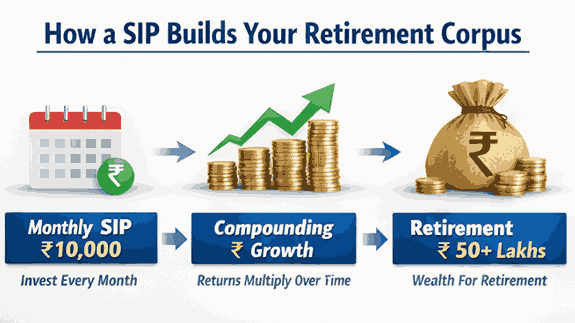
A SIP can help investors invest regularly from monthly income and avoid the need to decide when to deploy the entire amount.
A lump-sum investment may be appropriate when an investor already has money available for long-term investment, but the decision should consider the investor’s asset allocation, risk tolerance, and ability to withstand market declines.
No fixed rule says a particular investment horizon automatically makes lump-sum investing better than SIP investing.
Why consider these funds
HDFC Large Cap Fund is historically among the more consistent large-cap active funds; it invests in market leaders across sectors and typically shows stable multi-year returns.
Nippon India Large Cap Fund has delivered higher-than-category returns at times and remains a popular large-cap pick among platform curations.
ICICI Prudential Large Cap Fund has a large AUM and a track record of steady returns, good for investors who want an institutional-sized, well-distributed fund.
SBI Large Cap Fund has a value tilt and a wide distribution, making it a sensible core holding for many retail investors; it can act as a conservative large-cap anchor.
DSP Large Cap Fund appears among top performers in category snapshots and often scores high on platform return tables; suitable for investors who want an actively managed pick with recent outperformance.
How Much Should You Allocate to Large-Cap Funds for Retirement?
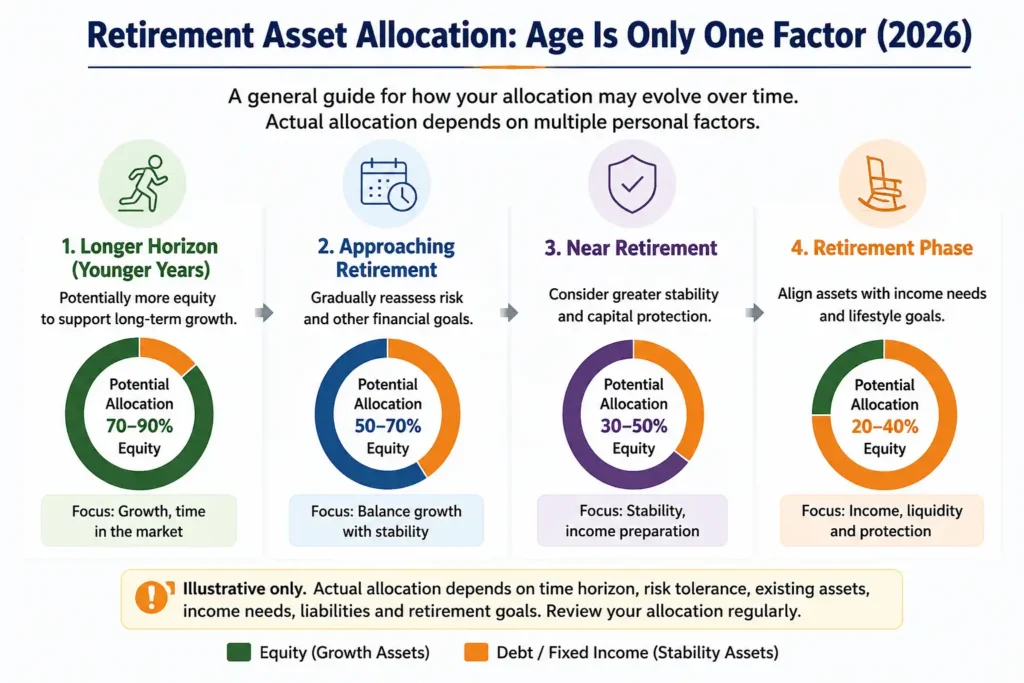
There is no universal equity allocation that can be determined from age alone.
Your retirement allocation should consider:
- Years remaining until retirement
- Current retirement corpus
- Expected pension or other retirement income
- Emergency savings
- Existing equity and debt investments
- Debt obligations
- Ability to tolerate a large temporary fall in the portfolio
- How soon you will need to withdraw the money
For example, an investor with 20 years until retirement may have more capacity for equity volatility than someone who needs to start withdrawing from the portfolio within a few years. But age by itself does not determine the correct percentage.
Large-cap funds can form part of the equity allocation for a long-term investor, while debt and other assets can help manage the portfolio’s overall risk.
The percentages in this article should therefore be treated as illustrative examples, not personalised investment advice.
Risks, tax, and exit points to remember
- Market risk: Large caps reduce but don’t eliminate market volatility.
- Concentration risk: Some funds may be heavily invested in a few sectors; check the top 10 holdings.
- Tax: equity funds held over 1 year qualify for long-term capital gains (LTCG) treatment in India; gains above the LTCG exemption threshold are taxed as per current rules — verify the latest tax slabs before planning withdrawals.
- Exit: for retirement, avoid panic selling during a 6–12 month correction. Instead, use staggered exit (e.g., convert to debt or use SWP) and lock in gradual income. (Check current tax rules/limits before acting).
Practical checklist before you invest
- Choose the direct plan, not the regular.
- Compare expense ratios and AUM across platforms.
- Check the fund’s 3- and 5-year rolling returns and drawdown history.
- Review the top 10 holdings and sector concentration.
- Prefer SIPs for steady retirement accumulation; build an emergency fund first.
- Rebalance annually to maintain target allocation.
3 Callout Boxes (Ready Content)
Callout Box 1 (Large-Cap Funds as a Core Equity Option)
Large-cap funds can serve as a core part of the equity allocation for some long-term investors. They are generally less volatile than mid-cap and small-cap funds, but they are still equity investments and can fall significantly during market declines.
Callout Box 2 (Build a Balanced Retirement Portfolio)
A retirement portfolio does not need to rely entirely on large-cap funds. Combining suitable equity and fixed-income investments can help balance long-term growth, stability, and future income needs. The right mix depends on your time horizon, risk tolerance, and existing assets.
Callout Box 3 (Growth + Stability)
Equity investments can provide long-term growth potential, while debt and fixed-income investments can add stability and liquidity. The appropriate balance depends on when you need the money and how much market volatility you can tolerate.
Risk/tax section
Even the best large-cap funds for retirement in India can fall during market corrections, so avoid panic selling and stay invested for the long term.
Final Takeaway
Large-cap funds can be useful as a core part of the equity allocation for a long-term retirement portfolio, but they are not risk-free or capital-protected investments. Even large-cap funds can experience significant declines during market downturns.
The key is not choosing the fund with the highest recent return. Instead, focus on factors such as long-term consistency, costs, portfolio diversification, investment process, current Riskometer, and how well the fund fits your overall retirement plan.
The best large-cap funds for retirement in India are not necessarily the same for every investor. Your investment horizon, risk tolerance, existing assets, expected retirement income, and withdrawal needs should all influence your choice.
If you are investing through a SIP, consistency over many years can help you build your retirement corpus. Before investing, compare the latest fund factsheet and make sure the fund’s risk and portfolio are appropriate for your circumstances.
Past performance does not guarantee future returns. Mutual fund investments are subject to market risks.
Before investing, always check the latest expense ratio, portfolio holdings, Riskometer, and official fund factsheet. Fund information can change, so verify the latest details before making an investment decision. Your retirement plan becomes powerful not because of one fund, but because of consistent investing for many years.
FAQs
Q 1: Which is the best large-cap mutual fund for retirement in 2026?
There is no single “best” large-cap fund for everyone, because it depends on your risk tolerance and investment horizon. However, for retirement planning in 2026, investors should prefer large-cap funds that have a consistent long-term track record, a reasonable expense ratio (direct plan), and a diversified portfolio of top Indian companies. Always check the latest factsheet and 3–5 year rolling returns before investing. Value Research Online+1
Q Q 2: Are large-cap funds safe for retirement?
Large-cap funds are generally less volatile than mid-cap and small-cap funds, but they are still equity investments and can experience substantial declines. For retirement planning, their suitability depends on your investment horizon, risk tolerance and overall asset allocation.
Q 3: Should I invest in large-cap funds via SIP or lump sum in 2026?
Both SIP and lump-sum investing can be appropriate. SIP can help investors invest regularly from monthly income, while lump-sum investing may suit someone who already has money available for long-term investment. The choice should depend on cash availability, asset allocation, risk tolerance and investment discipline rather than a fixed rule.
Q 4: How many large-cap funds should I hold for retirement?
For retirement investing, holding 1 to 2 large-cap funds is usually enough. Holding too many funds often creates portfolio overlap and makes tracking difficult. A simple portfolio with fewer high-quality funds works better for long-term retirement compounding.
