For Financial Year 2026-27 | Assessment Year 2027-28
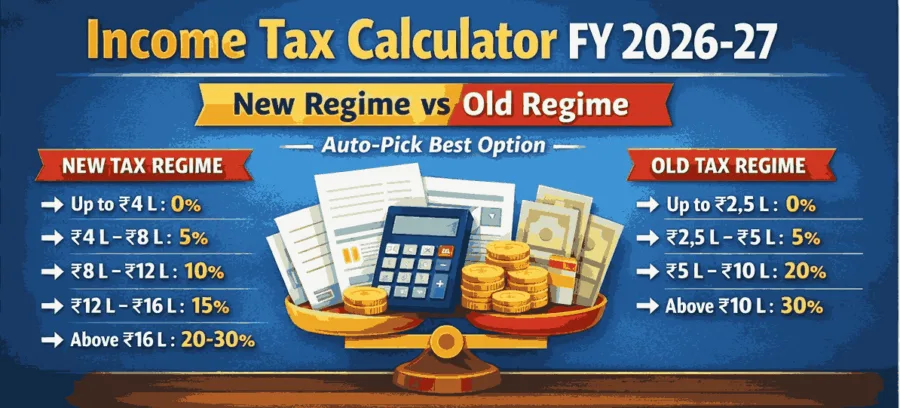
The Union Budget 2026-27, presented by Finance Minister Nirmala Sitharaman on February 1, 2026, brings stability and continuity in income tax rates while introducing significant structural reforms. Income Tax Calculator FY 2026-27 India helps taxpayers instantly compare the new and old tax regimes after Budget 2026.
This calculator estimates your tax liability under the new and old tax regimes using the income and deductions you enter. It can help you compare the two regimes, but the result is an estimate and may not cover every taxpayer’s income type, exemption, or special tax provision.
Created by shaikh Farooque Akhtar, MBA, CFA | Reviewed by SK Waseem, BCom (Honours), MBA (Finance)
Last reviewed: [August 27, 2026]
Key Highlights from Budget 2026 for Taxpayers
✅ No Changes in Income Tax Slabs
The income tax slabs remain unchanged from FY 2025-26 for both old and new tax regimes. This provides predictability for financial planning.
Maximum Tax-Free Income: ₹12.75 Lakh
Under the New Tax Regime:
- Zero tax payable on income up to ₹12 lakh (after Section 87A rebate)
- Salaried employees can earn up to ₹12.75 lakh tax-free (including ₹75,000 standard deduction)
Income Tax Code Act, 2025, effective from April 01, 2026
The Income Tax Code, 2025, will replace the Income Tax Act, 1961, effective April 1, 2026, featuring:
- Simplified language and reorganized provisions
- Redesigned ITR forms for easier compliance
- Automated compliance processes
How It Works (Logic Summary)
- Input your Annual Gross Salary / Pension
- Enter eligible deductions (only for Old Regime)
- The calculator computes taxable income under both regimes
- Applies the correct slabs and rebates
- Adds cess (4%)
- Shows tax payable in each regime and the estimated lower-tax option based on the information entered
Key Rules After Budget 2026:
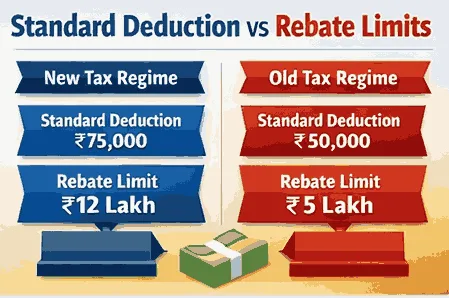
✔ New Regime standard deduction = ₹75,000
✔ Old Regime standard deduction = ₹50,000
✔ New Regime rebate upto ₹12,00,000 (zero tax)
✔ Old Regime rebate upto ₹5,00,000 (zero tax)
✔ Deduction inputs apply only in the Old Regime
Progressive Slabs Used in the Calculator
New Tax Regime (FY 2026-27)
Income Tax Slabs
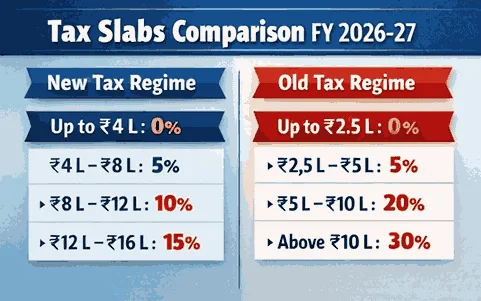
0 – ₹4,00,000 → 0%
₹4,00,001 – ₹8,00,000 → 5%
₹8,00,001 – ₹12,00,000 → 10%
₹12,00,001 – ₹16,00,000 → 15%
₹16,00,001 – ₹20,00,000 → 20%
₹20,00,001 – ₹24,00,000 → 25%
Above ₹24,00,000 → 30%
Key Benefits:
- Standard Deduction: ₹75,000 for salaried individuals
- Section 87A Rebate: Up to ₹60,000 (making income up to ₹12 lakh tax-free)
- 30% tax rate now applies only above ₹24 lakh (vs. ₹15 lakh previously)
Rebate
Section 87A rebate: Up to ₹60,000 where eligible, for taxable income up to ₹12 lakh under the new regime.
Old Tax Regime (FY 2026-27)
Income Tax Slabs
0 – ₹2,50,000 → 0%
₹2,50,001 – ₹5,00,000 → 5%
₹5,00,001 – ₹10,00,000 → 20%
Above ₹10,00,000 → 30%
Key Benefits:
- Standard Deduction: ₹50,000
- Multiple deductions available under Section 80C, 80D, HRA, etc.
- Zero tax up to ₹5 lakh income
Rebate
✔ If taxable income (after deductions + standard deduction) ≤ ₹5,00,000 → tax = ZERO
You can verify official tax provisions on the Income Tax Department website.
Calculator Logic (Step by Step)
Step 1 — Taxable Income
New Regime
Taxable = Gross Income – 75,000
Old Regime
Taxable Income = Annual Gross Salary or Pension − ₹50,000 standard deduction − eligible deductions entered by the user
Total Deductions = sum of
✔ Section 80C (max 1.5 lakh)
✔ Section 80D (health insurance)
✔ Home loan interest
✔ Other eligible deductions
Ensure deductions do not exceed legal limits. The calculator uses the combined eligible deduction amount entered by the user for the old-regime comparison.
Important: The calculator does not separately verify deduction-wise eligibility or statutory limits. Enter only deductions and exemptions that are legally applicable to your situation.
Step 2 — Apply Slab Tax
Tax = sum of slab amounts × slab rates.
Step 3 — Apply Rebate
- New Regime: If taxable ≤ ₹12,00,000, tax = ₹0
- Old Regime: If taxable ≤ ₹5,00,000, tax = ₹0
Step 4 — Add Cess 4%
Final Tax = Tax × 1.04
Calculator Assumptions and Limitations
This calculator is designed to provide an estimated comparison of income tax under the old and new tax regimes for resident individuals with salary or pension income.
The calculation:
- Applies the standard deduction assumed by the calculator for each applicable tax regime.
- Calculates tax using the income-tax slabs programmed into the calculator.
- Applies the applicable rebate based on the calculator’s assumptions and eligibility conditions.
- Adds Health and Education Cess at the applicable rate after calculating the estimated income tax.
- Uses the eligible deduction amount entered for the old-regime comparison, subject to the calculator’s stated scope.
The calculator does not provide a complete tax computation for every taxpayer. It does not cover all income types, exemptions, deductions, special tax rates, surcharge, capital gains, or other complex tax provisions.
Important: The calculator provides an estimate for planning and comparison purposes. Please verify your final tax liability based on the tax rules applicable to your individual circumstances.
Income Tax Calculator FY 2026-27
For a simplified calculation for salaried individuals and pensioners. Enter eligible deductions applicable under the old tax regime. The ₹50,000 standard deduction is applied separately.
Income Tax Report FY 2026-27
Annual Gross Salary / Pension: ₹
Old Regime Eligible Deductions: ₹
FinanceRead Calculator – financeread.in
This is an estimated tax report for informational and planning purposes only. Actual tax liability may vary depending on the taxpayer’s income, eligibility, deductions, exemptions, special-rate income and other applicable provisions.
How to Read Your Income Tax Calculator Result
After you enter your annual income and eligible deductions, the calculator compares your estimated tax under both the old and new tax regimes.
Estimated Tax Under the New Regime
This shows the estimated tax payable under the new tax regime based on the income entered and the assumptions used by the calculator, including the applicable standard deduction.
Estimated Tax Under the Old Regime
This shows the estimated tax payable under the old tax regime after considering the standard deduction and the eligible deductions entered by you.
Estimated Taxable Income
Taxable income is the amount remaining after the applicable standard deduction and eligible deductions are considered. The taxable income may differ under the old and new tax regimes.
Estimated Tax Difference
The difference between the estimated tax payable under the two regimes shows how much more or less tax may be payable based on the information entered.
Estimated Lower-Tax Option
If one regime shows a lower estimated tax amount, the calculator highlights that option based on the information you entered.
However, the result is an estimate and should not be treated as personalised tax advice. Your final tax liability may differ depending on factors not covered by this simplified calculator, such as other income sources, exemptions, special-rate income or other applicable tax provisions.
Illustrative Example: ₹15 Lakh Gross Salary Under the New Regime
This illustration assumes only the standard deduction and does not include special-rate income, surcharge or other taxpayer-specific adjustments.
Annual Income: ₹15,00,000 (Salaried)
| Component | Amount (₹) |
|---|---|
| Gross Income | 15,00,000 |
| Less: Standard Deduction | (75,000) |
| Taxable Income | 14,25,000 |
Tax Calculation:
- ₹0-4,00,000: Nil = ₹0
- ₹4,00,001-8,00,000 @ 5% = ₹20,000
- ₹8,00,001-12,00,000 @ 10% = ₹40,000
- ₹12,00,001-14,25,000 @ 15% = ₹33,750
Subtotal: ₹93,750
Add: 4% Health & Education Cess = ₹3,750
Total Tax Payable: ₹97,500
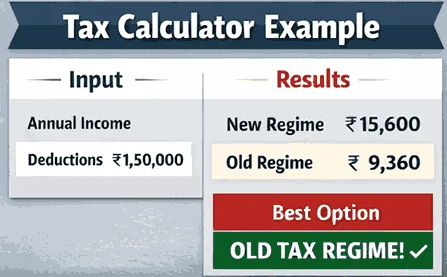
If your income is ₹10,00,000 and deductions ₹1,50,000:
✔ New Regime Tax (after rebate/standard deduction)
✔ Old Regime Tax (after deductions)
The calculator shows both and recommends the estimated lower-tax option based on the information entered. Using an Income Tax Calculator for FY 2026-27 in India is now essential because small deduction differences can change your final tax by thousands of rupees.
You can also refer to my page for the previous budget-related income tax calculator.
Budget 2026 vs Budget 2025 – What Changed for Taxpayers
Stability instead of surprises
Budget 2025 focused on promoting the new regime with rebate expansion and deduction tweaks. Budget 2026 kept the system stable rather than introducing new slabs. This stability signals that the government wants taxpayers to shift toward the simplified regime gradually.
New regime remains the government’s preferred model
The continued higher standard deduction and rebate thresholds show that policymakers are encouraging taxpayers to move toward the new system where compliance is easier, and paperwork is minimal.
Old regime still relevant for deduction-heavy taxpayers
Despite policy preference, the old regime continues to benefit those with home loans, insurance, HRA claims, and large investments. Budget 2026 did not remove it, which means taxpayers still have flexibility.
Predictability helps planning
Since slabs have remained stable, taxpayers can now plan long-term investments without worrying about sudden changes to tax rules every year.
What This Means for Salaried Individuals and Professionals
What This Means for Salaried Individuals
For salaried employees and pensioners, the better tax regime depends mainly on taxable income and the eligible deductions or exemptions available to them.
If You Have Fewer Eligible Deductions
The new tax regime may result in a lower estimated tax liability for some individuals who do not claim substantial deductions or exemptions.
If You Claim Significant Eligible Deductions
The old tax regime may result in a lower estimated tax liability when eligible deductions and exemptions substantially reduce taxable income.
Compare Both Regimes
There is no single tax regime that is automatically better for everyone. The result depends on your income and the eligible deductions included in your calculation.
Use the calculator to compare the estimated tax payable under both regimes based on the information you enter.
Important: This calculator is designed as a simplified comparison for resident individuals with salary or pension income. Taxpayers with business income, capital gains, special-rate income or complex tax situations should verify their tax calculation separately.
Conclusion
Budget 2026 did not introduce dramatic changes in personal taxation, but that itself is important. It confirms that India is moving toward a stable and simplified tax system while still allowing taxpayers the freedom to choose what suits them best.
Instead of guessing which regime is better, taxpayers should rely on data-driven comparisons. Budget 2026 keeps the current income-tax slab structure broadly stable, but the better tax regime can still vary from one taxpayer to another. Instead of relying on a general rule, compare both regimes using your actual income and eligible deductions.
Use this calculator as a planning estimate, then verify the applicable rules and your final tax computation before filing your return.
For most people today, the best approach is simple: calculate both regimes, compare the results, and let numbers guide your decision.
FAQs – Income Tax Calculator & Tax Regime (FY 2026-27)
Q1. Which tax regime is the default after Budget 2026?
The new tax regime continues as the default system. However, taxpayers can still choose the old regime while filing returns.
Q2. Did Budget 2026 change the income tax slabs?
No major slab changes were announced. The structure remains stable, which gives taxpayers predictability in planning investments and deductions.
Q3. Is income up to ₹12 lakh tax-free now?
In the new regime, effective tax can become zero up to ₹12 lakh due to rebate and standard deduction benefits. But this depends on the salary structure and the taxable income calculation.
Q4. Can I switch regimes every year?
Salaried employees can choose between regimes every financial year. Business income earners can switch only once after selecting the new regime.
Q5. Should I invest just to save tax now?
Tax savings should not be the only reason to invest. Choose investments based on financial goals, risk profile, and liquidity needs. The calculator helps you decide whether deductions actually reduce tax or not.
About the Creator
Farooque Akhtar, MBA, CFA, is the creator of FinanceRead and writes about personal finance, investing, taxation and financial planning.
[Read more about Farooque Akhtar →]
About the Reviewer
SK Waseem, BCom (Honours), MBA (Finance), reviewed the financial content and calculation methodology of this page for accuracy.