

Most Indian salaried people are not failing because they earn too little. They are failing because inflation quietly eats their savings while their money sleeps in savings accounts, fixed deposits, or random insurance-investment products. That is where index fund SIP investing becomes powerful.
Instead of trying to pick “multibagger” stocks or timing the market every week, index funds allow ordinary investors to build long-term wealth through disciplined investing. This free Index Fund SIP Calculator helps you estimate how much your monthly SIP can grow over time using expected returns and compounding.
Best index fund SIP 2026: Index funds can offer a low-cost way to track a market index, but their performance will differ from the benchmark because of expenses and tracking differences.
Index fund SIP 2025 has emerged as the preferred investment choice for passive investing through SIP. This systematic investment plan index funds approach offers investors a low-cost way to track benchmark indices while building wealth consistently.Index fund SIP investments in India are governed by strict SEBI regulations to protect investors. Industry data from AMFI shows that index funds have delivered consistent returns, while NSE historical data confirms the long-term performance trends discussed in our FAQs above.
Index funds reduce the dependence on active fund-manager stock selection because they aim to track a specified benchmark.
Free Index Fund SIP Calculator
Best Index Fund SIP Calculator (Google Sheet)
This calculator estimates SIP growth based on monthly investment, expected return, and investment duration. Actual returns may vary.
Projected growth of a ₹10,000 monthly SIP over 10 years at a 12% expected annual return.
What Is an Index Fund SIP?
An index fund SIP is a method of investing a fixed amount regularly into an index-tracking mutual fund.
Instead of depending on one company, index funds spread your money across major companies listed in an index like:
• Nifty 50
• Sensex
• Nifty Next 50
• Nifty Midcap 150
This reduces stock-specific risk while allowing investors to participate in India’s long-term economic growth. SIP stands for Systematic Investment Plan. It allows investors to invest monthly instead of trying to predict market highs and lows.
Why Are Young Indians Moving Towards Index Funds?
A silent shift is happening in India.
Earlier generations depended heavily on:
• fixed deposits
• LIC policies
• gold
• savings accounts
But younger investors now understand one harsh reality:
Inflation destroys low-return savings over long periods.
For example:
₹10 lakh today may not have the same purchasing power after 15–20 years.
That is why passive investing through low-cost index funds is becoming increasingly popular among:
• salaried employees
• freelancers
• side-hustlers
• first-time investors
• FIRE movement followers
Example: Illustration of ₹10,000 monthly SIP growth over 10 years at an assumed 12% annual return. Actual returns may vary.
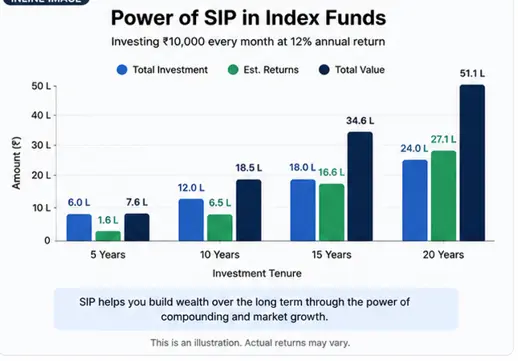
Let us understand the power of compounding.
If you invest:
• ₹10,000 every month
• for 10 years
• at an expected 12% annual return
Your estimated corpus may grow to close to ₹23 lakh.
Total invested amount:
₹12 lakh
Estimated wealth gain:
More than ₹11 lakh
This is why long-term investing matters more than short-term market excitement.
Is a 12% Return Guaranteed in Index Funds?
No.
Index funds do not guarantee returns.
Market-linked investments always carry volatility.
Some years it may deliver:
• negative returns
• flat returns
• very high returns
However, historically, Indian equity markets have rewarded patient long-term investors better than many traditional savings products.
The real advantage of index investing is consistency and discipline.
Best Index Funds Indians Commonly Explore
Popular categories include:
• Nifty 50 Index Funds
• Sensex Index Funds
• Nifty Next 50 Funds
• Nifty Midcap Index Funds
Before investing, compare:
• expense ratio
• tracking error
• fund size
• AMC reputation
• long-term consistency
Index Funds to Consider for SIP in India
| Index Fund | Index Tracked | Direct Plan TER* | 5-Year CAGR* | Suitable for |
|---|---|---|---|---|
| SBI Nifty Index Fund | Nifty 50 TRI | 0.23% | 11.39% | Core large-cap exposure |
| HDFC Nifty 50 Index Fund | Nifty 50 TRI | Verify latest | Verify latest | Core Nifty 50 exposure |
| UTI Nifty 50 Index Fund | Nifty 50 TRI | Verify latest | Verify latest | Long-term Nifty 50 investing |
| ICICI Prudential Nifty 50 Index Fund | Nifty 50 TRI | Verify latest | Verify latest | Low-cost Nifty 50 exposure |
| ICICI Prudential Nifty Next 50 Index Fund | Nifty Next 50 TRI | Verify latest | Verify latest | Higher-growth large-cap exposure |
| Motilal Oswal Nifty Midcap 150 Index Fund | Nifty Midcap 150 TRI | 0.26% | 18.29% | Investors seeking mid-cap exposure |
| Axis Nifty 100 Index Fund | Nifty 100 TRI | 0.25% | 10.29% | Broader large-cap exposure |
Data note: Fund returns, expense ratios and assets under management change over time. The figures above are historical data for comparison and should be checked against the latest AMC factsheet or AMFI data before investing. Past performance does not guarantee future returns.
Who Should Use This SIP Calculator?
This calculator is useful for:
• beginners planning first SIP
• salaried employees
• retirement planners
• FIRE investors
• students learning investing
• side-income earners
• long-term wealth builders
Common Mistakes SIP Investors Make
Many investors fail not because SIP is bad, but because their behaviour becomes emotional.
Common mistakes include:
1. Stopping SIP During Market Crash
Bear markets are often when units become cheaper.
Stopping a SIP during a market downturn can interrupt your investment discipline and may reduce the benefit of investing through different market cycles.
2. Expecting Quick Riches
SIP investing is boring by design.
That boredom is exactly why it works.
3. Investing Without an Emergency Fund
Never start aggressive equity investing without basic financial safety.
4. Chasing Trending Funds Every Year
Consistency usually beats constant switching.
How Much SIP Should Indians Start With?
Start with an amount you can continue consistently.
Even:
• ₹1,000
• ₹2,000
• ₹5,000It It
It is better than waiting endlessly for the “perfect” time.
The biggest wealth creator is not timing.
It is a duration.
Step-by-Step: How to Start the Best Index Fund SIP in 2026
- KYC: Complete e-KYC on the AMC website (Aadhaar + PAN + video selfie).
- Pick a platform: Coin by Zerodha, Groww, Paytm Money, or AMC Direct.
- Select direct plan: Always choose “Direct Growth” to avoid distributor commission.
- Choose a SIP date: Choose a SIP date that fits your cash flow and salary cycle. Consistency is more important than trying to select a particular day of the month.
- Automate mandate: One-time biller mandate via net banking; money auto-debits.
Final Thoughts
Most wealth creation stories look simple in hindsight. The difficult part is staying invested when markets become emotional. Index fund SIP investing is not glamorous. But disciplined long-term investing has quietly created wealth for millions of investors globally.
Use the calculator above to experiment with different SIP amounts, return expectations, and investment durations to understand how compounding can work over time. The earlier you start, the harder compounding works in your favour.
Frequently Asked Questions About Index Fund SIPs
Q1. What is an index fund SIP?
An index fund SIP is a method of investing a fixed amount regularly in an index mutual fund. The fund aims to track a particular market index, such as the Nifty 50, rather than actively selecting stocks to outperform the index.
Q2. Which index fund is best for a SIP in India?
There is no single index fund that is best for every investor. Compare the fund’s benchmark, expense ratio, tracking difference, tracking error, fund size and consistency before investing. A low-cost fund that closely tracks its benchmark can be a reasonable choice for long-term investors.
Q3. Is an index fund SIP safe?
Index funds are subject to market risk and their value can fall when the underlying index declines. They are generally diversified across multiple companies, but diversification does not eliminate the possibility of losses. Your investment horizon and risk tolerance should be considered before investing.
Q4. Can I start an index fund SIP with ₹500 or ₹1,000?
Yes, many mutual fund schemes allow relatively small SIP amounts, although the minimum investment varies by scheme and platform. Check the latest scheme details before starting a SIP.
Q5. Are index fund SIP returns guaranteed?
No. Index fund SIP returns are not guaranteed. The value of your investment depends on the performance of the underlying index, expenses, and tracking difference. Historical returns should not be treated as an indication of future performance.
