
Getting a personal loan with a low CIBIL score can be difficult, but a low score does not automatically mean every lender will reject your application. Lenders may also consider your income, employment, existing EMIs, repayment history, bank account activity, and their own eligibility criteria.
If your CIBIL score is around 450, 500, 550, or 650, the options available to you can be very different. A borrower with no established credit history is also in a different situation from someone with a low CIBIL score caused by missed payments or defaults.
This guide compares 8 digital loan apps and explains what to check before applying. It also covers loans for different CIBIL-score ranges, whether you can get a loan without a CIBIL score, how to compare the actual cost of borrowing, and how to avoid risky or unauthorised loan apps.
Approval is never guaranteed. Always check the actual lender, eligibility requirements, APR, processing charges, Key Facts Statement (KFS), and total repayment amount before accepting a loan.
What Is Considered a Low CIBIL Score?
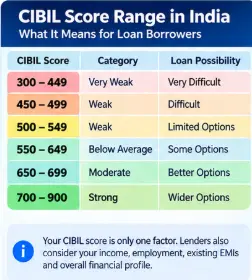
A CIBIL score generally ranges from 300 to 900. However, there is no single score at which every lender automatically approves or rejects a loan. Your score is only one part of the lender’s credit assessment.
For this guide, the following ranges are useful for understanding the level of difficulty borrowers may face:
| CIBIL Score | General Position | What It Means for Borrowers |
|---|---|---|
| 300–449 | Very weak | Getting an unsecured personal loan can be difficult |
| 450–499 | Weak | Fewer lenders may be willing to consider the application |
| 500–549 | Weak | Approval may depend heavily on income and overall profile |
| 550–649 | Below stronger credit ranges | Some lending options may be available depending on eligibility |
| 650–699 | Moderate | More options may be available, depending on the lender |
| 700+ | Stronger profile | Borrowers may have access to a wider range of credit options |
These ranges are not lender approval rules. A person with a 650 CIBIL score can still be rejected, while another applicant with a lower score may qualify for a particular product because of income, employment, repayment capacity or other factors.
Also, do not confuse a low CIBIL score with having no CIBIL history. Someone who has never used formal credit may have limited or no credit history, while a borrower with a 450 score has an established credit record with negative or weak credit information.
Your CIBIL score ranges from 300 to 900. If you’re not sure how your score is calculated, read this detailed guide on what the CIBIL score is and how it works.
Check your CIBIL score online.
Can You Get a Loan With a 450–500 CIBIL Score?
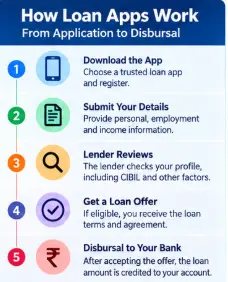
A CIBIL score between 450 and 500 is a weak credit profile, so getting an unsecured personal loan can be difficult. No legitimate loan app can guarantee approval based solely on your CIBIL score.
If you are in this range, lenders may look more closely at factors such as your regular income, employment, existing debt, repayment history, and recent credit applications. Applying for several loans at the same time is generally not a good strategy because each lender may perform its own credit assessment.
Before applying, first check whether you actually need the loan, how much EMI you can afford, and the total amount you would have to repay.
Can You Get a Loan With a 550 CIBIL Score?
A 550 CIBIL score is still a weak credit profile, but your score alone does not determine whether you will receive a loan.
Some digital lenders may consider applicants with weaker credit profiles, subject to their current eligibility criteria. However, you should not assume that an app will approve a loan because it appears on a list of low-CIBIL loan apps.
At this score level, compare the actual APR, processing fee, tenure, EMI and total repayment amount rather than choosing an app only because it advertises quick approval.
Can You Get a Loan With a 650 CIBIL Score?
A 650 CIBIL score is different from a score below 500. You may have more borrowing options, but approval is still dependent on the lender’s assessment of your complete financial profile.
Before applying, check your income, existing EMIs, repayment history and the lender’s eligibility criteria. If you qualify for more than one offer, compare the total borrowing cost instead of choosing the lender with the lowest advertised interest rate alone.
Moneyview: An Option to Check for 600+ CIBIL Scores
If your CIBIL score is 600 or above, Moneyview may be one option worth checking, subject to its current eligibility criteria.
The current Moneyview affiliate campaign available through Cuelinks specifies a minimum CIBIL score of 600 or an Experian score of 650. Other factors, including income, age, location, employment status and the lender’s assessment, may also affect eligibility.
Moneyview is therefore not an option for every low-CIBIL borrower. If your score is below 600, you should not assume that this offer will be available to you.
Before applying, check the current eligibility requirements, interest rate/APR, processing charges, loan tenure, EMI and total repayment amount.
Affiliate disclosure: FinanceRead may earn a commission if you apply through this link, at no extra cost to you.
Can You Get a Loan With a 700 CIBIL Score?
A 700 CIBIL score represents a stronger credit profile than a score of 450 or 550, but it does not guarantee loan approval or a particular interest rate.
If your score is around 700, compare personal loan offers based on APR, processing charges, tenure, EMI, and total repayment. You may also want to compare offers from regulated banks and NBFCs rather than limiting your search to loan apps.
Can You Get a Loan Without a CIBIL Score?
Having no CIBIL score is not the same as having a low CIBIL score.
You may have no established CIBIL history if you have never used a formal credit product that has been reported to a credit bureau. In that situation, a lender may have less credit-history information available when assessing your application.
Some lenders may consider applicants with limited or no established credit history, but this does not mean they ignore credit risk. They may consider other information such as income, employment, bank-account activity and repayment capacity.
Therefore, be careful with loan apps that advertise phrases such as “100% loan without CIBIL” or “guaranteed loan without credit check.” Treat these as marketing claims unless the actual lender clearly explains its eligibility and assessment process.
Which Loan App Does Not Check CIBIL?
There is an important difference between a lender considering applicants with limited credit history and a lender completely ignoring credit information.
Do not assume that a loan app does not check CIBIL simply because it advertises loans for borrowers with low or no credit history. The actual assessment method depends on the lender and the particular loan product.
Instead of searching only for a “no CIBIL check” loan, compare the lender’s eligibility requirements, APR, fees, repayment terms and regulatory details. A loan that is easy to obtain can still be expensive or unsuitable for your financial situation.
8 Loan Apps to Consider for Low-CIBIL Borrowers
The apps below should not be treated as guaranteed low-CIBIL lenders. Eligibility, loan amount, interest rate, fees, and approval decisions can change by product and applicant. Before applying, verify the current terms and identify the actual bank or NBFC providing the loan.
| App | Typical Use Case | CIBIL / Eligibility | What to Check |
|---|---|---|---|
| KreditBee | Digital personal-loan options | Applicant and lender criteria apply | APR, fees, lender and eligibility |
| mPokket | Smaller-ticket borrowing | Product-specific eligibility | Total repayment and applicable charges |
| Fibe | Digital personal-loan options | Income and applicant profile matter | APR, processing fee and tenure |
| CASHe | Personal-loan options, particularly for eligible salaried borrowers | Applicant and lender criteria apply | Eligibility, APR and fees |
| StashFin | Digital credit options | Credit and other eligibility factors apply | Total cost, fees and repayment terms |
| TrueBalance | Smaller-ticket digital credit | Product-specific eligibility | Monthly cost, fees and total repayment |
| Nira Finance | Smaller personal-loan options | Applicant and lender assessment | Current offer, APR and charges |
| Freo Credit | Digital credit/personal-loan options | Applicant and lender criteria apply | Current terms, APR and lender |
Approval depends on income, bank activity, and profile—not just CIBIL score.
Best Loan Apps for Low CIBIL Score in India
1. KreditBee
KreditBee is a digital lending platform through which eligible borrowers can apply for personal loan products. The amount, interest rate, tenure and approval decision depend on the applicant’s profile and the applicable lending partner.
Before accepting an offer, check the actual lender, APR, processing charges, repayment schedule, and total amount payable.
2. mPokket
mPokket offers digital credit products, including smaller-ticket borrowing options for eligible customers. Product limits, charges and eligibility can vary.
If you are considering a small loan because of a low CIBIL score, compare the total repayment amount rather than focusing only on the amount you can receive.
3. Fibe
Fibe offers digital personal loan products for eligible borrowers. The terms available to an applicant depend on the product and the lender’s assessment.
Check the current APR, processing fee, tenure, EMI, and total repayment before accepting an offer.
4. CASHe
CASHe provides digital personal-loan products for eligible borrowers, with eligibility and loan terms depending on the applicant and applicable lending criteria.
Borrowers should verify the current interest rate, fees, tenure, and actual lender before proceeding.
5. StashFin
StashFin provides digital credit products subject to eligibility and applicable terms. The cost of borrowing can vary considerably depending on the product and applicant.
Check the complete cost of the loan, including applicable fees, rather than relying on a promotional rate.
6. TrueBalance
TrueBalance provides digital credit products subject to product-specific eligibility. Loan limits, pricing and repayment terms can vary between borrowers and products.
Before applying, check the current terms and calculate the total amount you will repay.
7. Nira Finance
Nira Finance offers digital borrowing options subject to eligibility and lender assessment. The offer available to one borrower may not be the same as the offer available to another.
Check the current loan terms, APR, fees, tenure and actual lender before accepting an offer.
8. Freo Credit
Freo Credit provides digital credit and personal loan options subject to eligibility and applicable lender criteria.
Before accepting an offer, compare the APR, processing charges, repayment schedule, and total cost with other available options.
What a Low CIBIL Score Can Mean for Your Loan
A low CIBIL score can make borrowing more difficult, but the outcome depends on the lender and your complete financial profile.
You may face one or more of these situations:
- Fewer lenders may be willing to consider your application.
- The loan amount offered may be lower than what you requested.
- The interest rate or APR may be less favourable.
- The lender may ask for additional information before deciding.
- Your application may be rejected.
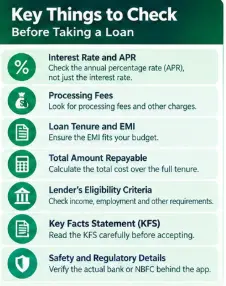
This is why comparing only the advertised loan amount is not enough. Always look at the APR, processing fee, tenure, EMI, and total repayment amount before accepting an offer.
How to Improve Your Chances of Getting a Loan
There is no reliable way to guarantee loan approval, but you can improve the quality of your application by:
- Providing accurate income and employment information.
- Checking the lender’s eligibility criteria before applying.
- Keeping existing EMIs and credit-card payments up to date.
- Avoiding unnecessary loan applications.
- Applying for an amount that matches your repayment capacity.
- Checking your credit report for errors before applying.
- Keeping documents and bank-account information accurate and up to date.
If you are approved, borrow only the amount you actually need and can comfortably repay. Taking a loan simply because an app offers a higher limit can increase your financial burden and make future borrowing more difficult.
How to Check Whether a Loan App Is Safe
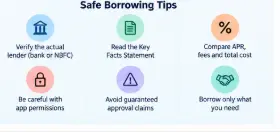
An app being available in an app store does not by itself prove that the loan offer is safe or suitable.
Before applying, check the following:
1. Identify the actual lender
Find out which bank or NBFC is providing the loan. The app may be a digital lending platform or service provider rather than the actual lender.
2. Verify the lender
Check whether the lender is a regulated bank or NBFC and verify the information using reliable official sources.
3. Read the Key Facts Statement
Before accepting a digital loan, review the Key Facts Statement (KFS) and understand the APR, fees, repayment schedule and other important terms.
4. Check the total cost
Do not compare loans only by the advertised interest rate. Look at the APR, processing charges, other applicable fees, EMI and total amount payable.
5. Be careful with personal data permissions
Be cautious if a loan app requests unnecessary access to contacts, photos, messages or other personal information.
6. Avoid guaranteed-approval claims
Be particularly cautious about claims such as “100% approval”, “no rejection”, “guaranteed loan” or “loan without any verification.” Legitimate lending decisions are still subject to eligibility and assessment.
Verify the actual bank or NBFC behind the digital lending platform using current information from official sources before applying.
Are These Loan Apps Safe?
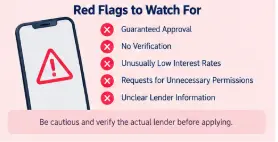
A loan app should not be considered safe simply because it is available on an app store. Before applying, identify the actual lender behind the app and verify its association with an RBI-regulated bank or NBFC.
Before accepting a digital loan, check the Key Facts Statement, APR, processing fee, EMI, total repayment amount, and other applicable charges. Avoid apps that ask for unnecessary access to contacts, photos, or other personal information.
APR vs Interest Rate: What Should You Compare?
The interest rate alone does not tell you the complete cost of a loan.
The Annual Percentage Rate (APR) is a more useful figure for comparing the overall cost of borrowing because it incorporates the applicable interest and certain charges associated with the credit product.
Before accepting a loan offer, compare:
- APR
- Interest rate
- Processing fee
- Other applicable charges
- Loan tenure
- Monthly EMI
- Total amount repayable
A loan with a lower advertised interest rate is not necessarily the cheapest option if it carries higher fees or other charges.
What Is a Key Facts Statement (KFS)?
A Key Facts Statement is an important document that helps a borrower understand the key terms and cost of a credit product before accepting it.
Before taking a digital loan, read the KFS carefully and check the APR, repayment schedule, fees and other applicable charges. If you do not understand a charge, clarify it before accepting the loan.
Before Applying for a Low-CIBIL Loan
Before submitting an application, answer these five questions:
1. How much do I actually need?
Do not borrow more simply because a lender offers a higher limit.
2. Can I comfortably pay the EMI?
Calculate the EMI alongside your existing monthly obligations.
3. What is the total repayment?
Look beyond the monthly EMI and calculate how much you will repay over the complete tenure.
4. What is the APR and what fees apply?
Check the KFS and loan agreement for the complete cost of borrowing.
5. Who is the actual lender?
Identify the bank or NBFC behind the digital lending platform and verify the current information before proceeding.
Check the Cost Before You Borrow
Before applying for a loan, calculate the EMI and total repayment amount and compare the offer with other available options. A quick approval is not necessarily a low-cost loan.
Example: Why You Should Compare Total Repayment
Suppose you borrow ₹50,000 for one year. The EMI depends on the interest rate and the lender’s applicable charges.
Two loans can have similar monthly repayments but different processing fees or other charges. Therefore, compare the total amount payable rather than choosing an offer only because its advertised interest rate looks low.
Use the FinanceRead Loan and Credit Calculator to estimate your EMI and repayment cost before accepting a loan offer.
Final Verdict
A low CIBIL score does not automatically mean that you should accept the first loan offer available. Compare the lender’s eligibility requirements, APR, processing fees, EMI, and total repayment amount before borrowing.
If you are rejected, avoid repeatedly applying to multiple lenders without understanding why. Focus on improving your credit profile, maintaining timely repayments, and borrowing only when the repayment obligation is affordable.
The goal should not simply be to obtain a loan. It should be to borrow responsibly without worsening your financial position.
Frequently Asked Questions
Q1. Can I get a loan with a CIBIL score below 500?
It can be difficult, but a particular CIBIL score does not automatically determine approval. Some lenders may consider borrowers with weaker credit profiles, depending on their current eligibility criteria and the applicant’s income, repayment capacity and other factors.
Q2. Can I get a loan with a 550 CIBIL score?
A 550 CIBIL score is a weak credit profile, but some lenders may consider applications depending on the borrower’s overall financial profile. Check eligibility and compare the complete cost before applying.
Q3. Can I get a personal loan with a 650 CIBIL score?
A 650 score may provide more borrowing options than a very low score, but approval still depends on the lender and the applicant’s complete profile. Compare APR, fees, tenure and total repayment before choosing an offer.
Q4. Is a 700 CIBIL score good enough for a personal loan?
A 700 CIBIL score represents a stronger credit profile than a score of 450 or 550, but it does not guarantee approval or a particular interest rate. Lenders may consider income, existing debt, repayment history and other criteria.
Q5. Can I get a loan without a CIBIL score?
Possibly. Having no established credit history is different from having a low score. Some lenders may consider applicants with limited credit history using other information, such as income and repayment capacity.
Q6. Which loan app does not check CIBIL?
Do not assume that a loan app ignores CIBIL simply because it advertises loans for borrowers with low or no credit history. The lender’s actual assessment process and eligibility criteria should be checked before applying.
Q7. Does applying for a loan affect my CIBIL score?
A lender may make a credit enquiry when you apply for credit. Avoid submitting unnecessary applications to multiple lenders, particularly within a short period.
Q8. Can I get a loan without a salary slip?
Some lenders may accept alternative income or financial information depending on the product and applicant. However, this does not mean income verification is unnecessary. Check the lender’s current eligibility requirements before applying.
Q9. Is there a loan app with guaranteed approval?
You should be cautious of any app claiming guaranteed approval for every applicant. Legitimate lending decisions are subject to the lender’s eligibility and assessment process.
Q10. What should I check before taking a low-CIBIL loan?
Check the actual lender, APR, interest rate, processing fee, other applicable charges, EMI, tenure, total repayment amount and Key Facts Statement before accepting the loan.

Comments are closed.