
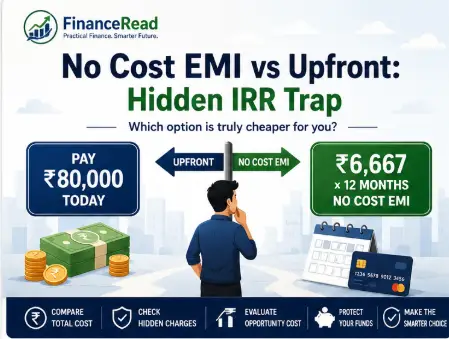
No-Cost EMI vs Upfront is one of the most common financial decisions Indian buyers face when purchasing smartphones, laptops, TVs, and other expensive products. While a No Cost EMI may look like an interest-free deal, the real cost depends on discounts, hidden charges, and how you manage your money.
Imagine you’re buying a new laptop priced at ₹80,000.
The salesperson gives you two options:
Option 1: Pay the full amount today.
Option 2: Pay ₹6,667 per month for 12 months with No Cost EMI.
At first glance, the second option seems like the obvious winner. Why pay everything today when you can spread the payments without paying interest?
But here’s what many buyers never realize.
In some cases, choosing No Cost EMI means giving up a valuable cash discount, incurring hidden processing charges, or missing the opportunity to earn returns on money that remains invested. In other situations, No Cost EMI genuinely helps you preserve cash flow and can be the better financial decision.
The right choice isn’t simply “EMI is good” or “cash is better.” It depends on how the offer is structured, whether discounts are involved, and what you could do with your money instead.
This guide explains how No Cost EMI really works, uncovers the hidden IRR trap behind many offers, and helps you decide when paying upfront makes sense and when choosing EMI is the smarter option.
Quick Answer
No Cost EMI is not always the cheapest way to buy a product. If you lose a cash discount, pay processing fees, or miss investment opportunities, the real cost of the purchase can be higher than expected. Compare the total purchase cost, available discounts, and the value of keeping your money invested before choosing between No Cost EMI and upfront payment.
Key Takeaways
✔ No Cost EMI does not always mean zero cost.
✔ Some offers reduce or remove cash discounts to compensate for interest.
✔ Processing fees and GST may increase the actual cost.
✔ Paying upfront can be better when a significant cash discount is available.
✔ No Cost EMI can be a smart choice if it helps preserve your emergency fund or allows your investments to continue growing.
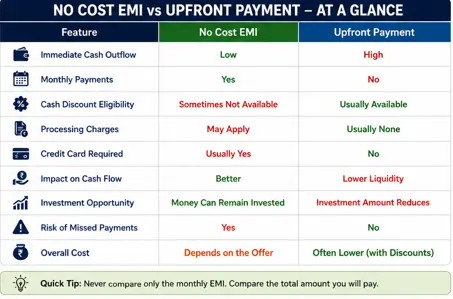
No-Cost EMI vs Upfront Payment: At a Glance
| Feature | No Cost EMI | Upfront Payment |
|---|---|---|
| Immediate cash outflow | Low | High |
| Monthly payments | Yes | No |
| Cash discount eligibility | Sometimes not available | Usually available |
| Processing charges | May apply | Usually none |
| Credit card required | Usually yes | No |
| Impact on cash flow | Better | Lower liquidity |
| Investment opportunity | Money can remain invested | Investment amount reduces |
| Risk of missed payments | Yes | No |
| Overall cost | Depends on the offer | Often lower when discounts are available |
Quick Tip: Never compare only the monthly EMI. Compare the total amount you will pay after considering discounts, fees, cashback, and investment returns.
What Is No Cost EMI?
No Cost EMI is a financing option that allows you to buy a product today and pay for it in monthly installments without paying explicit interest.
This option is commonly available on:
- Smartphones
- Laptops
- Televisions
- Home appliances
- Furniture
- Premium electronics
Most No Cost EMI offers require an eligible credit card issued by participating banks, although some retailers also provide similar financing through NBFCs.
The phrase “No Cost” often creates the impression that the financing is completely free. In reality, the interest charged by the bank is frequently adjusted through a discount provided by the retailer or manufacturer. As a result, the customer may not see a separate interest charge, but the cost is absorbed elsewhere in the transaction.
Understanding this mechanism is essential before assuming that every No Cost EMI offer is automatically the best deal.
How Does No Cost EMI Actually Work?
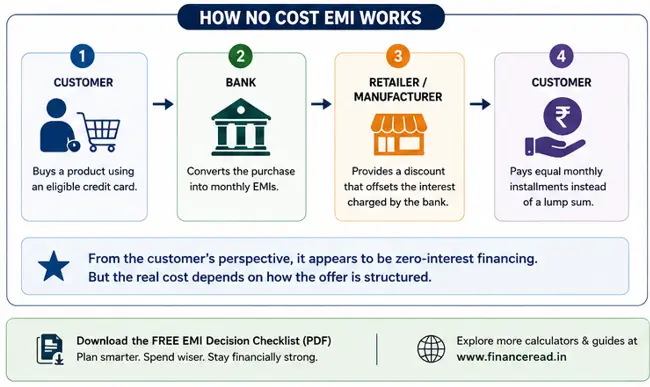
Let’s simplify the process.
Suppose a laptop is listed at ₹60,000.
The bank normally charges interest for EMI purchases.
Instead of asking you to pay that interest directly, the retailer agrees to compensate the bank by offering an equivalent upfront discount. This adjustment allows your monthly installments to appear interest-free.
A simplified flow looks like this:
Customer buys the laptop using an eligible credit card.
↓
Bank converts the purchase into monthly EMIs.
↓
Retailer or Manufacturer provides a discount that offsets the interest charged by the bank.
↓
Customer pays equal monthly installments instead of a lump sum.
From the customer’s perspective, it appears to be a zero-interest loan. However, the actual economics depend on the offer’s terms. Some retailers may reduce cash discounts, charge processing fees, or exclude cashback benefits for EMI transactions.
This is why two products with the same price can have very different effective costs depending on how the financing is structured.
Why This Matters More Than Ever
Online marketplaces and electronics retailers prominently advertise “No Cost EMI” because lower monthly payments encourage purchases.
While these offers can improve affordability, they can also lead buyers to focus solely on the monthly installment rather than evaluating the total financial impact.
A financially sound decision requires looking beyond the EMI amount and asking:
- Am I giving up a better cash discount?
- Are there any processing or foreclosure charges?
- Could my money earn a higher return if I keep it invested?
- Will this EMI affect my monthly budget or emergency fund?
The answers to these questions often determine whether No Cost EMI is a smart financial tool or an expensive convenience.
The Hidden IRR Trap Nobody Tells You About
If you’ve ever seen a “No Cost EMI” banner on an online shopping website or in an electronics showroom, you’ve probably wondered:
“If there is no interest, what’s the catch?”
The answer lies in a concept most buyers never think about—the hidden cost of money over time.
Financial experts often explain this using a term called the Internal Rate of Return (IRR). While the mathematics behind IRR can be complex, the idea itself is surprisingly simple.
Imagine someone offers you two ways to pay for the same product:
- Pay ₹60,000 today.
- Pay ₹5,000 every month for 12 months.
At first glance, both options total ₹60,000. It feels like there is no difference.
But money has a time value. A rupee today is worth more than a rupee paid several months later because the money you keep today can be saved, invested, or used for other financial needs.
This is where the hidden IRR trap begins.
Instead of asking “How much is the EMI?”, ask yourself:
“What am I giving up by choosing this offer?”
Understanding the Time Value of Money
Think about ₹50,000 sitting in your bank account today.
If you pay the full amount immediately, that money is gone.
But if you choose a genuine No Cost EMI, much of that ₹50,000 remains with you for several months. During that time, you can:
- Earn interest in a savings account or fixed deposit.
- Keep your emergency fund intact.
- Continue investing in mutual funds.
- Handle unexpected expenses without borrowing.
Even if the total purchase price remains the same, delaying payment can have financial value.
However, this benefit disappears if the retailer quietly removes a cash discount or adds hidden charges.
Example 1: When Paying Upfront Saves Money
Let’s compare two offers for the same laptop.
Option A: Upfront Payment
Laptop Price: ₹70,000
Cash Discount: ₹5,000
Final Price: ₹65,000
Option B: No Cost EMI
Laptop Price: ₹70,000
No Discount
12 Monthly EMIs of ₹5,833
Total Paid: ₹70,000
Which Option Is Better?
Many buyers immediately choose EMI because they don’t have to spend ₹70,000 at once.
But look carefully.
By paying upfront, you save ₹5,000 immediately.
Even if you had enough money to choose either option, the upfront payment gives you an instant, guaranteed return equal to the discount.
In this situation, the No Cost EMI isn’t actually free.
You effectively “pay” ₹5,000 because you lose the cash discount.
This hidden cost rarely appears in advertisements.
Example 2: When No Cost EMI Makes More Sense
Now consider another situation.
Smartphone Price
₹80,000
Cash Discount
None
No Processing Fee
12 Equal EMIs
You already have ₹80,000 invested in a mutual fund expected to earn around 11% annually over the long term.
If you pay the full amount today, your investment reduces immediately.
If you choose a genuine No Cost EMI, your investment can continue growing while you make monthly installments from your salary.
In this case:
- No discount is lost.
- No extra fee is charged.
- Your investment continues earning returns.
- Your emergency savings remain available.
Here, No Cost EMI can actually be the smarter financial decision.
The important point is that the decision depends on your financial situation—not the marketing headline.
Example 3: The Processing Fee Trap
Suppose you buy a television for ₹50,000.
The advertisement says:
“Zero Cost EMI Available.”
Everything looks perfect until checkout.
Processing Fee: ₹999
GST on Processing Fee: ₹180
Documentation Charges: ₹250
Total Extra Cost
₹1,429
Technically, the loan still carries no interest.
But your purchase has become more expensive.
Always read the complete terms before assuming an EMI offer has no additional cost.
Example 4: Cashback Changes the Equation
Imagine an online shopping festival.
A washing machine costs ₹40,000.
Offer 1
Pay upfront.
Instant Cashback
₹2,500
Offer 2
Choose No Cost EMI.
No Cashback.
Many customers select EMI because the monthly payment looks comfortable.
But they forget they are giving up ₹2,500 immediately.
Whenever cashback is available only for full payment, compare the final amount—not just the EMI.
The Opportunity Cost Most Buyers Ignore
Opportunity cost simply means what you sacrifice by choosing one option over another.
Let’s say you have ₹1,00,000 available.
You decide to pay ₹80,000 upfront for a laptop.
Now imagine three days later your car needs urgent repairs costing ₹25,000.
Because most of your savings are gone, you end up using a credit card that charges much higher interest than the original No Cost EMI would have cost.
In hindsight, keeping your cash available may have been the wiser choice.
Money provides flexibility.
Sometimes preserving liquidity is more valuable than taking the maximum discount.
A Simple Decision Formula
Before choosing No Cost EMI, compare these four questions.
Step 1
Is there a cash discount for paying upfront?
If yes, calculate how much you will lose by choosing EMI.
Step 2
Are there processing fees, GST, or foreclosure charges?
Include every additional cost.
Step 3
Can your money earn better returns elsewhere?
For example:
- Savings account
- Fixed Deposit
- Debt fund
- Equity mutual fund (for long-term goals)
Step 4
Will paying upfront affect your emergency fund?
If paying cash leaves you financially vulnerable, preserving liquidity may be more important than saving a small amount through a discount.
The Psychology Behind No Cost EMI
Retailers understand human behavior extremely well.
Research consistently shows that people focus more on monthly affordability than on the total purchase price.
Which sounds easier?
Option A
Pay ₹72,000 today.
Option B
Pay only ₹6,000 per month.
Most people instinctively choose the second option without calculating the overall financial impact.
This psychological effect is one reason EMI offers are so effective.
The lower monthly figure feels less painful, even when the total cost may be higher.
Smart buyers reverse this thinking.
They first compare the total amount paid, then evaluate the effect on their savings, investments, and monthly budget.
Only after considering the complete financial picture do they decide whether paying upfront or choosing No Cost EMI is the better option.
Before choosing an EMI option, it’s worth understanding your rights as a credit card holder under the RBI Credit Card Guidelines
When No Cost EMI Is the Smarter Choice
Despite the myths surrounding it, No Cost EMI isn’t a bad financial product. In the right situation, it can actually improve your cash flow and help you make a better financial decision.
Here are the situations where choosing No Cost EMI makes sense.
1. You Have the Money but Want to Preserve Your Emergency Fund
Suppose you have ₹2 lakh in your savings account, including an emergency fund.
You want to buy a laptop costing ₹75,000.
Paying the entire amount today would reduce your emergency savings significantly.
Instead, if a genuine No Cost EMI is available with no hidden charges, paying in installments allows you to keep your emergency fund intact.
Unexpected events such as job loss, medical emergencies, or urgent home repairs can happen at any time. Keeping sufficient cash available is often more valuable than exhausting your savings for a one-time purchase.
FinanceRead Tip: Never use your emergency fund just because you can pay upfront.
2. There Is No Cash Discount for Upfront Payment
Sometimes retailers charge the same amount whether you pay immediately or choose No Cost EMI.
Example
Product Price
₹55,000
Upfront Price
₹55,000
No Cost EMI
₹4,583 × 12
Processing Fee
Nil
Cashback Difference
Nil
In this case, choosing EMI can improve your monthly cash flow without increasing the total purchase cost.
3. Your Money Can Earn Better Returns
Imagine you have ₹1 lakh invested for long-term goals.
You are planning to buy a laptop costing ₹80,000.
Instead of withdrawing your investment today, you choose a genuine No Cost EMI and continue investing regularly.
Over time, your investments may grow while you comfortably pay the monthly installments from your salary.
This strategy works only if:
- You already have the money.
- The investment aligns with your financial goals.
- You never miss EMI payments.
4. The Purchase Is Necessary, Not Impulsive
Some purchases cannot be postponed.
Examples include:
- A laptop required for work.
- A smartphone needed for business.
- Essential household appliances.
- Medical equipment.
If a No Cost EMI helps you buy something necessary without disrupting your financial stability, it can be a practical option.
When Paying Upfront Is the Better Choice
There are also situations where paying immediately is clearly the smarter decision.
1. A Large Cash Discount Is Available
Suppose you receive the following offer.
Laptop Price
₹90,000
Upfront Discount
₹8,000
No Cost EMI
No Discount
Even if the EMI advertises “zero interest,” you are effectively paying ₹8,000 more by choosing installments.
Always compare the final purchase cost, not the marketing headline.
2. Processing Fees Are Charged
Many No Cost EMI offers include:
- Processing fees
- Documentation charges
- GST on processing fees
- Foreclosure charges
- Late payment penalties
Even a small fee can reduce or eliminate the benefit of the EMI.
3. You Tend to Overspend
EMIs make expensive products feel affordable.
A ₹1 lakh purchase sounds intimidating.
A monthly payment of ₹4,200 feels manageable.
This psychological effect often encourages people to buy products they don’t actually need.
If you frequently make impulse purchases, paying upfront forces you to think more carefully before spending.
4. Your Monthly Budget Is Already Tight
Every EMI becomes a fixed monthly commitment.
If you already have:
- Home loan EMI
- Car loan EMI
- Education loan
- Personal loan
- Credit card dues
Adding another EMI may strain your monthly budget.
In such cases, postponing the purchase or paying upfront (if affordable) may reduce financial stress.
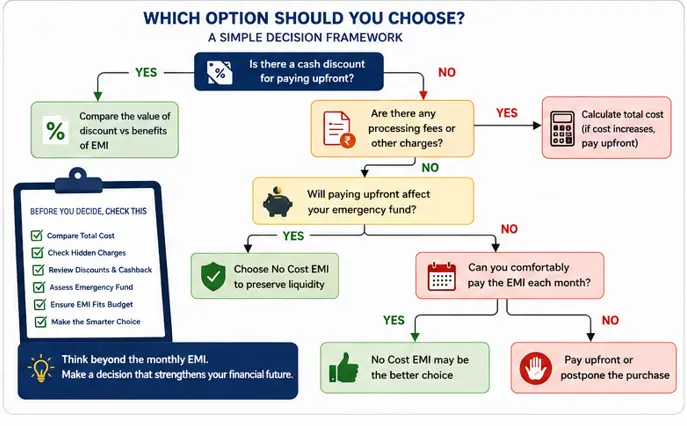
A Simple Decision Framework
Before selecting No Cost EMI, answer these five questions.
Question 1
Am I receiving a cash discount for paying upfront?
If the answer is yes, compare the value of that discount with the benefits of paying in installments.
Question 2
Are there any hidden charges?
Check for:
- Processing fees
- GST
- Documentation charges
- Foreclosure penalties
- Late payment fees
Question 3
Will paying upfront reduce my emergency savings?
If the answer is yes, preserving cash through EMI may be the safer option.
Question 4
Can I comfortably pay every monthly installment?
Missing an EMI can lead to:
- Penalty charges
- Higher interest
- Lower credit score
- Additional financial stress
Question 5
Am I buying this because I need it or because EMI makes it look affordable?
This is the most important question.
No Cost EMI should make purchases easier—not encourage unnecessary spending.
Common Mistakes Buyers Make
Mistake 1: Looking Only at the Monthly EMI
Many buyers compare only the monthly payment.
Instead, compare the total cost over the entire repayment period.
Mistake 2: Ignoring Cash Discounts
Sometimes paying upfront saves more money than choosing a No Cost EMI.
Always ask:
“Is there a better price if I pay immediately?”
Mistake 3: Forgetting Processing Charges
A “zero interest” offer may still include fees.
Read the complete terms before making a decision.
Mistake 4: Missing EMI Payments
One missed payment can result in:
- Late fees
- Interest charges
- Negative impact on your credit history
Set up automatic payments whenever possible.
Mistake 5: Using EMI for Lifestyle Upgrades
Buying a premium phone instead of a mid-range model simply because EMI is available is rarely a wise financial decision.
EMI should improve affordability for necessary purchases—not justify unnecessary upgrades.
Mistake 6: Ignoring Existing Debt
Multiple small EMIs can quietly become a significant monthly burden.
Before taking another EMI, calculate your total monthly debt obligations.
Mistake 7: Not Reading the Offer Terms
Many consumers rely only on advertisements.
Always review:
- Eligible cards
- Tenure options
- Processing fees
- Cancellation policy
- Foreclosure rules
- Cashback eligibility
A few minutes of reading can prevent expensive surprises later.
Myths vs Facts
| Myth | Reality |
|---|---|
| No Cost EMI is always free. | It may involve hidden costs such as lost discounts or processing fees. |
| Paying upfront is always better. | Not necessarily. Preserving liquidity can sometimes be more valuable. |
| No Cost EMI never affects your finances. | Every EMI becomes a monthly financial commitment. |
| EMI is only for people who cannot afford the product. | Many financially disciplined buyers use EMI strategically to manage cash flow. |
| Every retailer offers the same No Cost EMI benefits. | Terms, discounts, fees, and participating banks differ between merchants. |
Expert Insight
After reviewing hundreds of consumer offers, one pattern appears repeatedly.
Most buyers compare monthly EMIs.
Very few compare the total financial impact.
The smartest buyers ask different questions.
- What is the final amount I will pay?
- Am I giving up a cash discount?
- Will this affect my emergency fund?
- Does this purchase fit comfortably within my monthly budget?
No Cost EMI is neither good nor bad on its own. It is simply a financing tool. Whether it benefits you depends on how the offer is structured and how it fits into your overall financial plan.
Before choosing any EMI, spend five minutes comparing the numbers. That small effort can save you thousands of rupees over the life of the purchase.
Smart Buy Checklist
Before clicking “Buy Now”, make sure you can answer Yes to most of these questions:
✅ I have compared the upfront price with the EMI price.
✅ I have checked for processing fees and other charges.
✅ I know whether cashback or discounts change with EMI.
✅ I can comfortably pay every monthly installment.
✅ This purchase is based on a genuine need, not just because the monthly EMI looks affordable.
✅ Choosing EMI will not put my monthly budget under pressure.
If you cannot confidently tick most of these boxes, pause and review the offer again. A few extra minutes today can prevent unnecessary financial stress tomorrow.
Should You Choose No Cost EMI or Upfront Payment?
Use this quick decision guide before making your purchase.
| Your Situation | Better Choice | Why? |
|---|---|---|
| Large cash discount is available | Upfront Payment | The discount usually outweighs the convenience of EMI. |
| No discount, no processing fee | No Cost EMI | You keep your money available while paying in installments. |
| Your emergency fund is limited | No Cost EMI | Preserves liquidity for unexpected expenses. |
| You already have several EMIs | Upfront Payment (if affordable) | Avoids increasing your monthly financial commitments. |
| The purchase is an impulse buy | Wait | Financing unnecessary purchases can create avoidable debt. |
| Your investments are earning good long-term returns | No Cost EMI | Allows investments to continue growing while you pay gradually. |
| The offer includes processing or foreclosure charges | Compare Carefully | The extra charges may eliminate the benefit of the EMI. |
Final Verdict
There is no universal winner between No Cost EMI and upfront payment.
Choose upfront payment when:
- A significant cash discount is available.
- You can comfortably afford the purchase.
- There are hidden charges on the EMI option.
- You want to avoid additional monthly commitments.
Choose No Cost EMI when:
- The offer is genuinely interest-free.
- No valuable discount is lost.
- Your emergency fund remains protected.
- The monthly installments fit comfortably within your budget.
- You have the financial discipline to make every payment on time.
The smartest financial decision isn’t the one with the lowest monthly payment—it’s the one that leaves you in the strongest overall financial position.
Frequently Asked Questions
Q1. Is No Cost EMI really free?
Not always. While interest may be waived, you could lose a cash discount or pay processing fees. Always compare the total cost before deciding.
Q2. Does No Cost EMI affect my credit score?
Yes. Like other credit card transactions, your repayment behaviour can influence your credit history. Paying every EMI on time helps maintain a healthy credit profile.
Q3. Can I prepay a No Cost EMI?
Many banks allow prepayment, but some charge foreclosure fees. Check your card issuer’s terms before converting a purchase into EMI.
Q4. Is No Cost EMI available without a credit card?
Sometimes. Some retailers and NBFCs offer similar installment plans without a credit card, although eligibility criteria and terms vary.
Q5. Does No Cost EMI include processing charges?
Some offers do, while others don’t. Always review the final payment summary before confirming your purchase.
Q6. Which is better for buying a smartphone?
If there is no cash discount or hidden fee and you can comfortably manage the installments, No Cost EMI may be a practical choice. If paying upfront gives you a meaningful discount, compare the total savings first.
Q7. Is No Cost EMI better than a personal loan?
For short-term purchases, genuine No Cost EMI is often cheaper than a personal loan because personal loans usually carry interest charges. However, compare all fees and repayment terms before deciding.
Q8. Can I earn cashback on No Cost EMI purchases?
Some banks and retailers allow cashback on No Cost EMI, while others exclude EMI transactions from promotional offers. Read the offer terms carefully.
Q9. Is paying upfront always the smarter financial decision?
No. If paying upfront weakens your emergency fund or forces you to redeem long-term investments unnecessarily, a genuine No Cost EMI may be the better option.
Q10. Can I cancel a No Cost EMI after purchase?
Cancellation policies vary between banks and merchants. Some allow reversal within a specified period, while others may charge cancellation or processing fees.
Q11. Does No Cost EMI encourage overspending?
It can. Lower monthly payments often make expensive products feel more affordable, which may tempt buyers to spend beyond their needs. Always evaluate whether the purchase is necessary.
Q12. How do I know which option is cheaper?
Compare:
- Final purchase price
- Cash discount
- Cashback
- Processing fees
- GST on fees
- Foreclosure charges
- The value of keeping your money invested
The option with the lower overall financial cost—not the lower monthly payment—is usually the better choice.
Common Financial Mistakes to Avoid
Before clicking Buy Now, avoid these mistakes:
❌ Comparing only the monthly EMI.
❌ Ignoring processing fees and GST.
❌ Missing a better upfront discount.
❌ Buying a more expensive product simply because EMI is available.
❌ Using your emergency fund for a non-essential purchase.
❌ Taking multiple EMIs without reviewing your monthly budget.
A few minutes of comparison can prevent months of unnecessary financial pressure.
Key Takeaways
- No Cost EMI can be a useful financing tool, but it isn’t automatically the cheapest option.
- Compare the total purchase cost instead of focusing only on monthly installments.
- Preserve your emergency fund whenever possible.
- Read the complete offer terms before accepting an EMI.
- Make buying decisions based on your financial goals—not marketing slogans.
Related Calculators & Guides
- Credit Card Interest Calculator
- Monthly Budget Calculator
- Emergency Fund Calculator
- Net Worth Calculator
- Personal Finance Toolkit
- Zero Cost Budget Templates
- Diwali Bonus Calculator
- New Year Budget Reset: 30-Day Challenge
