
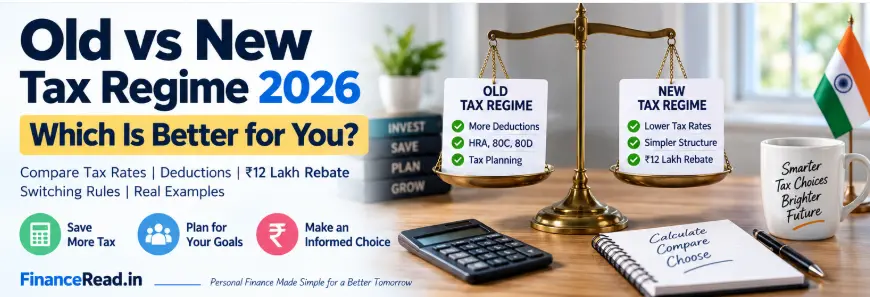
Choosing between the old and new tax regime can affect how much income tax you pay. For FY 2026-27, the new tax regime is the default regime, while eligible taxpayers can opt for the old regime if it works better for their income, deductions, and exemptions.
The new regime has lower slab rates and a higher Section 87A rebate limit, while the old regime continues to provide a wider range of deductions and exemptions. Therefore, there is no single regime that is best for everyone.
In this guide, we compare the old vs new tax regime for 2026, explain the key differences, show how deductions and exemptions affect the calculation, explain switching rules, and help you understand which regime may be more suitable for your situation.
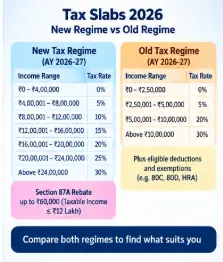
The current Income Tax Department information shows the new-regime slabs for AY 2026-27 and a Section 87A rebate of up to ₹60,000 for eligible resident individuals with taxable income up to ₹12 lakh.
Quick Answer: Old vs New Tax Regime — Which Is Better?
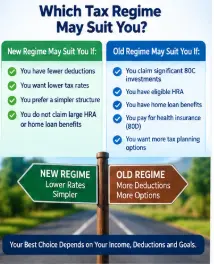
The new tax regime may be more suitable if you have relatively few deductions and exemptions and prefer a simpler tax calculation. The old tax regime may be more suitable if you can claim substantial eligible deductions and exemptions such as Section 80C, Section 80D, HRA, and certain home-loan benefits.
However, salary alone does not determine which regime is better. The correct choice depends on your taxable income, eligible deductions, exemptions, and other applicable tax benefits. The safest approach is to calculate your tax under both regimes before making a decision.
For FY 2026-27, the new regime provides a Section 87A rebate of up to ₹60,000 for eligible resident individuals with taxable income up to ₹12 lakh.
Explore our complete guide on tax-saving investments in India to reduce your tax liability legally.
Not Sure Which Tax Regime Saves More?
Don’t choose the old or new tax regime based only on your salary. Compare your estimated tax liability under both regimes using our free Income Tax Calculator.
Old vs New Tax Regime: 7 Key Differences
1. Tax Slab Rates
The old and new tax regimes have different tax slab structures. The new tax regime generally offers lower slab rates but follows a different income-tax structure, while the old regime has higher slab rates with greater scope for deductions and exemptions. Therefore, comparing the tax rates alone is not enough to decide which regime is better.
2. Deductions and Exemptions
The old tax regime allows taxpayers to claim a wider range of deductions and exemptions, subject to the applicable conditions. These can include benefits under Section 80C, Section 80D, HRA, and certain home-loan-related provisions. The new tax regime has fewer deductions and exemptions, although some deductions remain available under specific provisions.
If you use the old regime, you can also estimate your potential Section 80C tax savings using our Section 80C Tax Saving Calculator.
Health insurance premiums may qualify for a Section 80D deduction under the old regime. See our Section 80D Deduction Guide for the applicable limits and rules.
3. Standard Deduction
Salaried employees and pensioners can claim the applicable standard deduction under the tax rules. The standard deduction is available under the new regime as well as the old regime, so it should not be treated as a benefit available only under the old regime.
4. Section 87A Rebate
Section 87A can significantly affect the final tax payable for eligible resident individual taxpayers. Under the new tax regime for AY 2026-27, eligible taxpayers with taxable income up to ₹12 lakh can receive a rebate of up to ₹60,000, subject to the applicable conditions. This makes the rebate an important factor when comparing the two regimes.
5. Tax Planning Flexibility
The old regime provides more opportunities to reduce taxable income through eligible deductions and exemptions. This can be useful for taxpayers who already have significant investments, insurance premiums, HRA benefits or other qualifying expenses. The new regime is comparatively simpler because fewer deductions and exemptions need to be considered.
6. Ease of Tax Calculation
The new tax regime is generally simpler because taxpayers do not need to consider many of the deductions and exemptions available under the old regime. The old regime requires more detailed tax planning because the final tax liability can depend significantly on the deductions and exemptions a taxpayer is eligible to claim.
7. Choosing and Switching Between Regimes
The new tax regime is the default regime, but eligible taxpayers can opt for the old regime subject to the applicable rules. For taxpayers without business or professional income, the choice can generally be changed from one assessment year to another. Taxpayers with business or professional income have additional conditions when opting out of the default regime.
No single tax regime is automatically better for everyone. Your best option depends on your taxable income, deductions, exemptions, rebate eligibility, and other applicable tax benefits. Compare your tax liability under both regimes before making your final decision.
Old vs New Tax Regime for Salaried Employees
For salaried employees, the choice between the old and new tax regime depends on more than annual salary. You should consider your standard deduction, HRA eligibility, Section 80C investments, health insurance deductions, home-loan benefits and other eligible deductions before choosing a regime.
If you have relatively few deductions, the new regime may offer a simpler calculation and lower tax liability. If you claim substantial eligible deductions and exemptions under the old regime, the old regime may be worth comparing carefully.
Instead of using a fixed salary threshold to decide, calculate your tax under both regimes using your actual figures.
Can You Switch Between the Old and New Tax Regime?
Yes, eligible taxpayers can choose between the old and new tax regimes subject to the rules applicable to their income and filing situation. For taxpayers who do not have income from business or profession, the choice can generally be changed from one assessment year to another by following the applicable ITR rules.
Taxpayers with income from business or profession have additional conditions for opting out of the default new tax regime and may need to file Form 10-IEA within the prescribed timeline. Therefore, business and professional taxpayers should check the specific rules before changing regimes.
Q. Can salaried employees switch between the old and new tax regime?
Eligible salaried taxpayers can generally choose the regime applicable to them for the relevant assessment year. If you are a salaried taxpayer without business or professional income, check the applicable ITR rules when filing your return.
₹12 Lakh Income: Old vs New Tax Regime
For FY 2025-26 / AY 2026-27, the new tax regime provides a Section 87A rebate of up to ₹60,000 for eligible resident individuals whose taxable income does not exceed ₹12 lakh. This makes the ₹12 lakh level particularly important when comparing the two regimes.
However, you should not assume that every person earning ₹12 lakh will have the same tax outcome. The calculation depends on whether the figure refers to gross salary, total income, or taxable income, and on the deductions and exemptions applicable to the taxpayer.
Use the Income Tax Calculator to compare both regimes using your actual income and eligible deductions.
Old vs New Tax Regime for ₹10 Lakh Salary
A ₹10 lakh salary does not automatically make either regime better. Your result will depend on your taxable income and eligible deductions and exemptions. A taxpayer with substantial eligible deductions may find the old regime more competitive, while a taxpayer with fewer deductions may prefer the new regime.
Rather than relying on a fixed rule, compare the tax payable under both regimes using your actual figures.
Old vs New Tax Regime for ₹15 Lakh Salary
At a ₹15 lakh salary, the difference between the two regimes can become more significant because the new-regime slab structure and the deductions available under the old regime can produce different tax outcomes. The better option depends on your taxable income and eligible deductions.
Use a side-by-side calculation before choosing your regime instead of assuming that one regime is always better at a particular salary level.
Old vs New Tax Regime: Which One Should You Compare First?
| Your situation | Regime worth comparing first |
|---|---|
| Few eligible deductions | New regime |
| Substantial 80C deductions | Old regime |
| Eligible HRA exemption | Old regime |
| Eligible health insurance deductions | Old regime |
| Significant eligible home-loan benefits | Old regime |
| Prefer simpler tax planning | New regime |
| Taxable income near ₹12 lakh | Compare carefully |
| High income with substantial deductions | Compare both |
This table is only a starting point. It does not guarantee that one regime will produce lower tax for every taxpayer. Your final decision should be based on an actual calculation using your income and eligible deductions.
Old Tax Regime vs New Tax Regime: Pros and Cons
Old Tax Regime
The old regime can be useful for taxpayers who have substantial eligible deductions and exemptions. It provides access to a wider range of tax deductions, but the tax rates are generally higher than under the new regime.
New Tax Regime
The new regime offers lower slab rates and a simpler tax structure, but it provides fewer deductions and exemptions. It may be particularly attractive to taxpayers who do not have substantial eligible deductions.
The better regime is the one that results in the lower tax liability after applying the deductions, exemptions and rebates available to you.
Don’t Choose Based on Salary Alone
Two taxpayers with the same salary can have different tax liabilities because their deductions, exemptions and other income details may be different. For example, one salaried employee may claim HRA and eligible deductions under the old regime, while another employee with similar salary may have very few deductions. Their tax comparison can therefore produce different results.
This is why a tax calculator is more useful than a simple salary-based rule. Enter your actual income and eligible deductions and compare the estimated tax under both regimes.
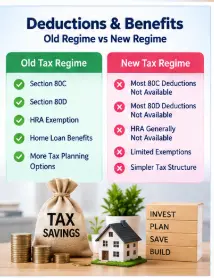
Old vs New Tax Regime: Key Differences
| Feature | Old Tax Regime | New Tax Regime |
|---|---|---|
| Tax Rates | Higher slab rates | Lower slab rates |
| Deductions & Exemptions | Wider range available | Fewer available |
| Tax Planning | More scope for deductions | Simpler structure |
| Complexity | More calculations | Relatively simpler |
| Best Suited For | Taxpayers with substantial eligible deductions | Taxpayers with fewer deductions |
Old vs New Tax Regime: Which is Better for You?

The old regime may be worth considering if you have substantial eligible deductions and exemptions such as Section 80C, Section 80D, HRA or certain home-loan benefits. The new regime may be worth considering if you have relatively few deductions and prefer a simpler tax structure with lower slab rates.
Don’t guess which regime is better. Compare your estimated tax under both regimes.
Compare Now →There is no single regime that is better for every taxpayer. The right choice depends on your taxable income, eligible deductions, exemptions, and applicable rebates. Compare your tax liability under both regimes using your actual figures before making a decision.
₹10 Lakh Salary: Old vs New Tax Regime Example
A ₹10 lakh salary does not automatically make either the old or new tax regime better. The final tax liability depends on your taxable income, eligible deductions, exemptions, and applicable rebates.
For example, a salaried taxpayer with substantial eligible deductions may find the old regime worth comparing, while another taxpayer with few deductions may find the new regime more suitable. The correct choice should be based on an actual tax calculation rather than a fixed salary-based rule.
Before choosing a regime, compare your estimated tax under both options using your actual salary, deductions and other relevant income details.
Final Verdict: Old vs New Tax Regime 2026
The old and new tax regimes are designed for different tax-planning situations. The new regime offers lower slab rates and a simpler structure, while the old regime can be valuable for taxpayers who can use substantial eligible deductions and exemptions.
For FY 2026-27, the new regime’s Section 87A rebate of up to ₹60,000 for eligible resident individuals with taxable income up to ₹12 lakh is an important factor when comparing the two options.
Do not choose a regime simply because your salary falls into a particular range. Calculate your tax under both regimes using your actual income, deductions and exemptions, then choose the option that produces the more suitable tax outcome for your circumstances.
FAQs
Q1. Which is better, old or new tax regime in 2026?
Neither regime is automatically better for everyone. The new regime may suit taxpayers with fewer deductions, while the old regime may be more suitable for taxpayers with substantial eligible deductions and exemptions. Compare your actual tax liability under both regimes before deciding.
Q2. Can I switch between the old and new tax regime?
Eligible taxpayers can generally change their choice subject to the rules applicable to their income and tax-filing situation. Taxpayers with business or professional income have additional conditions.
Q3. Can salaried employees change their tax regime?
Eligible salaried taxpayers can generally choose the applicable regime for the relevant assessment year. The rules are different for taxpayers with business or professional income.
Q4. Is Section 80C available in the new tax regime?
Most of the commonly used Section 80C deductions are not available under the new regime. If you make substantial 80C investments, compare the resulting tax liability under both regimes before deciding.
Q5. Is Section 80D available in the new tax regime?
Section 80D is generally associated with the old regime. If health insurance deductions are important to your tax planning, compare both regimes using your actual figures.
Q6. Is HRA exemption available under the new tax regime?
The HRA exemption available under the old regime is generally not available under the new regime. Taxpayers receiving HRA should compare both regimes before choosing.
Q7. Is the new tax regime compulsory?
No. The new regime is the default regime, but eligible taxpayers can opt for the old regime subject to the applicable rules.
Q8. What happens if my taxable income is ₹12 lakh?
For AY 2026-27, eligible resident individuals can receive a Section 87A rebate of up to ₹60,000 under the new regime when taxable income does not exceed ₹12 lakh. Your final tax position should still be calculated using your complete income details.
