

ROCE is one of the financial ratios investors can use to understand how efficiently a company uses the capital employed in its business. This ROCE SIP calculator helps you explore what regular investments in a selected group of high-ROCE stocks could look like under an assumed return or historical scenario.
Unlike a mutual fund SIP, this approach involves investing directly in individual stocks. That means the result can vary significantly because of stock selection, valuation, business performance, and market conditions.
Short introduction
Created by Shaikh Farooque Akhtar, MBA, CFA | Reviewed by SK Waseem, BCom (Honours), MBA (Finance)
Last reviewed: [July 2026]
Use the calculator as a research and learning tool, not as a prediction of future returns.
ROCE SIP Calculator India-What is it?
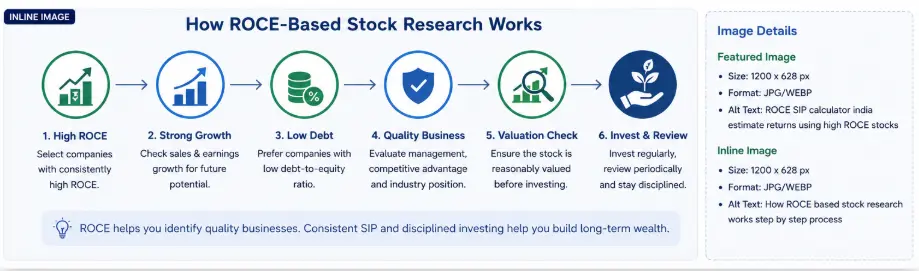
ROCE, or Return on Capital Employed, is a profitability ratio used to assess how efficiently a company generates operating earnings from the capital employed in its business. A higher ROCE can be a useful indicator of capital efficiency, but it should not be used by itself to decide whether a stock is attractive.
Here is a tool that helps you understand ROCE, test regular investment assumptions, and research companies more intelligently.
Investors should also consider valuation, earnings growth, debt, cash flows, competitive position, and management quality.
Is a ROCE SIP the same as a mutual fund SIP?
No.
A mutual fund SIP is a method of investing a fixed amount regularly into a mutual fund scheme. A ROCE-based stock SIP is simply a regular investment strategy in which an investor buys selected individual stocks periodically.
The latter carries individual-stock risk and does not provide the diversification of a broad-market mutual fund or index fund.
If you’re comparing stock investing with diversified mutual fund investing, you can also explore our [SIP to ₹1 Crore Calculator].
Many investors use SIPs to invest regularly for long-term goals. A similar approach can be used when researching individual companies, where an investor may focus on businesses with strong capital efficiency and other healthy financial characteristics. ROCE can be one useful measure for assessing how efficiently a company uses its capital. This ROCE SIP Calculator helps you estimate how regular monthly investments could grow over time based on the assumptions you enter.
ROCE, or Return on Capital Employed, is a profitability ratio used to assess how efficiently a company generates operating earnings from the capital employed in its business. A higher ROCE can be a useful starting point for research, but it should not be used alone to decide whether a stock is worth buying. Investors should also consider earnings growth, debt, cash flow, valuation and the quality of the underlying business.
Key Factors to Check Alongside ROCE
| ROCE Research Factor | What It Tells You | Why It Matters |
|---|---|---|
| ROCE | Capital efficiency | Helps assess how efficiently a business uses capital |
| Sales growth | Business expansion | Shows whether revenue has grown over time |
| Debt-to-equity | Financial leverage | Lower leverage can reduce balance-sheet risk |
| Operating margin | Operating profitability | Helps assess the quality of business earnings |
| Free cash flow | Cash generation | Shows whether accounting profits translate into cash |
| Valuation | Price paid for the business | A good company can still be an expensive investment |
For readers who want to research individual companies further, the Screener.in stock screens can be used to explore companies based on financial metrics such as ROCE, growth, and debt. Always check the latest financial results and annual reports before making an investment decision.
How the ROCE SIP Calculator Works
This calculator is designed to help investors understand how regular investing and assumed returns affect long-term wealth.
You can enter a monthly investment, investment period, and assumed annual return to estimate the potential future value of the investment.
For the stock-screening example, ROCE can be combined with other financial filters such as debt levels and sales growth to create a research shortlist. However, a stock passing these filters does not mean that it will outperform the market.
The calculator uses the assumptions you enter to estimate potential investment growth. These estimates are not predictions of future stock returns. Actual results can vary significantly depending on business performance, valuation, market conditions, dividends, investment costs, and other factors.
ROCE SIP Calculator
ROCE SIP Calculator
Estimate how a regular monthly investment could grow over time using an assumed annual return. This calculator is useful for understanding SIP compounding when researching high-ROCE businesses.
Estimated SIP Result
This calculator is for educational purposes only. It does not predict stock returns and does not guarantee any investment outcome. Actual returns may vary because of market conditions, business performance, valuation, taxes, costs and other factors.
Example: ₹5,000 Monthly Investment
For example, if you enter:
₹5,000/month
15 years
12% assumed annual return
The calculator uses the SIP compounding formula and shows the total invested, estimated gain, and estimated final value.
The calculator also clearly separates ROCE research from investment-return assumptions. That’s important because we should not imply that a 20% ROCE automatically means a 20% investment return.
Conclusion
Use the ROCE SIP Calculator to test different monthly investment amounts, investment periods and return assumptions. If you use ROCE and other financial factors to build a stock shortlist, review the latest annual reports and financial results before making an investment decision. ROCE can be a useful research metric, but it should not be used on its own to select a stock.
For more practical calculators, budgeting tools and personal-finance guides, you can subscribe to FinanceRead for free.
FAQs
Q1. What is a ROCE SIP Calculator?
A ROCE SIP Calculator is a planning tool that combines regular investment assumptions with ROCE-based stock research. It can help investors understand how different investment amounts, time periods, and assumed returns affect potential long-term wealth. It should not be treated as a prediction of future stock returns.
Q2. Is a high ROCE enough to select a stock?
No. ROCE is only one factor in stock research. Investors should also consider earnings growth, valuation, debt, cash flow, competitive advantages, management quality, and business risks. A high ROCE does not guarantee that a stock will outperform the market.
Q3. Is investing in high-ROCE stocks risky?
Yes. Individual stocks can lose significant value even when the underlying company has a high ROCE. Business performance, valuation changes, economic conditions, and market sentiment can all affect returns. Diversification and appropriate risk management are important.
Q4. Is this the same as a mutual fund SIP?
No. A mutual fund SIP invests regularly in a mutual fund scheme, while a ROCE-based stock SIP involves buying individual shares. The stock approach can have much higher concentration and company-specific risk.
About the Creator
Farooque Akhtar, MBA, CFA, is the creator of FinanceRead and writes about personal finance, investing, taxation and financial planning.
[Read more about Farooque Akhtar →]
About the Reviewer
SK Waseem, BCom (Honours), MBA (Finance), reviewed the financial content and calculation methodology of this page for accuracy.
[Read more about the reviewer →]
