

Tax saving guide for India can help you understand legal ways to reduce your taxable income, compare the old and new tax regimes, and use eligible deductions and exemptions.
Looking for legal ways to reduce income tax in India? The first step is to compare the old and new tax regimes before making any tax-saving investment.
The right choice depends on your taxable income, eligible deductions, exemptions, salary structure, and other sources of income. Under the current rules for AY 2026–27, the new tax regime is the default regime for eligible taxpayers, but eligible taxpayers can opt for the old regime.
This tax saving guide explains the main deductions and tax-saving options available to eligible taxpayers. It also explains practical tax-saving options in simple language, including Section 80C, Section 80D, NPS, HRA, home-loan benefits, and the Section 87A rebate. It also shows why you should calculate your tax under both regimes before deciding where to invest.
Short introduction
Created by Shaikh Farooque Akhtar, MBA, CFA | Reviewed by SK Waseem, BCom (Honours), MBA (Finance)
Last reviewed and updated: [September 2026]
Tax rules can change. Always verify important tax provisions with the Income Tax Department before filing your return or making a major financial decision.
Quick Answer: How Can You Reduce Income Tax in India?
You can legally reduce your tax liability by first choosing the tax regime that works better for your situation and then using the deductions, exemptions, and tax benefits available under that regime.
Depending on your circumstances, tax planning may include:
- Comparing the old and new tax regimes
- Using eligible deductions under the old regime
- Checking whether you qualify for the Section 87A rebate
- Claiming eligible health-insurance deductions
- Using eligible NPS benefits
- Checking HRA eligibility if you are a salaried employee
- Checking eligible home-loan benefits
- Using employer NPS contributions where applicable
- Planning investments according to your financial goals rather than buying products only for tax savings
The important point is that tax saving should begin with a tax calculation, not an investment purchase.
Keep this tax saving guide as a reference when reviewing your tax planning during the financial year.
Old Tax Regime vs New Tax Regime
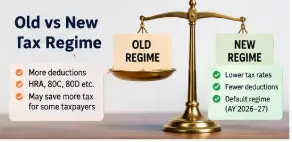
The choice between the old and new tax regimes is one of the most important tax-planning decisions for many individual taxpayers.
For AY 2026–27, the new tax regime is the default regime. Eligible taxpayers can opt for the old regime subject to the applicable rules. The old regime provides access to various deductions and exemptions, while the new regime has lower slab rates and fewer deductions.
New Tax Regime
The AY 2026–27 new-regime slabs are:
| Taxable Income | Tax Rate |
|---|---|
| Up to ₹4 lakh | Nil |
| ₹4 lakh–₹8 lakh | 5% |
| ₹8 lakh–₹12 lakh | 10% |
| ₹12 lakh–₹16 lakh | 15% |
| ₹16 lakh–₹20 lakh | 20% |
| ₹20 lakh–₹24 lakh | 25% |
| Above ₹24 lakh | 30% |
These are the slab rates before considering applicable rebate, surcharge and cess.
For eligible resident individuals, Section 87A provides a rebate of up to ₹60,000 where taxable income does not exceed ₹12 lakh under the new regime.
Old Tax Regime
The old regime continues to provide various deductions and exemptions for eligible taxpayers.
Common examples include:
- Section 80C
- Section 80D
- Section 80CCD(1B)
- Eligible HRA exemption
- Certain home-loan benefits
- Other deductions applicable to your circumstances
The old regime therefore needs to be evaluated using your actual deductions rather than assuming that it will always produce a lower tax bill.
Which Regime Saves More Tax?
There is no single tax regime that is best for everyone.
I recommend calculating tax under both regimes every year before deciding.
The new tax regime may be more beneficial if you have relatively few deductions and can benefit from its revised slab structure and applicable rebate.
The old tax regime may be more beneficial if you have substantial eligible deductions and exemptions that you cannot use under the new regime.
For example, a taxpayer with significant eligible deductions for investments, health insurance, HRA and certain other benefits may want to compare the old regime carefully.
The safest approach is simple:
Calculate your tax under both regimes using your actual income and eligible deductions, then choose the regime that results in the lower tax liability.
Do not choose the old regime merely because it offers more deductions. Do not choose the new regime merely because its tax rates are lower.
Use the [Income Tax Calculator] to compare your estimated tax under both regimes before making tax-saving investment decisions.
Section 80C: What Can You Claim?

Section 80C is one of the most widely used deductions under the old tax regime.
Eligible investments and payments can include:
- Employee Provident Fund (EPF)
- Public Provident Fund (PPF)
- ELSS mutual funds
- Life insurance premiums
- Eligible tax-saving fixed deposits
- Eligible home-loan principal repayment
- Certain other qualifying payments and investments
The combined deduction limit under Section 80C and certain related provisions is generally up to ₹1.5 lakh, subject to the applicable conditions.
Do not invest ₹1.5 lakh simply because the deduction is available.
First consider:
- Your financial goals
- Risk tolerance
- Investment horizon
- Liquidity requirements
- Existing investments
- Whether the investment is actually eligible for the deduction
You can also use our [Section 80C Tax Saving Calculator] to understand the available deduction based on your eligible investments.
Section 80D: Health Insurance Tax Benefit

Section 80D provides deductions for eligible health-insurance premiums and certain medical expenses, subject to the applicable conditions and limits.
For AY 2026–27, the Income Tax Department lists a deduction of up to ₹25,000 for self, spouse and dependent children, increasing to ₹50,000 where the relevant person is a senior citizen. Separate limits can apply for parents.
The deduction is subject to eligibility and the conditions specified under the Income Tax Act.
Tax saving should not be the only reason to buy health insurance.
The primary purpose of health insurance is financial protection against medical expenses. The tax benefit should be considered an additional benefit.
NPS Tax Benefits
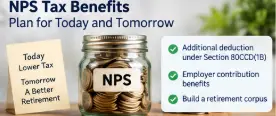
The National Pension System can provide tax benefits for eligible taxpayers.
Under the old regime, eligible individuals may claim an additional deduction under Section 80CCD(1B), subject to the applicable limit and conditions.
For eligible employees, employer contributions to NPS under Section 80CCD(2) can also provide a tax benefit. The applicable limits depend on the circumstances and tax regime.
Under the new regime, certain NPS benefits remain available, particularly eligible employer contributions, while several individual deductions available under the old regime are not available.
Therefore, do not describe NPS simply as a universal “₹50,000 tax saving.”
The actual benefit depends on the taxpayer’s circumstances and the applicable tax regime.
HRA Tax Benefit

If you are a salaried employee receiving House Rent Allowance and live in rented accommodation, you may be eligible for an HRA exemption under the applicable rules of the old tax regime.
The calculation depends on factors such as:
- Basic salary
- HRA received
- Rent paid
- Place of residence
You should maintain appropriate rent and supporting documents where required.
Use our [HRA Calculator] to estimate the HRA exemption that may be available to you.
Do not assume that receiving HRA automatically means the entire HRA is tax-free.
Home Loan Tax Benefits

Home-loan borrowers may qualify for tax benefits under specific provisions, subject to the applicable conditions.
These can include eligible deductions for:
- Principal repayment
- Interest on housing loans
- Certain additional deductions for eligible taxpayers and qualifying loans
The availability and amount of the benefit depend on factors such as the property, loan, date of sanction, use of the property and applicable tax regime.
Therefore, check the specific conditions before including a home-loan deduction in your tax calculation.
You can use our [Home Loan EMI Calculator] to understand your monthly repayment before taking a home loan.
Section 87A Rebate: Important Tax Benefit

Section 87A is a rebate from income tax for eligible resident individual taxpayers.
For AY 2026–27, the Income Tax Department states that:
- Under the new regime, the rebate can be up to ₹60,000 where taxable income does not exceed ₹12 lakh.
- Under the old regime, the rebate can be up to ₹12,500 where taxable income does not exceed ₹5 lakh.
A rebate is different from an exemption.
Therefore, do not simply say that “income up to ₹12 lakh is tax-free” without explaining the applicable conditions.
For salaried taxpayers, the standard deduction also needs to be considered when calculating taxable income. For AY 2026–27, the Income Tax Department’s ITR validation rules specify a standard deduction of up to ₹75,000 under the new regime for employees.
Example: ₹8 Lakh Salary — Why You Should Compare Both Regimes
Suppose a salaried employee earns ₹8 lakh during the financial year.
The taxpayer should not automatically invest in ELSS, PPF or NPS simply because these products are associated with tax saving.
Instead, the taxpayer should first calculate:
Under the new regime
- Gross income
- Applicable standard deduction
- Taxable income
- Applicable slab rates
- Section 87A rebate, if eligible
- Final tax liability
Under the old regime
- Gross income
- Applicable standard deduction
- Eligible deductions
- Taxable income
- Applicable slab rates
- Section 87A rebate, if eligible
- Final tax liability
The better regime is the one that produces the lower tax liability after applying all applicable rules.
This is why using an [Income Tax Calculator] before making tax-saving investments is more useful than following a general rule such as “old regime is better for investors.”
You can always verify the latest tax rules on the official Income Tax Department of India website.
Tax Saving Guide: Legal Ways to Reduce Income Tax
Tax-saving investments can be useful, but tax benefits should not be the only reason to invest.
ELSS Mutual Funds
ELSS funds are equity mutual funds that qualify for eligible Section 80C benefits under the old regime, subject to the applicable rules.
They have market-related investment risk and a three-year lock-in period.
ELSS may suit investors who understand equity-market risk and have a sufficiently long investment horizon.
Public Provident Fund
PPF is a long-term government-backed savings option with specified rules relating to contribution, interest, maturity and withdrawal.
It can be considered by investors looking for long-term, relatively conservative savings and eligible tax benefits under the old regime.
National Pension System
NPS is primarily designed for retirement planning.
It can provide tax benefits subject to applicable conditions, but investors should also consider the long-term nature of the product and withdrawal rules.
Tax-Saver Fixed Deposit
Certain bank fixed deposits qualify for Section 80C benefits under the old regime.
They generally have a five-year lock-in period for tax-saving purposes.
Before investing, compare the interest rate, lock-in, taxation, and your overall financial goals.
Don’t Invest Only to Save Tax
One of the biggest tax-planning mistakes is buying a financial product simply because someone says it will “save tax.”
For example, do not buy:
- Insurance you do not need
- ELSS without understanding equity risk
- NPS without considering retirement requirements
- A tax-saving FD without considering the lock-in
- An investment that does not fit your financial goals
A tax deduction can reduce your tax liability, but that does not automatically make the underlying investment a good investment.
Tax saving should support your financial plan, not replace it.
Tax-Saving Checklist
Before the end of the financial year, check:
- Have you compared the old and new tax regimes?
- Have you calculated your taxable income?
- Have you checked your eligible deductions?
- Have you reviewed your Form 16 and salary components?
- Have you checked HRA eligibility if applicable?
- Have you checked eligible health insurance deductions?
- Have you reviewed NPS benefits?
- Have you checked eligible home-loan benefits?
- Have you kept supporting documents?
- Are you investing because the investment suits you, rather than only for tax saving?
Tax Planning Throughout the Year

Tax planning should not be a last-minute March exercise.
April to June
Estimate your annual income and expected tax liability.
Compare the old and new regimes.
July to September
Review your investments, insurance, and eligible deductions.
Check whether your tax-saving plan still matches your financial goals.
October to December
Estimate your remaining tax liability and identify any eligible deductions you may use.
January to March
Complete any genuine tax planning that remains.
Avoid rushing into unsuitable investments simply because the financial year is ending.
Tax-Saving Mistakes to Avoid
1. Choosing a regime without calculating
The old regime is not automatically better for people who invest.
The new regime is not automatically better for everyone either.
Compare both.
2. Investing at the last minute
Last-minute investing can lead to poor product selection and unnecessary financial commitments.
3. Buying insurance only for tax benefits
Insurance should primarily address your protection needs.
4. Ignoring the new-regime rebate
Eligible taxpayers should understand the Section 87A rebate before estimating their tax liability.
5. Using outdated tax information
Tax slabs, deductions and other provisions can change.
Always verify current rules before filing your return.
6. Ignoring investment risk
A tax-saving investment can still lose money or produce disappointing returns depending on the product.
7. Assuming every deduction is available under both regimes
Many deductions available under the old regime are not available under the new regime.
Always check the applicable rules.
Advanced Tax Planning: What to Consider
Tax planning becomes more important as your income and financial responsibilities increase.
Depending on your circumstances, you may need to consider:
- Salary structure
- Employer NPS contributions
- HRA
- Home-loan interest
- Capital gains
- Investment income
- Retirement contributions
- Health-insurance deductions
- Other eligible deductions
These areas can become complicated, particularly for people with multiple income sources.
For investment-related tax issues, review the specific rules rather than relying on a generic tax-saving formula.
Use FinanceRead Tax Calculators
Calculating your tax is usually more useful than following a generic tax-saving checklist.
FinanceRead provides several calculators that can help you plan:
[Income Tax Calculator] — Compare estimated tax under the old and new regimes.
[HRA Calculator] — Estimate your eligible HRA exemption based on the applicable inputs.
[Section 80C Tax Saving Calculator] — Understand your eligible Section 80C investments and deduction.
[Personal Finance Calculators] — Explore calculators for investments, loans, budgeting and financial planning.
You can also explore our guides on [Investing & Retirement Planning] and [Budgeting in India] for broader financial planning.
You can also explore our complete Personal Finance Calculators Hub to plan your money smartly.
Always check your salary slip and talk to HR about available tax-friendly components. Check your HRA proof checklist.
HRA Calculator to see how much rent benefit you can claim
Final Thoughts
Tax saving is not about avoiding tax. It is about using the tax benefits available under the law while making sensible financial decisions.
The first step is to compare the old and new tax regimes.
The second step is to identify the deductions, exemptions and rebates that genuinely apply to you.
The third step is to choose investments and financial products based on your goals, risk tolerance and time horizon — not tax saving alone.
Before making a major tax decision, calculate your tax liability under both regimes and verify the applicable rules from the Income Tax Department.
Don’t wait until March to start thinking about tax. Plan early, calculate carefully and invest only when the investment makes financial sense for you.
Important: This article is for general educational purposes and is not personal tax advice. Tax rules can change and individual tax treatment depends on your circumstances. Verify the latest provisions with the Income Tax Department or a qualified tax professional before filing your return or making a major tax decision
Frequently Asked Questions
Q1. How can I reduce income tax in India legally?
Start by comparing the old and new tax regimes and then check the deductions, exemptions, rebates and other benefits for which you are actually eligible.
Q2. What are the best tax-saving tips in India?
The most useful approach is to compare tax regimes, understand your eligible deductions, plan investments according to your financial goals, and avoid last-minute decisions.
Q3. How can I reduce my taxable income?
Under the old regime, eligible deductions such as Section 80C, Section 80D, and certain NPS and home-loan benefits can reduce taxable income, subject to the applicable conditions.
Under the new regime, many of these deductions are not available, so the calculation needs to be done differently.
Q4. Which tax regime is better?
Neither regime is universally better. Compare your tax liability under both regimes using your actual income and eligible deductions.
Q5. Is Section 80C available under the new tax regime?
Most of the commonly used Section 80C deductions are not available under the new regime. Eligible taxpayers who need these deductions should compare their tax liability under the old regime.
Q6. How much income is tax-free under the new tax regime?
For AY 2026–27, the new-regime structure includes a Section 87A rebate of up to ₹60,000 for eligible resident individuals whose taxable income does not exceed ₹12 lakh, subject to the applicable conditions. This should not be confused with a general exemption of ₹12 lakh for every taxpayer.
Q7. Can I save tax without investing?
Yes, depending on your circumstances. Tax planning is not limited to investments. Eligible rebates, exemptions, salary-related benefits, employer contributions and other provisions may affect your final tax liability.
Q8. Should I invest in ELSS only to save tax?
No. ELSS carries market risk. Consider it only if equity exposure and the investment horizon suit your financial goals, not simply because it can qualify for a tax deduction under the old regime.
Q9. When should I start tax planning?
Ideally, start at the beginning of the financial year. This gives you time to compare options instead of making rushed decisions near the end of March.
About the Creator
Farooque Akhtar, MBA, CFA, is the creator of FinanceRead and writes about personal finance, investing, taxation and financial planning.
[Read more about Farooque Akhtar →]
About the Reviewer
SK Waseem, BCom (Honours), MBA (Finance), reviewed the financial content and calculation methodology of this page for accuracy.