
The FinanceRead Term Insurance Premium Index 2026 is a practical comparison framework for understanding how ₹1 crore term-insurance premiums differ between insurers and applicant profiles. It does not publish a fixed “cheapest insurer” ranking because actual premiums depend on age, health, smoking status, policy term, product structure and underwriting.
This guide explains how to make a fair comparison using the same applicant profile and current insurer quotations.
Important: Premiums shown by insurers can change, and individual quotes are profile-specific. FinanceRead does not present an unverified fixed premium as the price that every buyer will pay. Always obtain a current quote and read the policy document before purchasing.
The Term Insurance Premium Index 2026 helps readers compare premiums using a consistent methodology rather than relying only on advertisements. If you’re still evaluating policies, don’t miss our detailed guide on Best Term Insurance Plans in India 2026, where we compare features, riders, and claim records in depth.
Quick answer: What does ₹1 crore term insurance cost?
There is no single premium for a ₹1 crore term insurance policy.
For example, a 30-year-old healthy non-smoking applicant may receive a very different quote from a 40-year-old smoker, even when both request the same ₹1 crore cover.
The meaningful comparison is therefore not:
“Which insurer has the cheapest ₹1 crore policy?”
It is:
“Which policy provides the required protection at a premium I can comfortably maintain, with terms and features suitable for my family?”
That distinction is important because an insurance policy is a long-term protection contract, not a one-time purchase.
FinanceRead comparison methodology
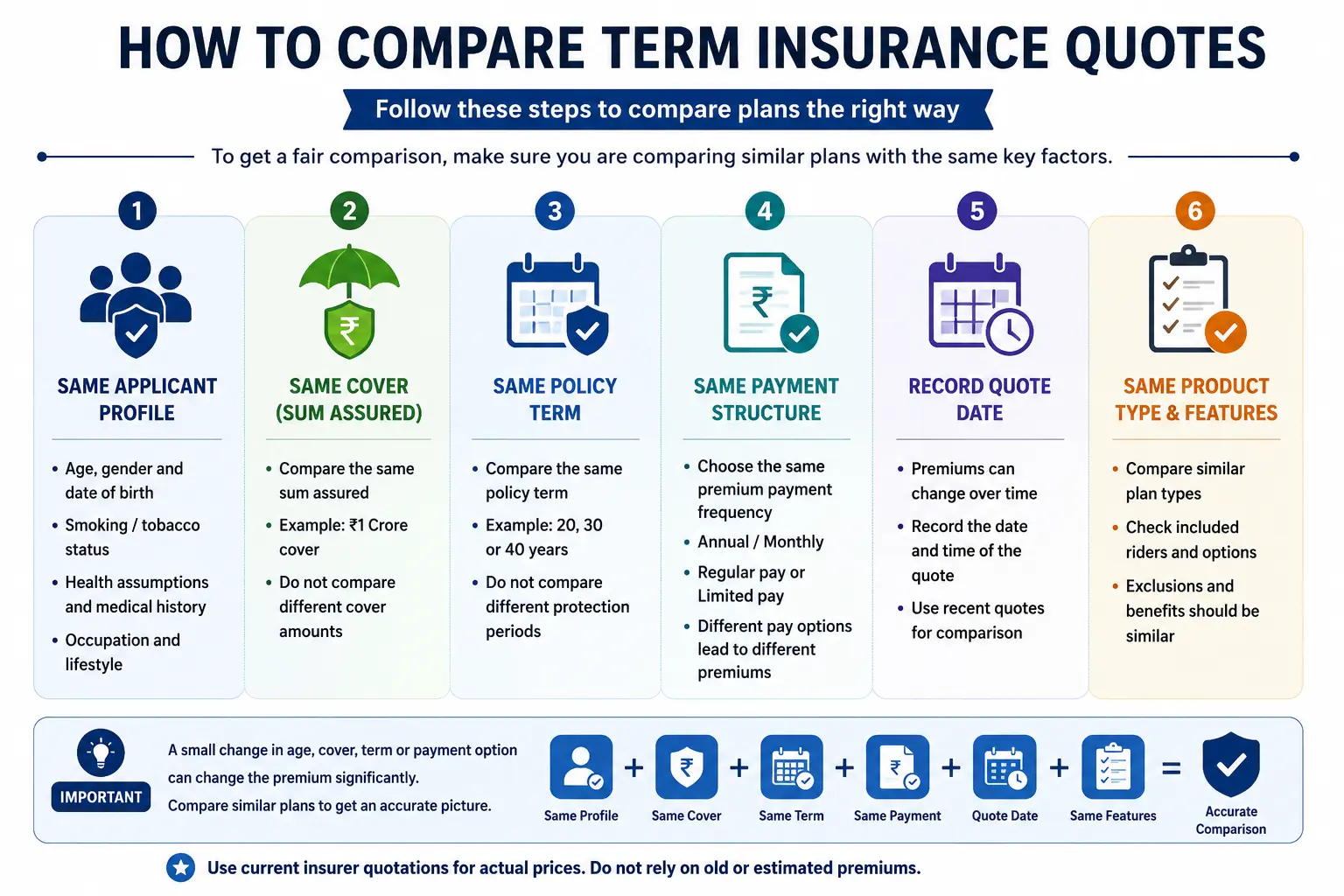
Instead of publishing a fixed premium table that may become inaccurate as insurers change their prices, FinanceRead recommends comparing quotes using the same applicant profile.
For a like-for-like comparison, record the following information for every insurer:
| Comparison factor | Example profile |
|---|---|
| Age | 30 years |
| Gender | Male |
| Smoking status | Non-smoker |
| Life cover | ₹1 crore |
| Policy term | 30 years |
| Premium frequency | Annual |
| Cover type | Pure term insurance |
| Quote date | Record the actual date |
| Premium shown | Record the insurer’s current quote |
| GST | Record whether included |
| Riders | Record separately |
This approach is more useful than comparing numbers copied from different websites or from different dates.
Why term insurance premiums differ
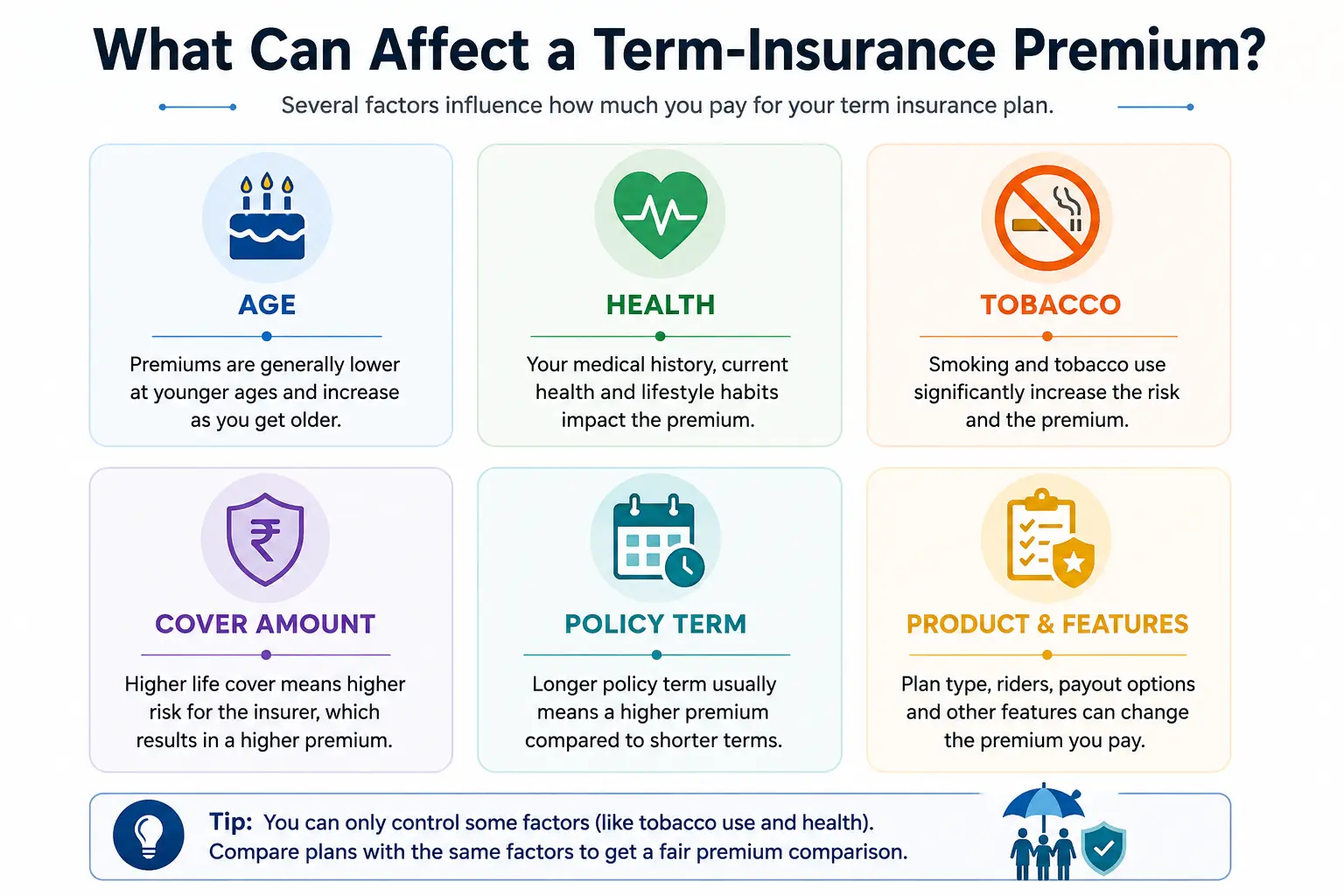
Two insurers can quote different premiums for the same nominal life cover.
This can happen because insurers use different underwriting models, pricing assumptions, distribution structures, product features and risk assessment methods.
Your individual profile also matters.
Important factors include:
Age
Age is one of the major factors affecting life-insurance pricing.
In general, buying protection earlier can result in a lower premium than waiting until a later age, assuming the applicant remains eligible and receives comparable underwriting terms.
However, “buy as early as possible” should not be interpreted as a reason to buy an unsuitable policy. The amount and duration of cover should match your financial responsibilities.
Smoking and tobacco use
Smoking and other tobacco use can materially affect life-insurance premiums because they increase the insurer’s assessed mortality risk.
Never hide tobacco use simply to obtain a lower quote.
Health and medical history
Existing illnesses, medical history, height, weight, test results and other underwriting information can affect the final premium or policy terms.
The quote displayed before underwriting may therefore not be the final offer.
Policy term
A longer policy term generally provides protection for a longer period and can affect the premium.
Choose the term based on when your dependants are likely to remain financially dependent on you and when major liabilities such as a home loan are expected to be repaid.
Amount of cover
A ₹2 crore policy will generally cost more than a ₹1 crore policy for the same applicant and comparable terms.
The correct cover amount should therefore be calculated from your family’s financial needs rather than selected simply because ₹1 crore is a common figure.
How much term insurance cover do you need?
There is no universal rule that every person needs exactly 15 or 20 times annual income.
A multiple of income can be used as a starting point, but it should not replace a proper calculation.
Consider:
- Current annual household expenses
- Outstanding loans
- Children’s education
- Marriage or other major future obligations
- Existing investments and savings
- Existing life-insurance cover
- Expected future income
- Number of years your family may depend on your income
- Inflation
A better approach is:
Required cover = financial obligations + future family needs + income-replacement requirement − existing financial resources
The exact calculation will differ from family to family.
How to compare ₹1 crore term insurance plans
When comparing insurers, create a comparison sheet with these columns:
| Factor | What to check |
| Premium | Current insurer quote |
| Policy term | Years of protection |
| Cover amount | ₹1 crore or required amount |
| Payout structure | Lump sum or other available options |
| Medical underwriting | Tests and disclosures required |
| Riders | Whether genuinely useful |
| Exclusions | Policy-specific exclusions |
| Claim process | Available process and documentation |
| Insurer information | Current official disclosures |
| Policy document | Current version and terms |
Do not compare only the headline premium.
Claim settlement ratio: useful, but not enough
Claim settlement information can be useful when researching an insurer, but it should not be treated as a guarantee that an individual’s future claim will be paid.
IRDAI publishes official insurance statistics, including life-insurance data. FinanceRead recommends using the latest available IRDAI data rather than relying on an old percentage copied from another website.
When comparing claim statistics, check:
- The financial year
- The exact metric being reported
- Whether the figure relates to the number of claims or claim amount
- The type of claims covered by the statistic
- The source of the data
A high claim-settlement percentage should therefore be treated as one research input, not as a guarantee of claim approval.
Why honest disclosure matters
One of the most important things a policyholder can do is provide complete and accurate information when applying.
Disclose relevant information about:
- Existing medical conditions
- Previous medical treatment
- Smoking and tobacco use
- Alcohol consumption where asked
- Previous insurance policies
- Occupation and other information requested in the proposal
Do not deliberately hide information to obtain a cheaper premium.
A cheaper premium is worthless if important information was incorrectly declared and the family later faces a claim dispute.
Should you add riders?
A term-insurance rider can provide additional protection in specified circumstances, but you do not need every rider offered by an insurer.
Common rider categories include:
| Rider type | What it may provide |
| Accidental death benefit | Additional benefit subject to policy conditions |
| Critical illness | Benefit on diagnosis of specified illnesses |
| Waiver of premium | Premium waiver after specified events |
| Disability-related benefit | Benefit subject to the rider’s definition and conditions |
The exact coverage, exclusions and definitions differ between products.
Read the rider wording rather than selecting it simply because the name sounds useful.
For example, a critical-illness rider should also be compared with your existing health-insurance coverage. They serve different purposes.
Is term insurance eligible for a tax deduction?
Tax treatment needs to be considered carefully because the applicable tax regime matters.
The Income Tax Department’s guidance lists eligible life-insurance premiums under Section 80C, subject to the applicable conditions and the overall Section 80C limit.
However, deductions under Section 80C are not generally available under the new tax regime. The Income Tax Department states that taxpayers opting for the new regime cannot claim most Chapter VI-A deductions, subject to specified exceptions.
Therefore, do not buy term insurance merely for a tax deduction.
The primary purpose of term insurance is financial protection for your dependants.
What changed for GST on individual life insurance?
This is particularly important for a 2026 comparison.
The GST Council announced an exemption from GST for individual life-insurance policies, including term insurance, as part of its 2025 GST reforms.
Therefore, an old article or old premium comparison that simply adds 18% GST to a current individual term-insurance quote may be outdated.
When comparing premiums in 2026, record the actual amount shown in the insurer’s current quote and the quote date.
Do not mix a pre-September-2025 premium illustration with a current 2026 quote and present them as though they are directly comparable.
Common mistakes when buying term insurance
1. Choosing only the cheapest premium
The lowest premium is not automatically the best policy.
Compare the policy terms, coverage, exclusions, insurer information and your actual needs.
2. Buying too little cover
A ₹1 crore policy may sound substantial, but it may not be sufficient for a family with large loans, several dependants and long-term financial obligations.
Calculate your requirement instead of using ₹1 crore as an automatic answer.
3. Buying too many riders
Additional riders increase complexity and may increase cost.
Select them only when the benefit fills a genuine protection gap.
4. Hiding medical information
Never misrepresent your health or lifestyle to reduce the premium.
5. Comparing quotes from different applicant profiles
A quote for a 30-year-old non-smoker cannot fairly be compared with a quote for a 35-year-old smoker.
Use the same profile and record the quote date.
6. Relying on an old premium table
Insurance pricing and product offerings change.
A premium published in 2024 or 2025 should not automatically be presented as the current 2026 price.
FinanceRead’s practical checklist
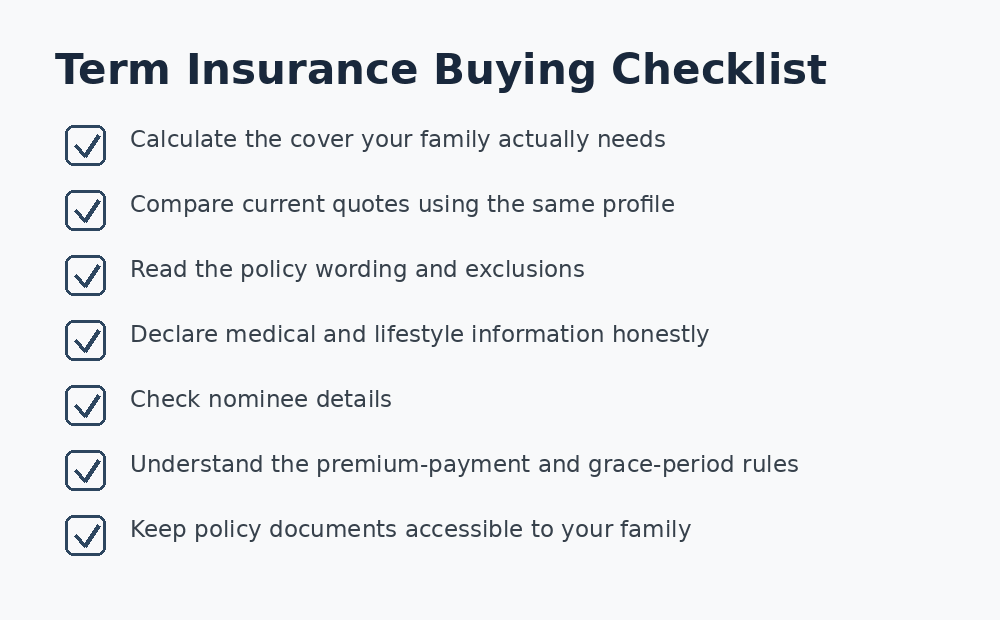
Before buying a term-insurance policy, check:
☑ I calculated the required cover instead of choosing an arbitrary amount.
☑ I compared at least three current quotes using the same profile.
☑ I recorded the date of each quote.
☑ I checked whether the quoted premium includes all applicable charges.
☑ I read the policy wording and exclusions.
☑ I disclosed my medical and lifestyle information honestly.
☑ I selected riders only where they provide a genuine benefit.
☑ I checked the latest available insurer and IRDAI information.
☑ I nominated the appropriate person and kept the policy documents safely.
☑ I can comfortably continue the premium for the full policy term.
Final verdict
There is no single “best” term-insurance plan for every Indian buyer.
The right policy is the one that provides sufficient financial protection for your family, fits your budget, has terms you understand, and is purchased after comparing current information from reliable sources.
Do not choose a policy solely because a website calls it “Best Overall” or because it has the lowest premium.
For a ₹1 crore policy, the correct premium depends on your personal profile and the insurer’s current underwriting.
Our recommendation at FinanceRead is therefore simple:
- Calculate the cover you actually need.
- Compare current quotes from multiple insurers.
- Compare the policy terms, not just the premium.
- Check the latest official insurer and IRDAI information.
- Disclose your health and lifestyle information honestly.
- Buy protection, not a marketing label.
Data note: FinanceRead does not publish a fixed “cheapest insurer” ranking in this article because insurer premiums are profile-specific and can change. A current quote obtained directly from an insurer is more reliable than an old premium figure copied from a comparison article.
Sources and verification
FinanceRead recommends using primary sources for final verification:
- IRDAI insurance statistics and official publications
- The insurer’s current product page
- The insurer’s current policy wording and brochure
- The insurer’s current premium quotation
- Income Tax Department guidance for applicable tax treatment
Looking for more financial planning tools? Explore our complete collection of personal finance calculators to make informed money decisions. The following FAQs answer the most common questions about the Term Insurance Premium Index 2026.
Continue Learning About Insurance & Financial Planning
If you’re planning to buy life insurance, these FinanceRead guides and calculators can help you compare policies, estimate tax savings, and build a stronger financial plan.
Related Insurance Guides
🔹 Best Term Insurance Plans in India 2026
A detailed comparison of leading term insurance plans, policy features, riders, claim settlement records, and expert recommendations.
🔹 The Real Cost of Delaying Term Insurance
See how waiting a few years can significantly increase your lifetime insurance premiums.
🔹 Claim Rejection Reasons in Term Insurance
Understand the most common reasons insurance claims are rejected and learn how to avoid costly mistakes.
Tax Planning Tools
🔹 Income Tax Calculator India
Estimate your income tax liability under the latest tax rules before making financial decisions.
🔹 Section 80C Tax Saving Calculator
The Income Tax Department confirms that the old-regime deduction framework includes life-insurance premiums under Section 80C, while the new regime doesn’t allow those Chapter VI-A deductions.
🔹 HRA Calculator
Calculate your House Rent Allowance exemption if you are a salaried employee.
Personal Finance Tools
🔹 Personal Finance Calculators
Explore our collection of calculators for EMI, SIP, FD, retirement planning, tax savings, and other financial goals.
Frequently Asked Questions
Q1. Which is the best term insurance plan in India in 2026?
There is no single best plan for everyone. The right plan depends on age, income, health condition, budget, and family requirements.
Compare premium, insurer reputation, claim record, and features before selecting.
Q2. Is ₹1 crore term insurance enough?
It depends on your income and responsibilities.
A person with higher income, loans, or dependents may require more coverage.
Q3. Should I buy term insurance online?
Online term plans can be convenient and transparent. However, always buy through official insurer websites or authorised platforms.
Q4. What is the best age to buy term insurance?
Generally, buying early helps because premiums are usually lower at younger ages.
Q5. Are term insurance premiums tax-deductible?
Eligible premiums may qualify under applicable income tax provisions. Tax rules can change, so verify the latest rules before making decisions.
If you are planning your taxes along with life insurance, use our estimate your Section 80C tax savings tool and calculate your income tax liability before making a purchase decision.
Disclaimer
This article is for educational purposes only and should not be considered financial advice or an insurance recommendation.
Insurance products are subject to insurer terms, underwriting rules, and regulatory changes.
Readers should compare official policy documents and consult a qualified advisor if required before purchasing.
Best Term Insurance Plans in India 2026 Income Tax Calculator Section 80C Calculator Old vs New Tax Regime Personal Finance Calculators HRA Calculator
Last reviewed: August 2026
