
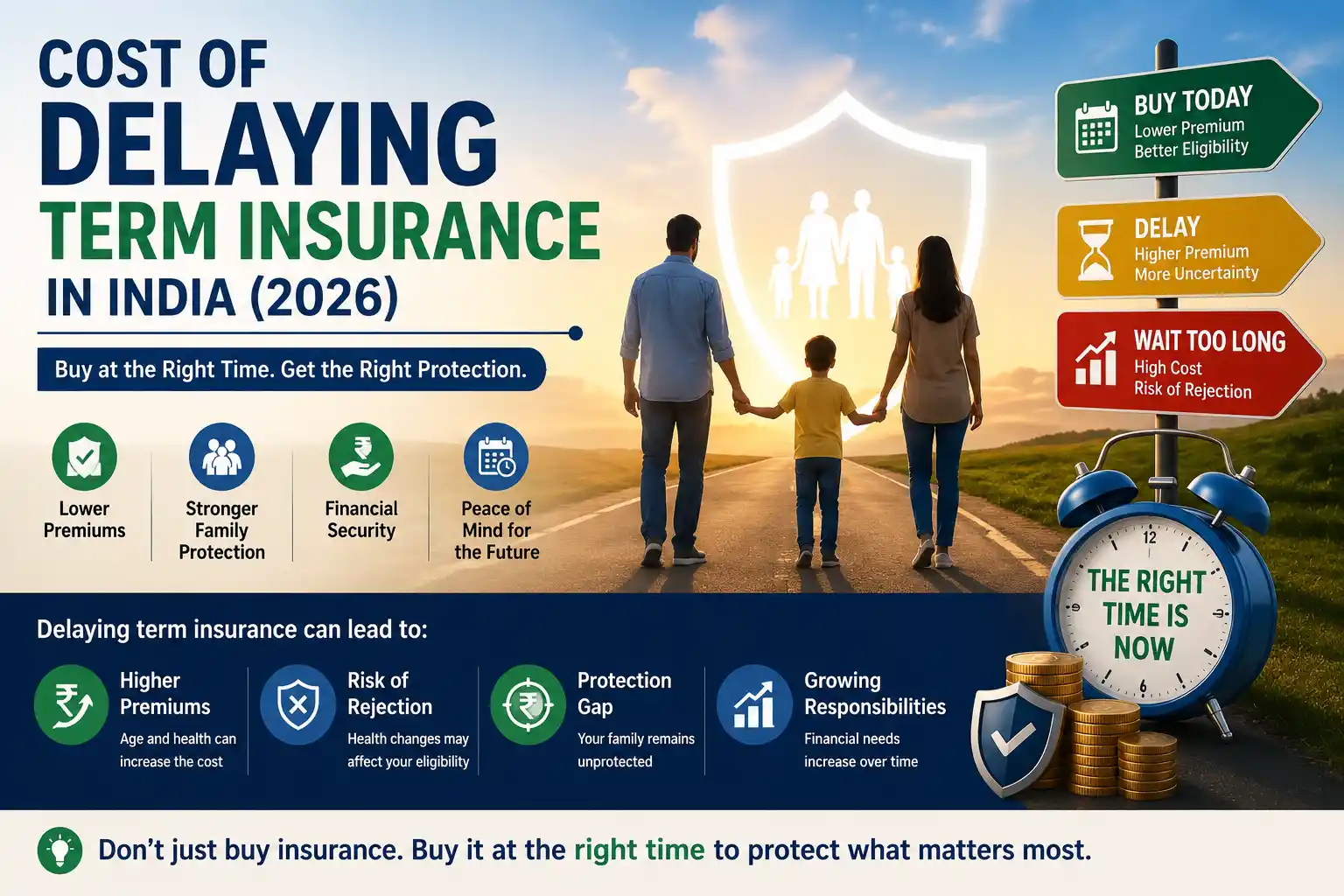
Many people postpone term insurance because they believe they can buy it later.
The reasons are familiar:
“I am still young.”
“I don’t have dependants yet.”
“I will buy it after marriage.”
“I will wait until my salary increases.”
“I will take it when I buy a house.”
Waiting does not necessarily make term insurance unaffordable. But it can change three important things:
the premium you are offered, your underwriting outcome, and the period during which your family remains financially unprotected.
This guide explains what actually changes when you delay buying term insurance and why “buy early” should not be reduced to a simple claim that earlier always means lower total lifetime cost.
Quick answer
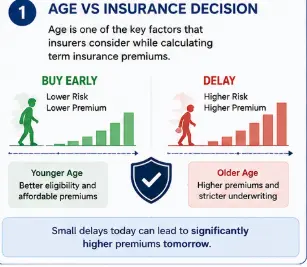
For a level-premium term-insurance plan, buying at a younger age will generally result in a lower premium than buying comparable cover later, assuming similar policy terms and underwriting.
The reason is straightforward: age is one of the factors used in life-insurance pricing, and insurers assess the applicant’s risk when the policy is issued.
Current insurer information also illustrates this principle. For example, ICICI Prudential states that premiums are fixed at the age of purchase for the policy duration and shows higher quoted premiums for older applicants for comparable cover.
But there is an important qualification:
A lower annual premium does not automatically mean a lower total lifetime premium.
Someone who buys at 25 may pay premiums for more years than someone who buys at 35.
The better reason to avoid unnecessary delay is therefore not simply “you will save money.”
It is:
You may secure cover while you are younger and healthier, while avoiding a period in which your family has no protection.
Why does term insurance become more expensive as you age?
Life insurers price policies according to the risk they are taking.
Age is one of the factors considered in underwriting and pricing.
As age increases, the probability of death during a given future period generally increases. That additional mortality risk is reflected in life-insurance pricing.
Your individual premium can also depend on factors such as:
- Age
- Sum assured
- Policy term
- Premium-paying term
- Smoking or tobacco use
- Medical history
- Occupation
- Lifestyle
- Other underwriting information
- Product features and options
The exact pricing formula differs between insurers.
Therefore, there is no universal percentage by which a term-insurance premium increases every year.
Buying early can lock in the premium applicable to your risk profile
For a level-premium term-insurance plan, the premium applicable under the policy is generally fixed for the policy duration, subject to the policy terms.
ICICI Prudential, for example, states that premiums are fixed at the age of purchase for the policy duration.
HDFC Life also describes level-premium term insurance as a structure where the life cover remains the same throughout the policy tenure against a fixed premium.
This creates a useful advantage.
Suppose you purchase a suitable level-premium policy while you are healthy.
If you later develop a medical condition, the insurer does not normally re-underwrite the already-issued policy simply because your health changed.
That is very different from waiting until after the health condition develops and then applying for a new policy.
The biggest risk of waiting: your health can change
Age is predictable.
Health is not.
A person may be healthy today but develop a condition before purchasing insurance.
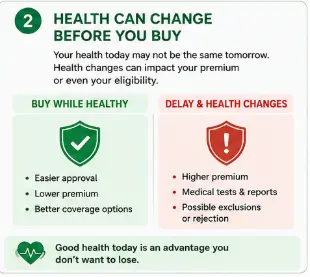
Depending on the condition and the insurer’s underwriting rules, this can result in:
- Additional medical tests
- Premium loading
- Postponement of the application
- Different policy terms
- Declining the application in some cases
This does not mean that developing a medical condition automatically makes someone uninsurable.
It means that the underwriting decision is made using the information and risk profile available when the new policy is applied for.
That is why delaying a decision can create a risk that cannot be measured in advance.
Example: the cost of a health change
Consider two people who are both 30 today.
Person A
Person A bought an appropriate level-premium term policy at age 26 while meeting the insurer’s underwriting requirements.
At age 30, Person A develops hypertension.
The existing policy generally continues according to its terms. The insurer does not simply reset the premium because the insured’s health changed after the policy was issued.
Person B
Person B waited until age 30 to purchase the policy.
During underwriting, the insurer discovers hypertension.
Person B may receive a different premium or underwriting decision depending on the medical information and the insurer’s rules.
The two people have the same medical condition at age 30.
But their insurance situations can be very different because one already had valid cover.
The cost of waiting is not only the premium
This is the most important point in the entire article.
Suppose you decide to wait three years before purchasing term insurance.
You may eventually pay a higher premium.
But there is another cost:
You remained uninsured for three years.
If nobody depends on your income and you have sufficient assets, that gap may be less important.
But if your parents, spouse, children or other dependants rely on your income, the risk is much more serious.
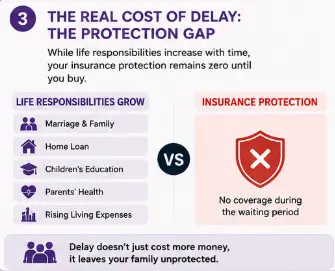
During the waiting period, the family has no death benefit from the policy you intended to buy later.
Therefore:
The cost of delay = potential change in future insurance cost + the value of protection you did not have during the waiting period.
The second component is often ignored.
Do not confuse lower annual premium with lower total premium
This is where many online articles oversimplify term insurance.
Suppose:
- Person A buys at 25.
- Person B buys at 35.
- Both purchase level-premium term insurance.
Person A may receive the lower annual premium because the policy is purchased at a younger age.
But Person A may also pay premiums for more years.
Therefore, we cannot simply multiply the younger person’s annual premium by the same number of years and declare that person the “lifetime winner.”
A proper comparison must keep the protection period and policy structure consistent.
For example, you could compare:
Same policy end age
or
Same policy duration
But these answer different financial questions.
This distinction is why FinanceRead does not publish a simplistic claim that buying ten years earlier automatically produces a specific rupee saving over the entire lifetime.
What does “buy early” actually mean?
“Buy early” should not mean:
Every 22-year-old must immediately purchase ₹3 crore of term insurance.
That is poor financial planning.
Instead, ask:
Who depends on my income?
If nobody depends on your income and you have sufficient assets, the immediate need for life insurance may be limited.
If your parents, spouse, children or another person depends materially on your income, the need becomes more important.
What liabilities would remain if I died?
Consider:
- Home loan
- Personal loans
- Education loans
- Other debts
- Future education expenses
- Household expenses
- Financial support for dependants
What assets already exist?
Consider:
- EPF
- PPF
- Mutual funds
- Bank deposits
- Other investments
- Existing life insurance
- Other financial resources
The required cover should be based on the family’s financial gap, not on an arbitrary number.
Buying term insurance after marriage
Marriage is often when people first realise that their income is no longer only their own financial responsibility.
That makes marriage a useful trigger for reviewing life insurance.
But it should not necessarily be the first time you think about protection.
If you already support parents or have significant liabilities, the need may exist before marriage.
And if you buy after marriage, the relevant premium will be based on your age and underwriting at that time.
The practical lesson is:
Do not wait for marriage if you already have a genuine financial dependency or liability that requires protection.
Buying term insurance after having children
Children increase the financial consequences of losing a parent’s income.
Future expenses can include:
- Education
- Housing
- Healthcare
- Daily household costs
- Childcare
- Other long-term financial needs
If you already have a policy, the birth of a child is a good reason to review whether the existing cover is still adequate.
You may need additional cover.
You should not automatically cancel an existing policy and replace it without comparing the consequences.
Buying term insurance after taking a home loan
A home loan creates a large financial obligation.
If the borrower dies, the outstanding liability does not automatically disappear.
Depending on the family’s financial arrangements, the surviving family may need to continue paying the loan or sell the property.
This is why taking a home loan should trigger a review of life insurance.
But it is not necessarily the right time to start thinking about insurance for the first time.
If you already have sufficient cover, you may only need to reassess the amount.
Do not rely entirely on employer-provided life insurance
Employer group life insurance can be valuable.
But it should not automatically be treated as a permanent substitute for personal term insurance.
Your employment can change.
The employer can change the benefit structure.
You can retire.
The group policy can have its own terms and limits.
Before depending on employer cover, check:
- Sum assured
- Eligibility
- Policy conditions
- Whether cover continues after leaving employment
- Whether you can retain or convert the cover
- Whether the amount is sufficient for your family
Your personal insurance strategy should not depend entirely on remaining in one job.
Should a young person buy term insurance even without dependants?
Not necessarily.
This is where FinanceRead takes a different position from simplistic “buy at 20” advice.
If a young person has:
- No financial dependants
- No major liabilities
- Adequate assets
- No immediate need for income replacement
then buying a very large policy simply because premiums are currently low may not be the best use of money.
The decision should be based on actual protection needs.
However, if the person already financially supports parents, has significant liabilities, or expects dependants soon, buying earlier may make sense.
Can you buy multiple term-insurance policies?
Yes, it is possible to have multiple life-insurance policies, subject to insurer underwriting and disclosure requirements.
A person may choose to add another policy when responsibilities increase.
For example:
At an earlier stage, you may have one policy sized for your existing responsibilities.
After marriage or a home purchase, you may reassess your total cover.
After having children, you may need additional protection.
The important point is not to follow a fixed ₹50 lakh + ₹50 lakh + ₹1 crore formula.
Instead:
Calculate the total protection required at each life stage.
Then determine whether your existing cover is sufficient.
What happens if you wait and your health changes?
Several outcomes are possible.
Standard underwriting
The insurer accepts the application at the standard premium.
Premium loading
The insurer accepts the risk but charges a higher premium.
Additional medical evaluation
The insurer asks for further medical tests or reports.
Postponement
The insurer may ask the applicant to apply again later depending on the circumstances.
Decline
In some cases, the insurer may decide that it cannot accept the risk under the product’s underwriting rules.
The exact outcome depends on the applicant, product and insurer.
Therefore, no website should promise that a particular illness will definitely lead to a particular premium increase.
Is there a perfect age to buy term insurance?
No.
A better question is:
When did your financial dependence or financial responsibility begin?
For some people, it may be when they start supporting parents.
For others, it may be marriage.
For others, it may be having children or taking a large loan.
A young person with no dependants may have little immediate need for life insurance.
A person of the same age supporting a family may have a substantial need.
Age affects pricing.
Financial dependence determines the need for protection.
Both matter.
How to decide whether you should stop delaying
Ask yourself five questions:
- Does anyone depend on my income?
- Would my family have difficulty repaying my debts if I died?
- Do I have enough existing life insurance?
- Would my current savings and investments replace my income adequately?
- Would waiting expose my family to an unnecessary period without protection?
If the answer to the first two questions is yes and you have insufficient existing resources, delaying the decision deserves serious reconsideration.
What should you do before buying?
Do not rush into the first policy simply because you are worried about getting older.
Instead:
Step 1: Calculate your protection requirement
Estimate your family’s financial gap.
Step 2: Compare suitable insurers
Compare policies using the same applicant profile.
Step 3: Complete the proposal honestly
Disclose relevant medical and lifestyle information.
Step 4: Review the issued policy
Check the sum assured, policy term, premium, nominee and important conditions.
Step 5: Keep the policy active
Pay premiums on time and understand the applicable grace period.
IRDAI’s life-insurance master circular states that during the grace period, the policy is considered in force and risk cover remains available without interruption, subject to the policy’s terms and conditions.
Cost of Delaying Term Insurance: Why Waiting Becomes Expensive
When people compare term insurance premiums, they usually focus on the amount they have to pay this year.
That is only part of the picture.
A better question is:
How much will delaying today’s decision cost over the next 30 years?
The cost of delaying term insurance is not limited to higher annual premiums. It also includes lost investment opportunities and the possibility of paying extra because of future health conditions. Unlike mobile phones, cars, or electronic gadgets, term insurance doesn’t become cheaper with time. Every birthday increases the insurer’s risk because the probability of illness and mortality gradually rises with age.
Insurance companies use actuarial models to estimate this risk. These models analyse millions of policies and medical records to determine how likely people of different ages are to make claims during the policy term.
The result is simple.
As age increases, premiums generally increase too. For most healthy applicants, the difference may appear small in the beginning. Waiting one year may only increase the annual premium by a few hundred rupees. That small increase creates a false sense of comfort.
Many people think,
“It’s only ₹500 more. I’ll buy next year.”
The problem is that premium increases are cumulative.
By the time someone reaches their mid-thirties, they are not paying a few hundred rupees extra each year. They may be paying thousands more every year for the same amount of life cover. Over a policy period of 30 or 40 years, that difference becomes substantial.
For example, imagine two healthy individuals purchasing the same ₹1 crore term insurance policy.
- Person A buys at age 25.
- Person B waits until age 35.
Both receive identical life cover. Both remain healthy. Both chose the same policy term.
The only difference is the age at which they purchased the policy.
Despite receiving the same protection, Person B is likely to pay significantly more over the life of the policy simply because they waited.
The extra money does not buy additional benefits, higher coverage, or better features. It is purely the cost of delaying the purchase.
This is one of the few situations in personal finance where taking action earlier reduces your lifetime cost without increasing your investment risk.
Age Is Only One Part of the Story
Many people assume that premiums increase only because they become older. In reality, insurers also consider the possibility that your health may change before you apply.
The risk of developing conditions such as diabetes, hypertension, thyroid disorders, obesity, or high cholesterol gradually increases with age. Even if these conditions are well managed, they can affect how insurers assess your application.
Depending on the insurer and the severity of the condition, you may experience one or more of the following:
- A higher premium because of additional medical risk.
- Extra medical tests before policy approval.
- Exclusions for specific medical conditions.
- Reduced policy options.
- In some cases, the application.
This means delaying your purchase creates two separate financial risks. The first is paying a higher premium simply because you are older. The second is losing the opportunity to qualify as a healthy applicant.
The first cost is predictable. The second is impossible to predict. No one plans to develop diabetes before turning 35. No one expects a routine health check-up to reveal high blood pressure.
Yet these situations occur every day, and once they appear in your medical history, they may influence your insurance premium for decades.
FinanceRead Insight
One of the biggest misconceptions about term insurance is that buying early means paying premiums for more years. While that is technically true, it ignores an important fact.
The annual premium you lock in today remains fixed throughout the policy term, even if your health changes later.
Someone who buys while healthy may continue paying the same premium for the next 30 or 40 years, even after developing diabetes or hypertension years later. That ability to lock in lower pricing is one of the strongest financial advantages of purchasing term insurance early.
In other words, buying early is not simply about getting insurance sooner. It is about securing today’s lower risk profile before circumstances change.
FinanceRead Premium Analysis: How Age Changes the Cost of a ₹1 Crore Term Insurance Plan
Most people assume that delaying term insurance by a year or two won’t make much difference.
At first glance, they seem right.
The premium increase between two consecutive birthdays often looks small enough to ignore. Paying ₹300 or ₹500 more each year doesn’t appear to be a major financial setback.
However, insurance premiums don’t increase in isolation. Every annual increase becomes part of your long-term financial commitment. Once you purchase a policy, you continue paying that higher premium for the next 30 or 40 years.
That’s where the real cost begins to emerge.
To understand this better, FinanceRead analysed premium quotations from leading Indian life insurers for healthy, non-smoking male applicants seeking a ₹1 crore term insurance cover. Although individual premiums vary depending on occupation, city, policy features, and underwriting decisions, the overall trend was remarkably consistent across insurers.
The older the applicant, the higher the premium.
Premium Comparison by Age
Age is one of the factors insurers consider when pricing term insurance. For comparable cover and policy terms, a younger applicant will generally receive a lower premium than an older applicant. However, there is no universal percentage increase for every year of age, so current insurer quotations should be compared using the same applicant profile.
Why Does the Premium Rise Faster After 30?
Understanding the cost of delaying term insurance helps families make better long-term financial decisions. Many readers assume insurers simply charge more because people celebrate another birthday.
The reality is more scientific.
Insurance companies calculate premiums using actuarial models that estimate the probability of a claim during the policy period. As people age, the likelihood of medical conditions and mortality gradually increases.
This additional risk is reflected in the premium.
Another reason for sudden jumps is that insurers often group applicants into underwriting age bands instead of calculating a completely new premium every single year.
Although every insurer has its own pricing model, moving into a new age bracket can produce a noticeably larger increase than the previous year.
That explains why someone buying at 30 may pay considerably more than someone who purchased the same policy just before turning 30.
The difference is not because the policy changed. It is because the risk category changed.
A Small Delay Creates a Large Lifetime Cost
The cost of delaying term insurance is not limited to the premium. A person who waits may eventually face a different premium because of age or underwriting, but they also remain without personal life-insurance protection during the waiting period. The financial impact of delay therefore depends on both the eventual cost of insurance and the protection gap created while waiting.
The Opportunity Cost Few People Notice
There is another financial cost that rarely receives attention.
Every additional rupee spent on insurance is a rupee that cannot be invested elsewhere.
Imagine paying an additional ₹1.75 lakh in premiums because you delayed buying your policy.
If that same amount had been invested gradually into a diversified equity mutual fund earning a long-term annual return of around 12%, the investment could potentially grow into a substantial corpus over the next two decades.
The exact amount depends on investment returns and market conditions, but the underlying principle remains the same. Delaying insurance not only increases your premium, but it also reduces your future wealth-building potential.
This hidden opportunity cost is one of the biggest reasons many financial planners recommend buying adequate term insurance early rather than postponing the decision.
FinanceRead Insight
When people consider delaying term insurance, they usually compare today’s premium to next year’s.
That comparison is incomplete.
The better comparison is between:
- paying a lower premium for the next 30 years, or
- paying a higher premium for the next 30 years.
The difference may seem modest in one year.
Over three decades, it has become a significant financial penalty for making the same purchase later.
The earlier you qualify as a healthy applicant, the longer you benefit from lower premiums.
That is why buying early is not simply about saving a few hundred rupees today.
It is about locking in one of the lowest insurance costs you are ever likely to receive.
Hidden Cost of Delaying Term Insurance: When Your Health Changes Before You Buy
Higher premiums are the most visible consequence of delaying term insurance. The hidden risk is far more serious.
You may no longer qualify for the same policy on the same terms.
Many people assume they will remain healthy until they’re ready to buy insurance. Unfortunately, health doesn’t always go according to plan. A routine medical check-up, an unexpected diagnosis, or even a slight weight change can alter how an insurer evaluates your application.
This is why financial planners often say that the best time to buy term insurance is when you don’t think you need it.
Once a policy is issued, your premium is generally fixed for the chosen policy term. But before the policy is issued, every medical condition becomes part of the insurer’s risk assessment.
In simple words, waiting gives life more time to change your health profile.
Why Insurers Care About Your Health
Life insurance companies are not trying to predict whether you will become ill next year.
Instead, they estimate the probability of paying a claim during the policy term.
To do that, insurers evaluate several factors, including:
- Your current age
- Height and weight
- Blood pressure
- Blood sugar levels
- Cholesterol profile
- Existing medical conditions
- Family medical history
- Smoking or tobacco use
- Alcohol consumption
- Occupation
- Lifestyle and hobbies
Each factor helps the insurer determine how much risk they are accepting.
A healthy 26-year-old office employee and a 36-year-old smoker with diabetes may both apply for ₹1 crore of life cover, but the insurer views them very differently.
The cover amount is identical. The expected risk is not.
Common Health Conditions That Can Increase Premiums
Many lifestyle-related illnesses become more common during a person’s thirties.
Some develop gradually without obvious symptoms, which means applicants often discover them only during routine medical tests required by the insurer.
Below are some of the conditions that may affect underwriting decisions.
| Health or lifestyle factor | Possible underwriting consideration |
|---|---|
| Type 2 diabetes | May require medical information or additional assessment |
| Hypertension | Underwriting may consider severity, treatment and control |
| Obesity | May be considered along with other health and risk factors |
| High cholesterol | May require additional medical information in some cases |
| Fatty liver | Assessment may depend on severity and liver-function information |
| Thyroid disorders | May require relevant medical documentation |
| Smoking or tobacco use | Can result in a different premium based on the insurer’s underwriting |
These are general examples, not guaranteed outcomes. Underwriting decisions vary by insurer, product, applicant profile and medical evidence. A medical condition does not automatically mean that an application will be rejected or that a particular premium loading will apply.
The Difference Between Being Healthy and Being Insurable
This is an important distinction that many people overlook.
You might feel perfectly healthy.
You may go to work every day.
You may exercise regularly.
Yet an insurance medical examination could reveal elevated blood sugar, high blood pressure, or abnormal cholesterol levels.
From your perspective, nothing has changed, but from the insurer’s perspective, everything has.
Insurance companies don’t price policies based on how healthy you feel. They price them based on measurable medical risk.
That is why many applicants are surprised when their premium is higher than the online quote they initially received.
The quote assumed a standard-risk applicant. The medical examination told a different story.
An Illustrative Example
Consider two software engineers earning similar salaries.
Both are 30 years old.
Both want ₹1 crore of term insurance.
The first purchased his policy at age 26 while he was healthy.
Four years later, he is diagnosed with hypertension.
His premium does not change.
His insurer cannot increase the premium because the policy was issued before the diagnosis.
The second engineer decided to wait until turning 30.
During the mandatory medical examination, elevated blood pressure is detected.
The insurer approves the application but charges a higher premium because the medical condition already exists.
Both individuals have the same health condition today.
Yet one continues paying the lower premium locked in years earlier, while the other starts paying a higher premium from the very beginning.
That difference may continue for the next three decades.
Premium Loading Explained
Many applicants hear the term premium loading for the first time when buying life insurance.
It simply means paying more than the standard premium because the insurer believes the applicant represents additional risk.
For example:
| Applicant profile | Possible underwriting outcome |
|---|---|
| Healthy non-smoker | May qualify for standard pricing, subject to underwriting |
| Controlled diabetes | May require medical information and could affect the premium |
| Hypertension under treatment | Underwriting may consider medical reports and treatment history |
| Smoker or tobacco user | May receive different pricing from a non-smoker |
| Multiple health conditions | May require additional underwriting and could affect the premium or policy terms |
Every insurer follows its own underwriting guidelines.
Some companies may approve an application that another insurer prices differently.
This is one reason comparing multiple insurers before purchasing is so important.
Buying Early Protects More Than Your Wallet
People often believe they are buying term insurance to protect their family’s future.
That is true.
But buying early also protects something else.
It protects your ability to qualify as a low-risk applicant.
Health is one of the few advantages that naturally decline with age.
Once lost, it usually cannot be regained for insurance pricing purposes.
A healthy applicant who locks in a policy today may continue enjoying lower premiums even if future medical conditions develop.
Someone who delays may never receive those same rates again.
The Cost Nobody Can Predict
Everyone knows they will celebrate another birthday.
No one knows what their next annual health check-up will reveal.
You cannot control your age.
You cannot completely control genetics.
You cannot eliminate every health risk.
What you can control is when you apply for life insurance.
Buying early doesn’t guarantee perfect health forever.
It simply ensures that today’s health works in your favour rather than against you.
FinanceRead Insight
Most people think delaying term insurance is a financial decision.
In reality, it is both a financial decision and a health decision.
Every year you postpone your purchase, two clocks continue to move.
The first is your age, which steadily increases your premium.
The second is your health, which can change without warning.
The premium increase is measurable.
The health risk is unpredictable.
That’s precisely why delaying term insurance often becomes much more expensive than most people expect.
“I’ll Buy It Later”: The Most Expensive Delay in Personal Finance
Very few people decide that they never want life insurance.
Most simply postpone it.
They tell themselves they’ll buy it after achieving the next milestone.
After the salary hike.
After marriage.
After buying a house.
After becoming a parent.
After clearing their education loan.
The intention is usually good. The timing isn’t.
The problem with waiting is that life rarely pauses while you prepare for it. Careers change, families grow, health evolves, and responsibilities increase much faster than most people expect.
Ironically, by the time many people feel they finally “need” term insurance, they are buying it at the point where it is naturally more expensive.
The Salary Hike Myth
One of the most common reasons for delaying term insurance is the belief that it should wait until income increases.
The thinking sounds reasonable.
“If I earn ₹50,000 a month instead of ₹35,000, paying the premium will be easier.”
But term insurance is one of the few financial products where affordability improves only marginally, while the price itself keeps increasing.
Consider this example.
Rohit starts working at age 24 and earns ₹4.5 lakh annually.
He decides to wait until his salary reaches ₹8 lakh before buying insurance.
Five years later, his salary has indeed doubled.
So has his annual premium.
Although he can comfortably afford the higher premium, he now pays that higher amount every year for the next three decades.
His improved income did not make insurance cheaper.
It only made paying the higher premium easier.
The smarter approach would have been to purchase adequate cover when he first became financially independent and increase the cover later as his income grew.
Waiting for Marriage Can Be a Costly Mistake
Many young professionals believe term insurance becomes necessary only after marriage.
At first glance, that seems logical because marriage often brings new financial responsibilities.
However, waiting until marriage overlooks an important fact.
Marriage changes your responsibilities overnight.
Insurance pricing changes gradually over time.
Suppose two friends begin working at the same age.
One purchases a ₹1 crore term insurance policy at 26.
The other decides to wait until marriage at 31.
When they compare policies after marriage, they discover something surprising.
Both receive the same life cover.
Both chose the same insurer.
Yet one has locked in a significantly lower premium simply because he acted earlier.
Marriage did not increase the value of the policy.
It only delayed the purchase.
The Home Loan Trigger
Buying a home is another event that pushes many people towards term insurance.
Banks often recommend or require life insurance to protect the outstanding loan amount.
Unfortunately, this usually happens when borrowers are already in their thirties.
By then, the premium has naturally increased.
A better strategy is to separate your insurance decision from your loan decision.
Your family’s financial security should not begin only after signing a housing loan agreement.
If you already have adequate term insurance before taking a loan, you simply review whether the existing cover remains sufficient.
You don’t need to start from scratch.
“I’ll Buy It Before We Have Children”
Children dramatically increase the need for financial protection.
They do not reduce the cost of buying it.
Parents often realise the importance of life insurance only after holding their child for the first time.
Emotionally, this is understandable.
Financially, it is late.
At that stage, you may also have:
- A home loan
- Higher monthly expenses
- Childcare costs
- School planning
- Reduced savings capacity
Adding a larger insurance premium to an already stretched budget makes financial planning more difficult.
Buying earlier avoids this pressure.
Every Delay Creates Two Problems
People usually focus only on the higher premium.
But postponing the decision creates another problem that receives much less attention.
It leaves your family financially exposed during the waiting period.
Imagine someone postpones buying term insurance for five years.
During those five years, they may:
- Get married.
- Buy a house.
- Become responsible for ageing parents.
- Have children.
- Build significant financial liabilities.
Their responsibilities continue growing.
Their financial protection remains zero.
This gap between responsibility and protection is one of the biggest weaknesses in many household financial plans.
The Cost of Waiting Is More Than Money
Suppose a family depends on one primary income.
If that income suddenly disappears because of an unexpected event, the family still has to pay:
- Home loan EMIs
- Rent
- Children’s education expenses
- Household bills
- Medical expenses
- Existing personal loans
These financial commitments do not stop simply because income has stopped.
This is why term insurance is often described as income replacement rather than an investment.
Its purpose is to buy time for the family to adjust financially after losing the primary earner.
Delaying that protection means accepting a period during which those responsibilities remain completely uncovered.
A Better Way to Think About Life Insurance

Many people ask,
“When should I buy term insurance?”
A better question is,
“When did someone first become financially dependent on my income?”
For some people, the answer is their parents.
For others, it is a spouse.
For many, it begins the day they sign their first home loan agreement.
Financial dependence—not age—is what creates the need for protection.
Once someone relies on your income, postponing insurance becomes increasingly difficult to justify.
Build Your Cover as Your Life Changes
Buying early does not mean you must purchase your final insurance cover on day one.
Many insurers now offer life-stage options that allow policyholders to increase their cover after major milestones such as:
- Marriage
- Birth of a child
- Home purchase
- Significant salary growth
Another practical strategy is to buy multiple policies over time.
For example:
- Age 25: ₹50 lakh cover
- Age 30: Additional ₹50 lakh cover
- Age 35: Additional ₹1 crore cover if responsibilities increase
This approach allows you to secure lower premiums for the earliest portion of your insurance while keeping your overall cover aligned with your changing financial responsibilities.
It also avoids paying for unnecessarily high cover when you are just beginning your career.
FinanceRead Insight
People often wait because they believe they are postponing an expense.
In reality, they are postponing protection while making that protection progressively more expensive.
The milestones people wait for—marriage, children, salary growth, and home ownership—are precisely the moments when financial responsibilities increase.
By then, buying insurance is no longer just a financial decision.
It becomes an urgent necessity.
The best time to purchase term insurance is usually before those responsibilities arrive, not after.
That way, when life changes, your family’s financial protection is already in place.
What Is the Best Age to Buy Term Insurance?
If you’ve read this far, you’ve probably reached the most practical question in this entire guide.
So, what is the right age to buy term insurance?
There isn’t a single answer that applies to everyone.
A 23-year-old graduate beginning their first job has different financial responsibilities than a 35-year-old parent with a home loan. Likewise, a self-employed professional may require a different level of protection than someone working in a salaried job.
However, one principle remains true regardless of occupation or income.
The best time to buy term insurance is when you become financially responsible for yourself or someone else—not when you think you are old enough.
Instead of choosing a specific age, it is more useful to think in terms of life stages.
1. Your 20s: The Best Time to Lock in Lower Premiums
Most people in their twenties believe life insurance can wait.
After all, they are healthy, energetic, and just beginning their careers.
Ironically, these are exactly the reasons insurers offer the lowest premiums.
At this stage, your biggest advantage isn’t your salary.
It’s your health.
A healthy applicant in their twenties is generally viewed as a lower insurance risk. That allows insurers to offer long-term protection at comparatively lower premiums.
Even if your income is modest, buying a basic policy now gives you something extremely valuable.
It locks today’s premium for decades.
2. Who should consider buying in their twenties?
You should seriously consider term insurance if you:
- Have a stable source of income.
- Financially support your parents.
- Have an education or personal loan.
- Want to secure lower premiums while you’re healthy.
- Expect greater financial responsibilities over the next few years.
You don’t necessarily need ₹3 crore of cover immediately.
Starting with an appropriate amount and increasing it later is often a more practical approach.
3. Your Early 30s: Protection Becomes a Priority
For many people, the early thirties bring major life changes.
You may be married.
You may have a young child.
You may have taken your first home loan.
Your income has likely increased.
Unfortunately, so have your financial responsibilities.
This is usually the stage where people realise they should have purchased term insurance a few years earlier.
If you haven’t yet bought a policy, don’t let that become another reason to delay.
Buying today is still better than postponing the decision further.
At this stage, your priorities should include:
- Replacing at least 15–20 years of family income.
- Covering outstanding loans.
- Protecting future education expenses for children.
- Reviewing employer-provided insurance instead of depending entirely on it.
Remember that employer group insurance usually ends when you change jobs or retire.
Your family’s financial protection should never depend entirely on your employer.
4. Your Late 30s: Review Before You Buy
By your late thirties, buying term insurance is still possible for many healthy individuals.
However, this is often the stage where insurers begin paying closer attention to medical history.
Before purchasing, consider the following:
- Have you had a full health check-up recently?
- Do you have diabetes or hypertension?
- Are you taking long-term medication?
- Is your existing cover sufficient for your current lifestyle?
If your answer to the last question is “No,” don’t focus only on the premium.
Focus on getting adequate protection while you still qualify.
Many people spend weeks comparing policies to save a few hundred rupees.
Very few calculate how much their family would need if their income stopped tomorrow.
That is the comparison that matters.
5. Age 40 and Beyond: It’s Not Too Late
One of the biggest mistakes people make after 40 is believing they have missed the opportunity.
That isn’t true.
Yes, premiums are higher than they were at 30.
Medical underwriting may also be stricter.
But having some protection is still far better than having none.
If you have financial dependants, outstanding loans, or a spouse who relies on your income, term insurance can still play an important role in your financial plan.
The key is to purchase appropriate cover while you remain eligible.
Waiting another five years rarely improves the situation.
How much term insurance cover do you need?
A practical approach is to estimate the financial resources your family would need if your income stopped, then subtract assets and existing protection that would remain available to them.
An income multiple can be used as a rough starting point, but it should not be the final calculation. Consider outstanding loans, household expenses, children’s future education, other financial responsibilities, existing investments, and existing life insurance.
| Factor | Include in your calculation |
|---|---|
| Outstanding loans | Home, personal and other major debts |
| Family income replacement | Financial support your dependants may need |
| Children’s future needs | Education and other major expenses |
| Household expenses | Ongoing family expenditure |
| Existing assets | Investments and savings available to the family |
| Existing insurance | Cover already in force |
Don’t Make These Common Mistakes
Buying early is important.
Buying wisely is equally important.
Avoid these mistakes:
1. Buying Based Only on the Lowest Premium
A cheaper policy is not automatically the better policy.
Compare features, claim settlement history, policy wording and insurer reputation before making a decision.
2. Depending Only on Employer Insurance
Group insurance is useful.
It should not be your only life cover.
Changing jobs, retirement, or company policy changes can leave you uninsured.
3. Hiding Medical Information
Some applicants fail to disclose existing illnesses because they worry about paying a higher premium.
This is a serious mistake.
Incorrect or incomplete disclosure can create problems for your family during the claim process.
Always answer medical questions honestly.
4. Delaying Because You Want the “Perfect” Policy
Many buyers spend months comparing dozens of plans.
Meanwhile, they remain completely uninsured.
A suitable policy purchased today is usually more valuable than a perfect policy purchased years later.
A Simple Action Plan
If you’re unsure where to begin, follow this checklist.
1. If you’re in your 20s
✔ Buy your first policy after your income becomes stable.
✔ Start with affordable cover.
✔ Review every three to five years.
2. If you’re in your 30s
✔ Increase your cover if your responsibilities have grown.
✔ Include home loans and children’s education in your calculations.
✔ Review your nominee details.
3. If you’re 40 or older
✔ Assess your current financial obligations.
✔ Purchase adequate protection without further delay.
✔ Review existing policies before buying additional cover.
FinanceRead Insight
People often spend weeks researching a smartphone worth ₹30,000.
They compare cameras, processors, battery life, and online reviews.
Yet many spend less time deciding how they will financially protect a family that depends on their income.
Term insurance deserves far more attention than it usually receives.
The best policy isn’t simply the one with the lowest premium.
It’s the one that provides sufficient protection, fits your financial plan, and is purchased before age or health begins working against you.
FinanceRead Research Methodology
This analysis was prepared to help readers understand how delaying the purchase of term insurance can affect long-term costs.
For this study, FinanceRead reviewed publicly available premium quotations from leading Indian life insurers for healthy, non-smoking applicants across multiple age groups. Premium trends were then compared to evaluate how age influences pricing over a long policy term.
The examples used throughout this article are intended to explain common underwriting principles and should not be interpreted as guaranteed premiums for every applicant.
Actual premiums vary depending on several factors, including:
- Age at the time of application.
- Medical history.
- Smoking or tobacco use.
- Occupation.
- City of residence.
- Policy term.
- Sum assured.
- Optional riders.
- Individual underwriting decisions.
All financial illustrations are designed to improve understanding and should not be considered personalised financial advice.
Sources Referenced
The analysis in this article is based on information available from:
- Official premium quotation tools of leading Indian life insurers.
- IRDAI publications and consumer information.
- Publicly available underwriting guidelines.
- Government health reports and published medical research.
- Financial planning principles widely used within the insurance industry.
Readers should always obtain fresh quotations directly from insurers or authorised insurance advisors before purchasing a policy.
Key Takeaways
If you remember only a few points from this guide, make them these.
1. Waiting Usually Costs More
Premiums generally increase with age.
Even a delay of a few years can increase the total amount you pay over the life of the policy.
2. Health Can Change Without Warning
Many people postpone buying insurance because they feel healthy.
Unfortunately, future health cannot be predicted.
Buying while healthy may help you qualify for more favourable premiums.
3. Financial Responsibilities Grow Faster Than Expected
Marriage, children, home loans, and ageing parents often arrive sooner than people anticipate.
Your insurance planning should ideally stay ahead of these responsibilities rather than react to them.
4. Price Should Not Be Your Only Consideration
A good term insurance policy balances affordability with adequate financial protection.
Choosing the lowest premium without understanding the policy may not always be the best decision.
5. The Best Time Is Usually Earlier Than You Think
Very few people regret buying appropriate life insurance early.
Many regret waiting until circumstances forced them to buy it.
FinanceRead’s conclusion
Buying term insurance earlier can have a genuine financial advantage because age is one of the factors affecting life-insurance pricing, and a level-premium policy can lock in the applicable premium for the policy duration.
But “buy early and save money” is too simplistic.
The stronger reason to avoid unnecessary delay is that:
your age can increase, your health can change, your financial responsibilities can grow, and your family may remain unprotected while you wait.
At the same time, buying insurance far earlier than you actually need can also be inefficient if you have no dependants, no meaningful liabilities, and no need for income replacement.
So the right rule is not:
Buy as young as possible.
It is:
Buy adequate life insurance when there is a genuine financial need, and do not unnecessarily postpone that protection once the need exists.
That is the financially responsible way to think about the cost of delaying term insurance.
Final Thoughts
Term insurance is often described as a financial product. In reality, it is much more than that. It represents a commitment to protecting the people who depend on your income, even when you are no longer there to provide it.
The biggest mistake most people make is choosing the wrong insurer. It is assuming they have more time. The cost of delaying term insurance is measured not only in higher premiums but also in lost opportunities to secure affordable protection.
Life rarely announces the right moment to begin financial planning. There will always be another promotion to wait for, another expense to manage, or another milestone to reach.
But insurance pricing does not pause while life unfolds. Each passing year changes the equation. Sometimes only slightly. Sometimes significantly.
The good news is that buying term insurance does not require perfect timing. It simply requires making a thoughtful decision before age or health begins limiting your options.
If this article encourages you to review your family’s financial protection today instead of next year, it has served its purpose.
Frequently Asked Questions
Q1. Can I buy more than one term insurance policy?
Yes.
No rule limits you to a single-term insurance policy. In fact, many financial planners recommend purchasing additional policies as your responsibilities increase rather than replacing an existing one.
For example, you might purchase:
- ₹50 lakh cover at age 25.
- Another ₹50 lakh after marriage.
- An additional ₹1 crore after taking a home loan.
This approach allows you to lock in lower premiums at different stages of your life while gradually increasing your total protection.
Q2. Should I buy term insurance if my employer already provides life insurance?
Employer-provided group insurance is a valuable employee benefit, but it should not be your primary financial safety net.
In most cases, group life insurance ends when you leave your job, change employers, or retire.
Individual term insurance remains with you regardless of where you work.
Think of employer insurance as an additional layer of protection rather than a substitute for your own policy.
Q3. Does smoking really make that much difference?
Yes.
Smoking is one of the most important factors considered during underwriting.
Smokers generally pay substantially higher premiums than non-smokers because tobacco use is associated with a greater risk of serious illnesses and premature death.
Some insurers may also ask for additional medical tests before approving the policy.
If you have recently quit smoking, check the insurer’s underwriting guidelines. Many insurers require applicants to remain tobacco-free for a specified period before considering them as non-smokers.
Q4. Will my premium increase if I develop diabetes after buying the policy?
Generally, no.
One of the biggest advantages of purchasing term insurance while healthy is that the premium is typically fixed when the policy is issued.
If you later develop diabetes, hypertension, or another medical condition, it usually does not affect the premium of an existing policy, provided all medical information was disclosed honestly at the time of application.
This is one of the strongest reasons to avoid unnecessary delays.
Q5. Can I reduce my life cover later?
Some insurers allow changes under specific conditions, while others do not.
Before making any changes, carefully consider whether reducing your coverage could leave your family underinsured.
Financial responsibilities often increase over time rather than decrease.
Review your protection periodically instead of making decisions based only on today’s expenses.
Q6. How often should I review my term insurance?
Buying a policy is not the end of the planning process.
Review your cover whenever a major life event occurs, such as:
- Marriage.
- Birth or adoption of a child.
- Purchase of a home.
- Significant salary increase.
- Starting a business.
- Taking a large loan.
Even if none of these events occur, reviewing your insurance every three to five years is a sensible practice.
Q7. Does delaying term insurance increase premiums?
Yes. The cost of delaying term insurance generally increases with age because insurers assess higher health risks as applicants grow older.
Continue Your Research on FinanceRead
If you’re still evaluating your options, these resources can help you make a more informed decision:
- Best Term Insurance Plans in India 2026 – Compare features, premiums, and policy options from leading insurers.
- Term Insurance Premium Index 2026 – Explore how premiums vary across insurers and age groups.
- Claim Rejection Reasons: Analysis of Consumer Complaints – Learn the most common mistakes that can lead to claim disputes and how to avoid them.
- How Much Term Insurance Cover Do You Really Need? – Calculate an appropriate cover based on your income, loans, and family responsibilities.
Each guide focuses on a different aspect of term insurance, helping you make decisions based on research rather than marketing claims.
✔ Best Term Insurance Plans in India 2026
✔ Term Insurance Premium Index 2026
✔ Claim Rejection Reasons: Analysis of Consumer Complaints
✔ Life Insurance vs Term Insurance
✔ How Much Term Insurance Cover Do You Need
✔ Personal Finance Hub
✔ Income Tax Calculator
✔ Section 80C Guide
Author
Farooque Akhtar, MBA, CFA
Founder of FinanceRead and personal finance researcher focused on insurance, taxation, and long-term financial planning. His work aims to simplify complex financial topics through evidence-based analysis and practical guidance for Indian readers.
Reviewed by: Sk Waseem, MBA Finance
Important note
This article is for general educational purposes and is not personalised financial advice.
Insurance premiums and underwriting decisions vary by insurer, product and applicant. Always obtain a current quotation and read the policy documents before purchasing.
