

How to save money from salary in India is a question many salaried employees ask when their income disappears before the month ends. Salary comes in, bills and EMIs are paid, UPI spending continues, and small purchases slowly reduce the remaining balance.
The real problem is not always low salary. The real problem is uncontrolled financial leakage. A person with a modest income may find saving difficult, but better spending habits, a realistic budget and an automatic savings system can make a meaningful difference.
Many salaried employees in India feel trapped in the same monthly financial cycle. Salary comes. Bills get paid. EMIs get deducted. Online shopping happens.
UPI spending continues silently. Then suddenly, before the month ends, the bank balance starts looking dangerous. This situation is far more common than most people admit.
The real problem is not always low salary. The real problem is uncontrolled financial leakage. A lower salary can make saving harder, but income is not the only factor. Two people with similar take-home pay can have very different financial outcomes because of their expenses, debt, savings habits, and financial priorities. The difference is rarely luck. The difference is in money management behaviour.
Modern spending systems are designed to make spending feel painless. Food delivery apps remove friction. UPI payments make small purchases invisible. One-click shopping creates impulsive buying. EMI culture creates fake affordability. Social media creates pressure to “look successful.” All these things slowly attack savings without people realizing it. That is why learning how to save money from salary has become an essential survival skill in India.
Why Most Salaried Employees Fail to Save Money
Most people think saving money requires a huge sacrifice. That belief is wrong. The real issue is a lack of awareness. People usually know their salary. But they do not know where their salary actually goes. Small expenses repeated daily become large monthly losses.
Example of How Small Expenses Can Add Up
The amounts below are illustrative examples, not average spending figures.
| Expense Type | Illustrative Monthly Spending |
|---|---|
| Food delivery | ₹2,000–₹5,000 |
| Online shopping | ₹3,000–₹10,000 |
| OTT subscriptions | ₹500–₹2,000 |
| Impulse UPI spending | ₹2,000+ |
| Weekend spending | ₹3,000–₹8,000 |
Many people never calculate these numbers together. That is exactly why savings disappear.
The Biggest Financial Mistake Salaried People Make
The biggest mistake is this: Saving whatever remains after spending. That approach usually fails. Because something always remains to spend money on.
A better system is:
Save first. Spend later.
A simple salary-day system
On the day your salary arrives:
- Transfer your planned savings.
- Set aside money for EMIs and fixed bills.
- Fund your emergency savings until the target is reached.
- Use the remaining amount for regular and discretionary spending.
Financially disciplined people usually automate savings immediately after their salary credit. They remove the temptation before spending begins.
That single habit changes long-term financial growth dramatically.
How to Save Money From Salary: 10 Practical Ways
1. Track Every Expense for 30 Days

Most people underestimate their spending badly. Expense tracking creates awareness.
For one month, track:
- UPI payments
- Cash spending
- Online orders
- Subscriptions
- Fuel expenses
- Food delivery
- Shopping
This exercise alone shocks many people. Because they finally see the invisible money leakage.
You cannot improve finances blindly. Financial clarity always comes first.
2. Create a Flexible Salary Budget

Budgeting is not punishment. It is financial control. A simple Indian salary budget can look like this:
| Category | Starting Range |
|---|---|
| Needs | 50–60% |
| Savings + investments | 20–30% |
| Lifestyle | 10–20% |
| Buffer/debt repayment | Adjust based on your situation |
If you want to build a more detailed monthly plan, use our Monthly Budget Calculator. One commonly used starting point is the 50/30/20 rule: 50% for needs, 30% for wants and 20% for savings, investments or debt repayment. It is a budgeting framework, not a rule that every household must follow. Your actual allocation may need to change based on rent, EMIs, dependants, income and financial goals.
Needs include:
- Rent
- Electricity
- Groceries
- Transportation
- EMI
- Insurance
Savings include:
- Emergency fund
- SIP investments
- Fixed deposits
- Retirement planning
Lifestyle includes:
- Entertainment
- Shopping
- Dining out
- Travel
The goal is not perfection. The goal is awareness and control.
3. Automate Savings Immediately
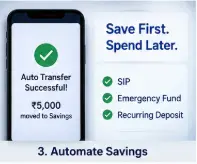
This is one of the most powerful financial habits. The moment the salary gets credited, transfer a fixed amount automatically into savings or investment accounts. Even small automatic savings build discipline.
Examples:
- ₹2,000 monthly SIP
- ₹5,000 emergency fund transfer
- ₹1,000 recurring deposit
Over time, these small systems become powerful. Most people fail financially because they depend too much on motivation instead of systems. Systems work better than motivation.
4. Control Food Delivery and Impulse Spending

This is one of the biggest salary destroyers today. Food delivery apps feel convenient. But repeated spending becomes dangerous.
A ₹300 order may feel small. But 20 similar orders monthly become ₹6,000. That is ₹72,000 yearly.
The same applies to impulse shopping. Most online purchases are emotional. Not essential. Before buying non-essential items, follow the 24-hour rule.
Wait one day. Many unnecessary purchases disappear automatically.
5. Avoid Bad EMI Culture

India’s EMI culture has become financially dangerous.
People finance:
- Phones
- Furniture
- Gadgets
- Vacations
- Luxury purchases
Easy EMI creates fake affordability. But every EMI reduces future financial flexibility. Too many EMIs create permanent salary pressure.
Before taking any EMI, ask: “Will this purchase improve my long-term financial life?” If the answer is no, avoid it.
6. Build an Emergency Fund First

Many people start investing without emergency savings. That is risky. You can estimate your required emergency reserve with our Emergency Fund Calculator.
An emergency fund protects you during:
- Job loss
- Medical emergencies
- Family crises
- Unexpected repairs
The Reserve Bank of India also explains that savings can help households handle unexpected expenses and periods when income is disrupted. RBI financial education guidance on savings. Without emergency savings, saving money from your salary becomes harder because an unexpected expense can force you to depend on loans or credit cards. That creates financial stress for years.
A practical starting point is around three to six months of essential living expenses. People with less stable income or higher financial responsibilities may choose to maintain a larger reserve.
Even small emergency savings create psychological security. This rule is not fixed.
A practical starting target is around 3–6 months of essential living expenses. People with unstable income, a single source of household income, or significant dependants may choose a larger buffer.
RBI financial education material suggests keeping an emergency fund that can cover at least three months of living expenses, with a larger reserve potentially appropriate for people with less secure income. RBI guidance on emergency funds
7. Increase Savings with Every Salary Hike
Most people increase their lifestyle immediately after salary growth.
That becomes a trap. Better approach:
Whenever salary increases, increase savings percentage first.
Example:
If salary rises by ₹10,000:
- Save ₹5,000
- Invest ₹3,000
- Spend ₹2,000
This prevents uncontrolled lifestyle inflation.
8. Reduce Subscription Waste
Most people forget recurring subscriptions.
Examples:
- OTT apps
- Gym memberships
- Premium apps
- Shopping memberships
- Cloud storage services
These small charges silently damage savings. Review subscriptions every month. Remove anything rarely used.
9. Deal With High-Cost Debt Before Increasing Investments
If you have expensive credit-card debt or other high-interest debt, don’t focus only on increasing investments. First build a small emergency buffer and make a plan to eliminate costly debt. Paying only the minimum on a credit-card balance can allow interest to accumulate and can keep your salary tied up in past spending.
If EMIs are taking up too much of your monthly income, see our guide to Loans and Debt Control in India for practical debt-management strategies.
10. Start Investing Early

Learning how to save money from salary is only the first step. Once your emergency savings are progressing, the next step is deciding how much of your surplus should be invested for longer-term goals.
Once your basic emergency buffer is in place, you can consider options appropriate for your goals and risk tolerance, such as:
- Bank savings/FD/RD for short-term or relatively stable goals
- PPF for eligible long-term savings
- Mutual fund SIPs for long-term market-linked investing
- EPF/NPS for retirement-oriented goals, depending on eligibility and suitability
That is much more financially responsible.
The biggest advantage young earners have is time. Compounding becomes powerful over long periods. Waiting too long becomes expensive.
How Much of Your Salary Should You Save?

There is no single percentage that works for everyone. As a starting point, someone with manageable expenses may aim to save around 20% of take-home income. If you have heavy EMIs or family responsibilities, starting with 10% may be more realistic. If your essential expenses are low, you may be able to save 30% or more.
The important thing is to start with a sustainable amount and increase it when your income rises.
| Take-Home Salary | 10% Saving | 20% Saving | 30% Saving |
|---|---|---|---|
| ₹25,000 | ₹2,500 | ₹5,000 | ₹7,500 |
| ₹30,000 | ₹3,000 | ₹6,000 | ₹9,000 |
| ₹50,000 | ₹5,000 | ₹10,000 | ₹15,000 |
| ₹75,000 | ₹7,500 | ₹15,000 | ₹22,500 |
| ₹1,00,000 | ₹10,000 | ₹20,000 | ₹30,000 |
What If You Cannot Save 20% of Your Salary?
Don’t wait until you can save 20%. Start with an amount you can maintain consistently.
If ₹5,000 is impossible, start with ₹1,000. If ₹1,000 is difficult, start with ₹500. The first objective is to create the habit and then increase the amount gradually.
After a salary increase, direct part of the additional income toward savings instead of allowing your lifestyle to absorb the entire increase.
One of the easiest ways to understand how to save money from your salary is to start with a simple monthly example.
Simple Salary Saving Example
How to Budget a ₹50,000 Monthly Salary
| Category | Amount |
|---|---|
| Rent + Utilities | ₹18,000 |
| Groceries + Food | ₹6,000 |
| Transportation | ₹3,000 |
| Savings | ₹8,000 |
| Investments | ₹5,000 |
| Lifestyle | ₹5,000 |
| Miscellaneous | ₹5,000 |
This type of structure creates financial balance. Without planning, spending usually expands automatically. You can also use our Personal Finance Calculators to work through different savings, loan, and investment scenarios.
If you want to understand how your salary and applicable deductions affect your tax calculation, the Income Tax Department provides an official online Income Tax Calculator. Income Tax Department Income Tax Calculator
Stop Comparing Lifestyle on Social Media
This is extremely important. Social media creates fake financial pressure. People compare their reality with other people’s highlights.
That pressure leads to:
- Unnecessary shopping
- Luxury spending
- Expensive gadgets
- Travel overspending
Many people look financially successful online while struggling privately with debt. Real financial growth usually looks boring. Wealth creation is often quiet.
Salary-Day Money Checklist
When salary is credited:
☐ Transfer savings
☐ Pay/allocate fixed bills and EMIs
☐ Fund emergency savings
☐ Set aside investment amount
☐ Keep the remaining amount for monthly spending
☐ Check last month’s unnecessary expenses
Common Mistakes That Destroy Savings
Saving After Spending
Wrong system.
Ignoring Small Expenses
Small leaks create large losses.
Too Many EMIs
EMIs reduce flexibility.
No Emergency Fund
Financial vulnerability increases.
Emotional Spending
Stress shopping destroys savings discipline.
Best Financial Habits for Salaried Employees
The following habits create great financial improvement over time:
- Weekly expense review
- Automatic savings
- Monthly budgeting
- Controlled EMI usage
- Investing consistently
- Avoiding emotional shopping
- Tracking net worth yearly
Financial growth is usually slow initially. But consistency creates massive long-term results.
Final Thoughts
How to save money from salary in India is ultimately less about extreme frugality and more about building a system that controls spending, automates savings, and gradually increases investments.
They need better money systems. A person earning an average salary with discipline can slowly build:
- Emergency fund
- Investments
- Financial security
- Reduced stress
- Long-term wealth
The earlier someone learns salary management, the easier their financial life becomes later.
Money problems rarely disappear automatically. Financial discipline solves them gradually.
FAQs
Q1. How much of my salary should I save every month?
There is no single percentage that works for everyone. A practical starting point is 10%–20% of your take-home salary, and you can increase it as your income grows or expenses fall. If you have high EMIs or essential expenses, starting with even 5% can help build the habit.
Q2. How can I save money from a ₹30,000 salary?
Start by tracking your expenses and setting aside a fixed amount immediately after receiving your salary. For example, saving 10% means ₹3,000, while 20% means ₹6,000 per month. Adjust the amount based on rent, EMIs, family expenses and other essential costs.
Q3. Is saving 20% of my salary enough?
Saving 20% can be a useful target, but it is not a universal rule. Your ideal savings rate depends on your income, expenses, debt, dependents, and financial goals. If 20% is difficult, start with a smaller amount and increase it gradually.
Q4. How can I save money when I have many EMIs?
First, list all your EMIs and other monthly commitments. Avoid taking new loans for non-essential purchases, maintain at least a small emergency reserve, and direct extra money toward expensive debt where appropriate. Once an EMI ends, consider redirecting that amount toward savings or investments.
Q5. Should I save money or invest it first?
Build an emergency reserve before putting money into investments that may fluctuate in value. After you have adequate emergency savings and have considered your high-cost debt, you can invest according to your financial goals, time horizon and risk tolerance.
Q6. How much emergency fund should a salaried person have?
A practical starting point is at least three months of essential living expenses. You may need a larger reserve if your income is less secure, you have dependents or your household expenses are high. Keep emergency money in an easily accessible place rather than relying entirely on market-linked investments.
Q7. Why does my salary finish before the end of the month?
Common reasons include untracked small expenses, frequent online purchases, food delivery, subscriptions, UPI spending, and EMIs. Tracking every expense for a month can help identify where your money is actually going.
Q8. What is the easiest way to start saving from salary?
Automate your savings. Set up a transfer to your savings account or another suitable financial goal soon after your salary is credited. This reduces the temptation to spend the money first and save whatever remains.
Q9. How can I increase my savings when my salary increases?
Do not allow every salary increase to become additional lifestyle spending. You can direct part of each increment toward your emergency fund, debt repayment, investments or another financial goal while keeping some amount available for lifestyle improvements.
Q10. How can I stop spending money before my salary arrives?
Create a monthly spending limit, separate essential expenses from discretionary spending, and review your expenses every week. Automatic savings on salary day can also ensure that part of your income is protected before discretionary spending begins.
