

SIP vs Lump Sum is one of the most important decisions every investor faces in India.
SIP and lump-sum investing are two different ways of putting money into a mutual fund. With an SIP, you invest a fixed amount at regular intervals. With a lump sum, you invest a larger amount at one time.
Neither method is automatically better for every investor. The appropriate approach depends on factors such as when you receive the money, your investment horizon, risk tolerance, cash-flow needs and the market conditions at the time of investment.
This guide compares the two approaches, explains the role of market timing and shows why the answer can differ depending on whether you are investing money gradually from your income or already have a large amount available.
Should you invest monthly through SIP, or invest a big amount in one go?
The answer is not emotional — it’s strategic.
The wrong choice can cost you lakhs over time.
What is SIP and Lump Sum
- SIP → A method of investing a fixed amount in a mutual fund at regular intervals.
- Lump Sum → Investing a larger amount in a mutual fund at one time rather than spreading the investment across multiple instalments.
Mutual funds in India operate within SEBI’s regulatory framework. Association of Mutual Funds in India (AMFI) is the industry association representing mutual funds and asset management companies and provides investor education and industry information.
SIP vs Lump Sum: Core Comparison Table
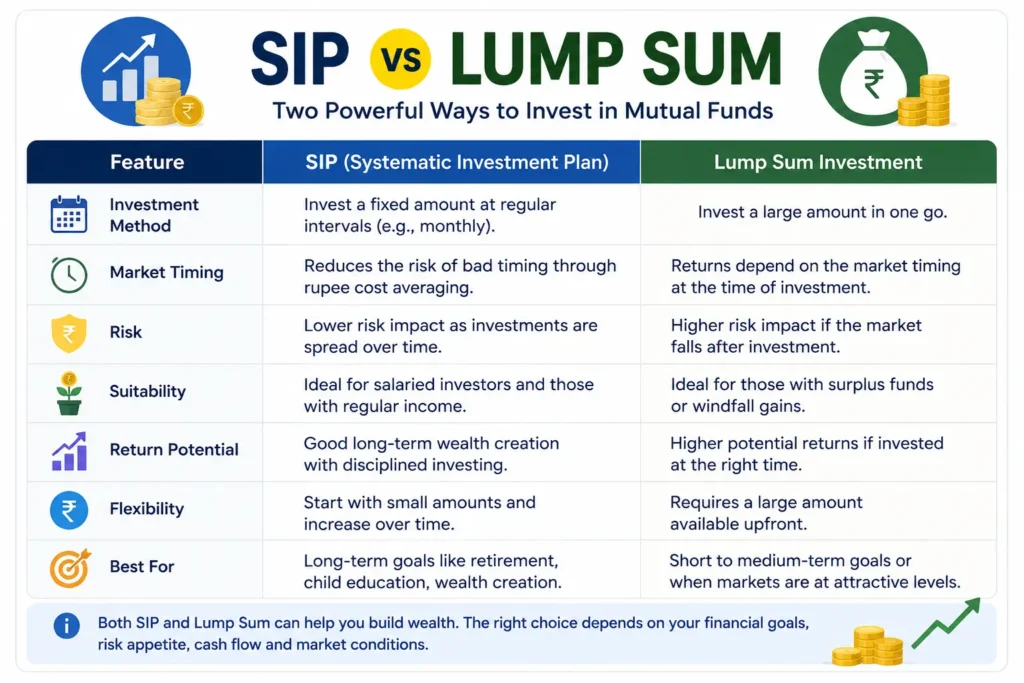
| Factor | SIP | Lump sum |
|---|---|---|
| Investment pattern | Fixed amount at regular intervals | Larger amount invested at one time |
| Market-entry exposure | Spread across multiple dates | Concentrated around the investment date |
| Timing sensitivity | Lower reliance on one entry date | Greater sensitivity to the entry date |
| Cash-flow source | Often suited to regular income | Requires capital already available |
| Flexibility | Contributions can be scheduled regularly | Large amount is deployed upfront |
| Market risk | Depends on the underlying investment | Depends on the underlying investment |
Still Confused Between SIP vs Lump Sum?
Don’t guess.
Use SIP Calculator to:
- Compare returns
- Plan investment
- Reduce risk
When SIP May Be More Suitable
An SIP may be more suitable when you are investing from regular income and do not have a large amount available to invest at once. It can also be useful if you prefer spreading purchases across multiple dates rather than making one large market-entry decision.
SIP does not protect you from market losses. Instead, regular investing reduces your dependence on choosing a single entry date.
Complete SIP investment guide India
What is SIP in India and how it works
₹5000 SIP returns in 10 years example
Check the SIP calculator for returns
When Lump Sum May Be More Suitable
Lump-sum investing may be appropriate when you already have a large amount available for investment and the money is intended for a sufficiently long-term goal.
It may also make sense when the investor is comfortable with the possibility of short-term market fluctuations after investing the money.
However, having a large amount of money does not mean you can reliably identify the best market-entry point.
SIP vs Lump Sum – Real Example in India
Investing the Same ₹1 Lakh
Suppose an investor has ₹1 lakh available today.
They could:
Option A: Invest ₹1 lakh immediately
or
Option B: Spread the same ₹1 lakh across 10 months at ₹10,000 per month.
Then explain that the outcome depends on what the market does during those 10 months.
If the market rises steadily, investing the lump sum earlier may produce the higher final value because more money was invested earlier.
If the market falls substantially after the initial investment, spreading the investment may reduce the impact of entering at the wrong time.
That is the actual SIP vs lump-sum question.
SEBI guidelines on mutual fund investingWhat This Means
- SIP reduces timing risk
- Lump sum depends heavily on timing
SIP spreads purchases across multiple dates, reducing the importance of selecting one entry point. A lump-sum investment puts the money into the market at one point in time, so its short-term outcome can be more sensitive to the market level around that date.
Neither method removes market risk. The underlying mutual fund can rise or fall regardless of how you invest.
Why SIP Can Be Practical for Regular Income
For someone investing from a monthly salary or other recurring income, an SIP can provide a simple way to invest regularly without waiting to accumulate a large lump sum.
It also avoids the need to make one large investment decision at a single point in time. However, the underlying investment remains subject to market risk.
For a beginner investing from regular income, an SIP can be easier to maintain because it matches recurring cash flow and avoids the need to deploy a large amount at one time.
Common Mistake
People mix both incorrectly:
- Start SIP during the bull run
- Stop SIP during a crash
Starting an SIP and then stopping it purely because the market falls can disrupt a long-term investment plan. A market decline does not automatically mean an investor should stop investing, although every investor should reassess whether the investment remains suitable for their goals and risk capacity.
Where Can You Invest?
Investors can generally set up mutual-fund SIPs or make lump-sum investments through an AMC’s platform, a mutual-fund investment platform or an intermediary. Before investing, compare the available services and understand whether you are choosing a direct or regular mutual-fund plan.
Starting earlier can give investments more time to compound, but the outcome depends on the amount invested, investment period and actual returns. There is no universal rule that an early SIP will outperform every later lump-sum investment.
When SIP and Lump Sum Are Not Really Alternatives
Suppose you receive ₹50,000 every month from your salary. You cannot invest the entire year’s ₹6 lakh at the beginning of the year because you don’t have that money yet. An SIP allows you to invest as the income arrives.
Now suppose you receive a ₹6 lakh bonus and want to invest it. The decision is different. You already have the money, so the question becomes whether to invest it immediately or spread the investment over time.
This distinction matters because SIP and lump sum often solve different cash-flow situations.
Conclusion
SIP and lump-sum investing are not competing products. They are two different ways of investing money into a mutual fund.
If you invest from regular income and do not have a large amount available upfront, an SIP can be a practical way to invest consistently and spread purchases across multiple dates. If you already have a substantial amount available, lump-sum investing puts the money to work immediately but exposes the investment to the market conditions around the entry date.
Neither approach guarantees better returns. The underlying mutual fund, investment horizon, market performance and your ability to tolerate risk matter more than simply choosing SIP or lump sum.
The right question is therefore not “Which is always better?” but “Which approach fits the money I have, my financial goal and my ability to handle market fluctuations?”
Compare Before You Invest
Use our SIP Calculator and Lump Sum Calculator to see how different investment amounts, time periods and return assumptions affect the projected value.
Calculate SIP Returns →*Affiliate link. No extra cost to you.
FAQs:
Q1. Which is better, SIP vs lump sum for beginners?
Neither is automatically better for every beginner. An SIP may be easier for someone investing from regular income because the investment is spread across multiple dates. A lump sum may be appropriate when an investor already has a large amount available and is comfortable investing it at once.
Q2. Is a lump sum investment riskier than SIP?
A lump-sum investment can be more sensitive to the market level at the time the investment is made because the entire amount is invested around one entry point. However, the underlying market risk depends on the mutual fund itself. SIP does not eliminate that risk.
Q3. Can SIP outperform lump sum?
Yes, it can, depending on the market path and the period being compared. But lump-sum investing can also outperform SIP when markets rise after the initial investment because more money is exposed to the market earlier. The result depends on the timing, amount invested and market performance.
Q4. When should I choose lump sum over SIP?
Lump sum may be appropriate when you already have a substantial amount available, have a suitable investment horizon and are comfortable with the possibility of short-term market fluctuations. You should not rely on trying to identify the exact market bottom.
Q5. Can I switch from SIP to a lump sum later?
You can change your future investment approach based on your financial goals and circumstances, subject to the terms of the investment and any applicable costs or tax implications. Changing from SIP to lump sum does not guarantee better returns.
