

65 20 15 Budgeting Rule in India is becoming the practical alternative to the outdated 50-30-20 budgeting formula. Rising rent, EMIs, inflation, and lifestyle costs have made traditional budgeting unrealistic for many Indian salaried households. The internet loves the 50-30-20 budgeting rule.
50% for needs.
30% for wants.
20% for savings.
Sounds clean. Sounds smart. Sounds Instagram-friendly. But there’s one problem nobody wants to admit:
The 50-30-20 rule is a useful starting point, but it may not fit every Indian household. High rent, EMIs, family responsibilities and other fixed expenses can make a 50% needs limit difficult to maintain.
Add EMIs, fuel, groceries, school fees, mobile bills, electricity, medicine, and suddenly you’re not budgeting anymore. You’re surviving.
What Is the 65 20 15 Budgeting Rule in India?
That is why the 65-20-15 budgeting rule makes more practical sense for salaried Indians in 2026.
Instead of forcing unrealistic ratios, this method adapts to how middle-class Indians actually spend money.
The formula is simple:
65% = Needs
20% = Savings, Investments, and Debt Reduction(Emergency fund, SIPs, Index funds, PPF, NPS, Extra repayment of high-cost debt)
15% = Lifestyle & Fun
These percentages are targets, not mandatory limits. Your actual allocation should depend on income, debt, family responsibilities and financial goals. And surprisingly, this small tweak can create a larger long-term corpus while reducing guilt around spending.
Why the 50-30-20 Rule Fails in India
The 50-30-20 rule was developed as a simple budgeting framework, but its fixed percentages may not suit every household or cost-of-living situation, where:
• Housing costs are structured differently
• Public transport reduces fuel dependency
• Medical insurance penetration is higher
• Family financial responsibilities are lower
• Education loans work differently
Indian households can face a different mix of expenses, including family support, education costs, EMIs, rent, and healthcare expenses.
A ₹30,000 salary in India is not the same as a $3,000 salary abroad.
Here’s what a realistic Indian monthly budget often looks like:
For some households, rent, EMIs, groceries, transport, education, and family support can consume a large part of take-home income. That’s why a budgeting framework should be treated as a starting point rather than a rigid rule.
You are already above 70% before “wants” even enter the picture.
That is why many salaried employees feel like failures while following viral budgeting advice online.
The problem is not your discipline.
The problem is the model itself.
Why the 65 20 15 Budgeting Rule in India Works Better
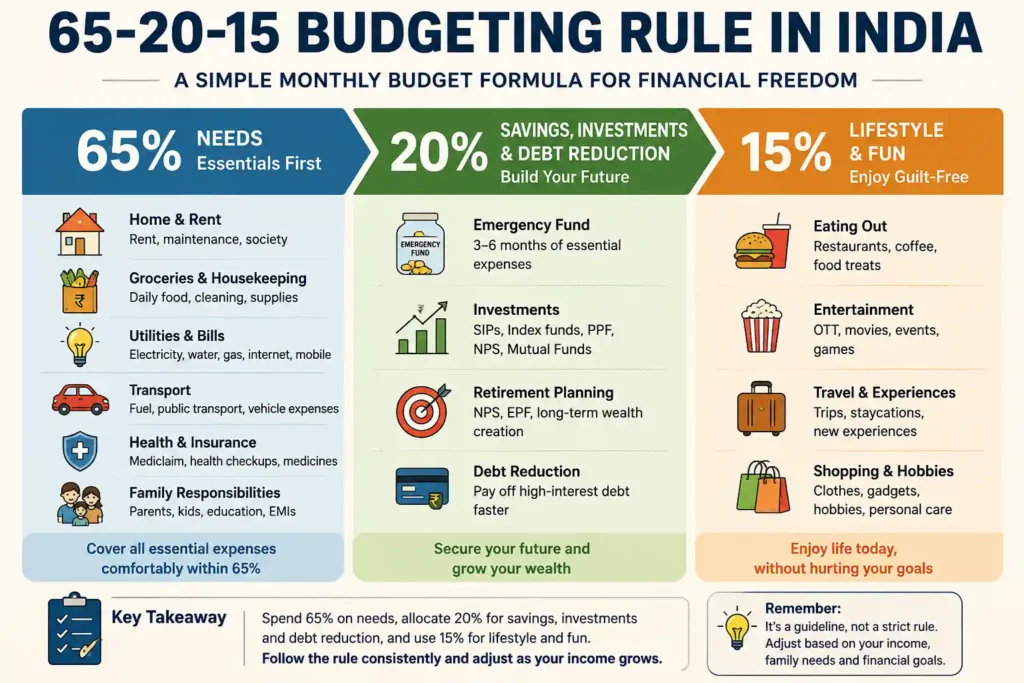
The 65-20-15 budgeting rule is a simplified Indian budgeting framework designed for realistic living costs.
Here’s the split:
65% for Needs
This includes:
• Rent
• EMI
• Electricity
• Groceries
• Insurance
• Fuel
• School fees
• Mobile bills
• Medicines
• Family obligations
The goal is not perfection.
The goal is control.
If your needs exceed 65%, your financial pressure starts increasing rapidly because investment allocation suffers.
20% for Investments
This is the wealth engine.
This category includes:
• SIPs
• Index funds
• PPF
• NPS
• Emergency fund
• Gold ETF
• Debt repayment acceleration
The 20% bucket can include emergency savings, retirement contributions, investments, and extra debt repayment. Once your emergency fund is adequate and expensive debt is under control, a larger share can be directed toward long-term investments.
Most people save “whatever remains.”
That approach never builds wealth.
The 65-20-15 model treats investments like a mandatory EMI to your future self.
If you want to improve long-term wealth creation, also read our guide on SIP vs Side-Hustle Reinvestment.
How Compound Growth Can Help Your Budget
A ₹5,000 monthly SIP invested at 15% annualized return over 10 years can create a surprisingly large corpus.
The 20% allocation becomes more powerful when it is invested or saved consistently over a long period. For example, if you invest ₹5,000 every month, the amount you contribute grows steadily over time. If the money earns a return, the returns can themselves generate further returns through compounding.
However, investment returns are not guaranteed. A SIP calculator can be used to test different investment amounts, time periods and assumed rates of return rather than treating any particular return as certain.
A=P(1+nr)nt
PV
$
r
%
n
PV is the starting amount; r is the rate; n is the number of periods.
FV=PV(1+r)n=1(1+0.05)20=2653.3dollars24681012141618205001000150020002500$2,653.30
This is the real difference between random saving and systematic investing.
Small monthly investments become powerful because of compounding, not because of salary size.
15% for Lifestyle and Fun
This is the most ignored category in Indian finance advice.
And ironically, it is the category that prevents burnout.
This includes:
• Eating out
• OTT subscriptions
• Short trips
• Shopping
• Gadgets
• Hobbies
• Weekend spending
A sustainable financial system must include controlled enjoyment. People who eliminate all fun spending usually fail at budgeting within months.
A sustainable financial system must include controlled enjoyment.
Otherwise, you eventually overspend emotionally.
Salary Planning Using the 65 20 15 Budgeting Rule in India
Example 1: ₹30,000 Monthly Salary
| Category | Allocation |
|---|---|
| Needs (65%) | ₹19,500 |
| Investments (20%) | ₹6,000 |
| Fun (15%) | ₹4,500 |
This gives a simple starting point for someone earning ₹30,000 per month. Actual expenses will vary by city, family situation and debt obligations.
65-20-15 Budgeting Calculator
65-20-15 Budgeting Calculator
Enter your monthly take-home income to see how the 65-20-15 budgeting framework could divide your money between essential expenses, savings and investments, and lifestyle spending.
Your 65-20-15 Budget
Treat these amounts as starting targets rather than fixed rules. Your actual allocation should reflect your rent, EMIs, family responsibilities, emergency savings and financial goals.
This calculator provides a simple budgeting estimate. The 65-20-15 framework is a guideline and is not a universally applicable financial rule.
Example 2: ₹60,000 Monthly Salary
| Category | Allocation |
|---|---|
| Needs | ₹39,000 |
| Investments | ₹12,000 |
| Fun | ₹9,000 |
This can provide a useful starting point for a household with ₹60,000 of monthly take-home income, although the actual allocation should be adjusted for rent, EMIs, and family expenses.
Example 3: ₹1,00,000 Monthly Salary
| Category | Allocation |
|---|---|
| Needs | ₹65,000 |
| Investments | ₹20,000 |
| Fun | ₹15,000 |
At higher income levels, the additional cash flow can create more room for investing, emergency savings, and long-term goals, provided essential expenses and expensive debt are under control.
Because a higher salary does not automatically create wealth.
Higher investing discipline does. The biggest advantage of the 65 20 15 Budgeting Rule in India is flexibility without destroying investment discipline.
Why Indian Salaried Employees Need Flexible Budgeting
Rigid budgeting systems fail because life is not fixed.
One month brings medical expenses.
Another month brings bike repair.
Then the wedding season arrives.
Then school admissions happen.
Indian households need elasticity.
The 65-20-15 model works because it accepts financial reality instead of pretending everyone lives inside a Budgeting advice on social media.
It creates balance between:
• Survival
• Wealth creation
• Mental satisfaction
That balance matters more than perfection.
How to Reduce Your “Needs” Percentage
This is where most wealth creation actually happens.
Every ₹1,000 reduced from unnecessary needs can improve both investing and lifestyle freedom.
If you permanently reduce unnecessary monthly spending by ₹1,000, you can redirect that amount toward your emergency fund, debt repayment or investments.
The biggest financial upgrades usually come from negotiating fixed costs:
• Lower rent
• Refinancing loans
• Reducing subscriptions
• Controlling food delivery habits
• Using public transport strategically
• Avoiding unnecessary EMIs
Tiny recurring leaks destroy wealth faster than occasional splurges.
Who Should Use the 65-20-15 Budgeting Rule in India?
This budgeting framework is ideal for:
• Salaried employees
• Beginners learning money management
• Middle-class Indian families
• Young professionals
• Dual-income households
• People struggling with overspending
It can be useful for people who want a simple budgeting structure without tracking every expense in detail.
However, if you have:
• Irregular income
• Heavy debt
• Medical emergencies
• Business losses
Then you may need temporary adjustments like 75-15-10 or even 80-10-10 until stability improves. These are temporary examples, not standard financial rules.
Budgeting rules should serve your life.
Your life should not become a prisoner of budgeting rules. Investors looking for tax-efficient investing can read our ELSS vs PPF vs VPF comparison.
The Biggest Budgeting Lie on the Internet
The finance industry keeps selling the idea that budgeting is about restriction, which is wrong.
Budgeting is about intentional spending. The goal is not to stop enjoying life. The goal is to stop financial chaos.
People earning ₹25,000 sometimes build more wealth than people earning ₹1.5 lakh because they control lifestyle inflation early.
Income matters, but behavior matters more.
Use the free 65-20-15 Budgeting Calculator to estimate how your monthly income could be divided between needs, savings and investments, and lifestyle spending.
Final Verdict
The 50-30-20 rule can be a useful starting point, but it may not fit every Indian household. The 65-20-15 framework offers another way to allocate take-home income, giving more room to essential expenses while still setting aside 20% for savings, investments and debt reduction.
The important point is not to follow 65 20 15 perfectly. Use it as a starting framework, track your actual spending, and adjust the percentages as your income, family responsibilities, and financial goals change.
It acknowledges:
• High rent
• EMI pressure
• Inflation
• Family obligations
• Realistic lifestyle spending
Most importantly, it still protects long-term investing. That is what actually builds wealth. If you want financial stability in India, stop copying viral Western budgeting templates blindly.
Build a system around your real life, not internet aesthetics. Open your spreadsheet today. Plug in your actual salary. Track where your money is leaking. Then optimize the only thing that truly matters:
Your monthly investing consistency.
FAQs
Q1. What is the 65 20 15 budgeting rule in India?
The 65 20 15 budgeting rule is a simple framework that allocates about 65% of take-home income to essential expenses, 20% to savings, investments, and debt reduction, and 15% to lifestyle spending. It is a budgeting guideline rather than a mandatory financial rule.
Q2. Is 65 20 15 better than 50 30 20?
Neither rule is universally better. The 65-20-15 framework may suit households whose essential expenses take up a larger share of income, while 50-30-20 may work well for households with lower fixed costs. The right allocation depends on your income, expenses, debt and financial goals.
Q3. How much should I save or invest every month?
The 20% allocation can be used as a starting target for savings, investments, and debt reduction. If you have high-interest debt or no emergency fund, some of this amount may be better directed toward those priorities before increasing long-term investments.
Q4. Can I change the 65 20 15 percentages?
Yes. The percentages are guidelines, not fixed rules. You may temporarily allocate more toward essential expenses during periods of high rent, medical costs, family obligations, or debt repayment. As your financial situation improves, you can increase savings or investment contributions.
Q5. Can I use the 65 20 15 budgeting calculator for free?
Yes. The FinanceRead calculator can help you estimate the three budget categories using your monthly take-home income. The results are planning estimates and should be adjusted to reflect your actual expenses and financial goals.
