
The best health insurance plans in India are not necessarily the cheapest policies or the ones with the biggest hospital network. The right health insurance plan depends on your age, health, family size, preferred hospitals, coverage requirements and budget.
Affiliate Disclosure: Some links in this article may be affiliate links. If you purchase a policy through these links, FinanceRead may earn a commission at no additional cost to you. Our comparisons and opinions are based on the policy features, terms and information available at the time of review.
Choosing health insurance is not simply about finding the lowest premium. Room-rent limits, waiting periods, co-payments, restoration benefits, exclusions, and claim-service processes can make a significant difference when you actually need the policy.
The better question is: Which health insurance policy gives you the right combination of coverage, waiting periods, room-rent rules, restoration benefits, claim support, and affordability for your situation?
For 2026, some of the health insurance plans worth comparing include HDFC ERGO Optima Secure+, Care Supreme, Aditya Birla Activ One MAX, Niva Bupa ReAssure 3.0, SBI Super Health Platinum Infinite, Bajaj General My Health Care, Tata AIG Medicare Select and ManipalCigna ProHealth Prime.
But there is no single “best health insurance plan” for everyone.
A young individual, a family of four, a person with diabetes, and a senior citizen may need very different policies.
This guide compares the important features and explains how to choose a policy based on your actual needs rather than advertisements.
Last updated: September 2026

Quick Answer: Which Are the Best Health Insurance Plans in India in 2026?
If you want a quick shortlist of the best health insurance plans in India, these are the policies I would compare first for different requirements. If you want a quick shortlist, these are the plans I would compare first for different requirements:
| Plan | Best suited for |
|---|---|
| HDFC ERGO Optima Secure+ | Strong all-round family coverage |
| Care Supreme | Value-focused buyers wanting strong recharge and bonus features |
| Aditya Birla Activ One MAX | Wellness-focused buyers and people looking at chronic-care features |
| Niva Bupa ReAssure 3.0 | Buyers attracted to unlimited coverage features |
| SBI Super Health Platinum Infinite | High-cover and international-treatment requirements |
| Bajaj General My Health Care | Buyers wanting a modular/customisable plan |
| Tata AIG Medicare Select | Buyers interested in restoration and flexible coverage options |
| ManipalCigna ProHealth Prime | Buyers who want different variants for different health needs |
These are editorial picks, not official rankings. Your age, health history, family size, city, preferred hospitals and budget can change which plan makes the most sense.
What Has Changed for Health Insurance Buyers in 2026?
There are two developments worth knowing before comparing policies.
First, GST on individual health insurance policies was exempted from September 22, 2025. The Government’s GST Council announcement specifically included individual health insurance, including family floater and senior-citizen policies.
Second, health insurance products themselves are changing rapidly. Insurers are introducing larger restoration benefits, wellness rewards, chronic-care options, higher coverage limits and different product variants.
That means an article written two or three years ago may contain product names or features that are no longer current.
For example, Niva Bupa now promotes ReAssure 3.0 as a new unlimited-coverage product, while Care Supreme’s current policy wording is effective from April 29, 2026.
This is why you should always check the latest policy wording and Customer Information Sheet before buying.
What Should You Check Before Buying Health Insurance?

Before looking at individual plans, understand the features that can make a real difference at claim time.
1. Room-Rent Limit
A room-rent restriction can affect more than just the room charge.
Depending on the policy wording, choosing a room above the eligible limit can result in proportionate deductions on certain associated hospital expenses.
For this reason, a policy with no room-rent restriction can be easier to use, particularly if you prefer private hospitals.
But “no room-rent limit” should never be the only reason to select a policy.
2. Disease-Specific Sub-Limits
Some policies may impose limits on particular treatments or procedures.
For example, a policy may have a separate maximum payable amount for a particular surgery even though the overall sum insured is much higher.
A policy without such sub-limits can provide more predictable protection.
3. Pre-Existing Disease Waiting Period
A pre-existing disease is generally subject to the waiting-period rules of the policy.
The period can vary between products and variants.
Do not assume that every health insurance policy has the same waiting period.
Some current products also offer optional features or specific variants that can reduce or waive waiting periods for selected conditions, subject to underwriting and policy terms.
4. Co-Payment
A co-payment means that you pay a specified percentage of an admissible claim.
For example, if a policy has a 20% co-payment and the admissible claim is ₹2 lakh, the policyholder may have to bear ₹40,000, subject to the policy conditions.
A policy with no mandatory co-payment can therefore be attractive, especially when buying long-term family coverage.
5. Restoration or Recharge
Suppose you have ₹10 lakh of health insurance and use the entire amount during a hospitalisation.
A restoration benefit may replenish the sum insured for future claims in the same policy year.
But restoration rules differ.
Before buying, check:
- Whether restoration is unlimited
- Whether it applies after complete or partial exhaustion
- Whether it covers the same illness
- Whether it applies to the same insured person
- When the restored amount becomes available
6. Cashless Hospitals Near You
A large national network sounds impressive, but your local network matters more.
Check whether the hospitals you actually prefer in your city are part of the insurer’s current cashless network.
This is particularly important for families with a preferred hospital, senior citizens and people with ongoing medical requirements.
7. Claim and Complaint Data
Claim Settlement Ratio can be useful, but it should not be treated as the only measure of an insurer.
A better comparison considers:
- Claim settlement data
- Complaint levels
- Incurred Claims Ratio
- Business scale
- Hospital network
- Product terms
- Claims process
- Policy exclusions
IRDAI publishes industry and insurer-level insurance statistics that can be used for broader analysis.
Best Health Insurance Plans in India 2026: Our Top Picks
The following plans are included because they offer different combinations of features and are frequently considered in current 2026 comparisons.
1. HDFC ERGO Optima Secure+ — Strong All-Round Choice
Best for: Families and individuals looking for a comprehensive policy with built-in coverage enhancement.
HDFC ERGO’s current Optima Secure+ is one of the strongest products to consider if your priority is maximizing usable coverage through built-in benefits.
The current product includes features such as:
- Secure Benefit providing 2X cover from day one
- Infinity Benefit that increases coverage on renewal
- Protect Benefit for specified non-medical expenses
- Pre- and post-hospitalisation benefits
- Home healthcare
- Day-care treatment
- AYUSH treatment
- Organ-donor expenses
- Optional riders such as chronic-care and serious-illness benefits
The current HDFC ERGO material identifies Optima Secure+ as the newer product structure and lists a range of optional benefits alongside the base policy.
Ditto’s 2026 analysis also places HDFC ERGO Optima Secure+ at the top of its current five-plan ranking, while nyvo independently places it first among its four shortlisted plans.
Why consider it?
The biggest attraction is not simply the initial sum insured. It is the way the policy can enhance usable coverage through its built-in and optional benefits.
What to check
Do not assume that every Optima Secure+ benefit is automatically included. Check the exact variant, add-ons, sum insured and current policy wording.
2. Care Supreme — Strong Value and Recharge Features
Best for: Buyers looking for substantial coverage enhancement and unlimited recharge.
Care Supreme is another major plan that repeatedly appears in current 2026 comparisons.
Its current product page highlights:
- Sum insured growth through the cumulative-bonus structure
- Unlimited automatic recharge
- No zone-based co-payment
- No sub-limits on several listed treatments
- Day-care treatment
- AYUSH treatment
- Organ-donor coverage
- Annual health check-up
- Optional OPD coverage
- Wellness-linked renewal benefits
The current Care Supreme product states that its cumulative bonus can increase the sum insured up to 7X and that unlimited automatic recharge is available when the cover is exhausted during the policy year.
The current policy version is important because Care has revised its product documentation during 2026. The insurer lists the current Care Supreme policy terms as effective from April 29, 2026.
Why consider it?
Care Supreme can be attractive for buyers who want strong recharge and cumulative-bonus features without moving to a very high-end plan.
What to check
The base plan and optional benefits are not the same thing. Check which benefits are included and which require additional premium.
3. Aditya Birla Activ One MAX — Strong Option for Wellness and Chronic-Care Needs
Best for: Buyers interested in wellness benefits and selected chronic-care features.
Aditya Birla Health Insurance’s Activ One range has become notable for combining traditional hospitalisation coverage with wellness-linked features.
Activ One MAX includes features such as:
- HealthReturns
- Wellness and activity-based benefits
- Hospitalisation coverage
- Modern treatment coverage
- Health-management features
- Chronic-care options under applicable terms
- Optional benefits and riders
The insurer currently states that HealthReturns can provide up to 100% of the premium back under the applicable programme and terms.
The important point is that HealthReturns should not be described simply as an unconditional premium discount. The benefit depends on the applicable programme conditions.
Why consider it?
This plan is particularly worth comparing if wellness rewards or chronic-care features are important to you.
What to check
If you have diabetes, hypertension or another existing condition, do not rely on the product name alone.
Check the exact chronic-care benefit, underwriting decision, waiting period and any applicable rider.
4. Niva Bupa ReAssure 3.0 — For Buyers Wanting Unlimited Coverage
Best for: Buyers attracted to unlimited sum-insured and restoration features.
Niva Bupa’s current ReAssure 3.0 represents a significant change from the older ReAssure 2.0 product that appears in many older articles.
The current insurer page describes:
- Unlimited sum insured
- Unlimited coverage from day one
- Day-one pre-existing-disease coverage option for eligible conditions
- Lock the Clock on eligible variants
- Wellness benefits
- Optional global treatment benefits
- Different room-category rules depending on the variant
ReAssure 3.0 offers four variants, and the room eligibility differs between them. The Black variant has no room-type capping, while other variants have different room-category restrictions.
The policy documentation also makes clear that day-one PED coverage involves an option and underwriting conditions rather than being an automatic benefit for everyone.
Why consider it?
If you are specifically looking for a policy built around unlimited coverage, ReAssure 3.0 deserves a place on your shortlist.
What to check
Do not compare “unlimited coverage” without comparing the variant.
The room rules, optional benefits and other conditions can differ significantly.
5. SBI Super Health Platinum Infinite — For High-Cover Requirements
Best for: Buyers looking for high sum insured and broader international-treatment features.
SBI General’s Super Health Insurance range includes Platinum Infinite, with sum insured options of ₹50 lakh, ₹75 lakh, ₹1 crore and ₹2 crore.
The product documentation lists features such as:
- Health Multiplier Benefit
- ReInsure Benefit
- Claims Shield
- Home healthcare
- Medical treatment abroad
- High sum insured options
- Optional features depending on the chosen plan
The insurer’s current downloads page continues to list Super Health Insurance among its active health products, including Platinum Infinite documentation.
Why consider it?
This is particularly relevant if you are looking beyond a basic ₹5 lakh or ₹10 lakh policy and want a higher-cover product.
What to check
Higher sum insured does not automatically mean better coverage.
Check deductibles, co-payment options, benefit conditions and international-treatment eligibility carefully.
6. Bajaj General My Health Care — Flexible and Modular
Best for: Buyers who want to customise their coverage.
Bajaj General’s My Health Care plan is designed around a modular structure.
Current product information highlights:
- Individual and family coverage
- Customisable benefits
- OPD options
- Hospitalisation coverage
- Day-care treatment
- Reinstatement options
- Consumables coverage
- Pre- and post-hospitalisation benefits
- Optional benefits depending on the selected configuration
The insurer describes the product as modular and provides a range of sum-insured options extending up to ₹5 crore.
Why consider it?
The main attraction is flexibility.
Instead of buying a standard package with every possible feature, buyers can compare different combinations according to their needs.
What to check
Customisation can also make comparison more complicated.
Before comparing premiums, make sure two plans actually provide comparable coverage.
7. Tata AIG Medicare Select — Strong Restoration Focus
Best for: Buyers who value restoration and flexible coverage options.
Tata AIG Medicare Select includes features such as:
- In-patient hospitalisation
- Pre- and post-hospitalisation benefits
- Day-care treatment
- Domiciliary treatment
- AYUSH treatment
- Organ-donor expenses
- Restore Infinity Plus
- No-claim bonus
- Optional benefits
- Different room-category options
The current Tata AIG policy documentation describes Restore Infinity Plus as a restoration feature and provides specific rules for room categories and other benefits.
That means the plan should not simply be described as having “no room-rent limit” without checking the selected coverage and policy terms.
Why consider it?
Its restoration structure and optional benefits make it worth comparing with other comprehensive health policies.
What to check
Read the room-category rules carefully and check how restoration works for repeated claims.
8. ManipalCigna ProHealth Prime — Multiple Variants for Different Needs
Best for: Buyers who want different variants rather than a one-size-fits-all product.
ManipalCigna’s ProHealth Prime range includes multiple variants designed for different customer requirements.
The current range includes:
- ProHealth Prime Protect
- ProHealth Prime Advantage
- ProHealth Prime Active
The product range includes features such as hospitalisation coverage, day-care treatment, AYUSH treatment, restoration, wellness benefits and optional benefits depending on the selected variant.
One particularly relevant feature is the Active variant’s treatment of certain conditions such as diabetes, hypertension, obesity and dyslipidemia under specific waiting-period rules.
Current product information should be checked carefully because the waiting periods are not identical across every variant.
Why consider it?
The range gives buyers more flexibility to match the policy with their health profile.
What to check
Do not compare “ProHealth Prime” as if it were one identical policy. Compare the exact variant and its policy wording.
Quick Comparison of the 8 Plans
| Health Insurance Plan | Best suited for | Main attraction | Important thing to check |
|---|---|---|---|
| HDFC ERGO Optima Secure+ | Families and broad protection | 2X cover from day one + coverage enhancement | Exact benefits and add-ons |
| Care Supreme | Value-focused buyers | Up to 7X cumulative structure + unlimited recharge | Current policy version and optional covers |
| Aditya Birla Activ One MAX | Wellness/chronic-care focus | HealthReturns + wellness features | Chronic-care terms and underwriting |
| Niva Bupa ReAssure 3.0 | Unlimited-cover seekers | Unlimited sum insured | Variant-specific room and benefit rules |
| SBI Super Health Platinum Infinite | High-cover buyers | ₹50 lakh–₹2 crore options | Deductibles and benefit conditions |
| Bajaj General My Health Care | Customisation | Modular plan design | Add-on configuration |
| Tata AIG Medicare Select | Restoration-focused buyers | Restore Infinity Plus | Room-category and restoration rules |
| ManipalCigna ProHealth Prime | Different health profiles | Multiple variants | Exact variant and waiting periods |
Which of the Best Health Insurance Plans in India Is Right for a Family?
Among the best health insurance plans in India, the right choice for a family of four depends heavily on the ages and health needs of the members.

For a family of four, don’t automatically buy four separate individual policies.
A family floater can often be a convenient structure because the members share a common sum insured.
However, a family floater is not always the best choice.
Consider:
- Ages of the family members
- Whether parents are included
- Existing illnesses
- Expected healthcare needs
- Premium affordability
- Whether senior parents should have separate coverage
For example, a young couple with two children may find a family floater easier to manage.
A couple with elderly parents may be better served by a family floater for the couple and children plus separate policies for the parents.
There is no universal rule.
Star Health Super Star
Best for: buyers looking for highly customizable coverage and unlimited restoration.
Star Health Super Star is a newer 2026 health insurance option worth considering for buyers who want extensive customization. The policy offers unlimited restoration of the sum insured, any-room coverage, multiple sum-insured options including ₹1 crore and unlimited cover, and a range of optional covers. Its “Freeze Your Age” feature can keep premiums based on the entry age until a claim or age 55, subject to the policy terms.
The policy has a 30-day initial waiting period, a 24-month waiting period for specified diseases/procedures and a 36-month waiting period for pre-existing diseases, subject to the applicable policy terms.
Star Health Super Star — A New 2026 Option
- What it offers
- Who it may suit
- Important waiting periods
- Room-rent rules
- Restoration
- Key limitations/conditions
- Check Star Health Super Star → [your affiliate link]
How Much Health Insurance Cover Do You Need?
The old approach of saying “₹5 lakh is enough” is increasingly difficult to justify without knowing the buyer’s circumstances.
A more practical approach is to consider:
Young Individual
A young person without major health risks may start with a meaningful base policy and consider a super top-up for additional protection.
Young Family
A family with two adults and children should consider future hospitalisation costs, not just today’s premium.
Metro-City Family
If you regularly use private hospitals in cities such as Mumbai, Delhi, Bengaluru, Hyderabad, Chennai or Pune, a larger sum insured may make sense.
Tier-2 or Tier-3 City
Healthcare costs may differ from large metros, but that does not mean a very low cover is automatically adequate.
Senior Citizens
Senior citizens generally need a more careful assessment because premiums, co-payments, waiting periods and underwriting can have a much larger impact.
The right sum insured should therefore be based on the family’s circumstances rather than a universal number.
Should You Buy ₹1 Crore Health Insurance?
Not necessarily.
A ₹1 crore policy may sound impressive, but the headline sum insured does not tell you everything.
A ₹10 lakh policy with strong terms can sometimes be more useful for a particular buyer than a ₹1 crore policy with restrictive conditions.
Before buying very high cover, compare:
- Room-rent restrictions
- Disease sub-limits
- Co-payment
- Restoration
- Waiting periods
- Exclusions
- Hospital network
- Premium
- Super top-up alternatives
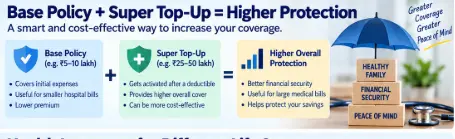
A base policy plus a super top-up can also be considered when you want a much larger overall protection amount at a potentially lower premium.
But compare the deductible and aggregate-claim rules carefully before buying.
Health Insurance vs Employer Group Insurance
Employer health insurance is useful, but it should not automatically be treated as your only health cover.
A personal policy can provide continuity if you:
- Change jobs
- Leave employment
- Start a business
- Retire
- Lose employer coverage
Employer policies may also have different limits for spouses, children and parents.
The ideal approach for many salaried employees is to understand the employer policy first and then decide whether a personal policy or super top-up is needed.
If you are also reviewing life protection for your family, see our guide to the Best Term Insurance Plans in India 2026.
Section 80D: Health Insurance Tax Benefit in 2026
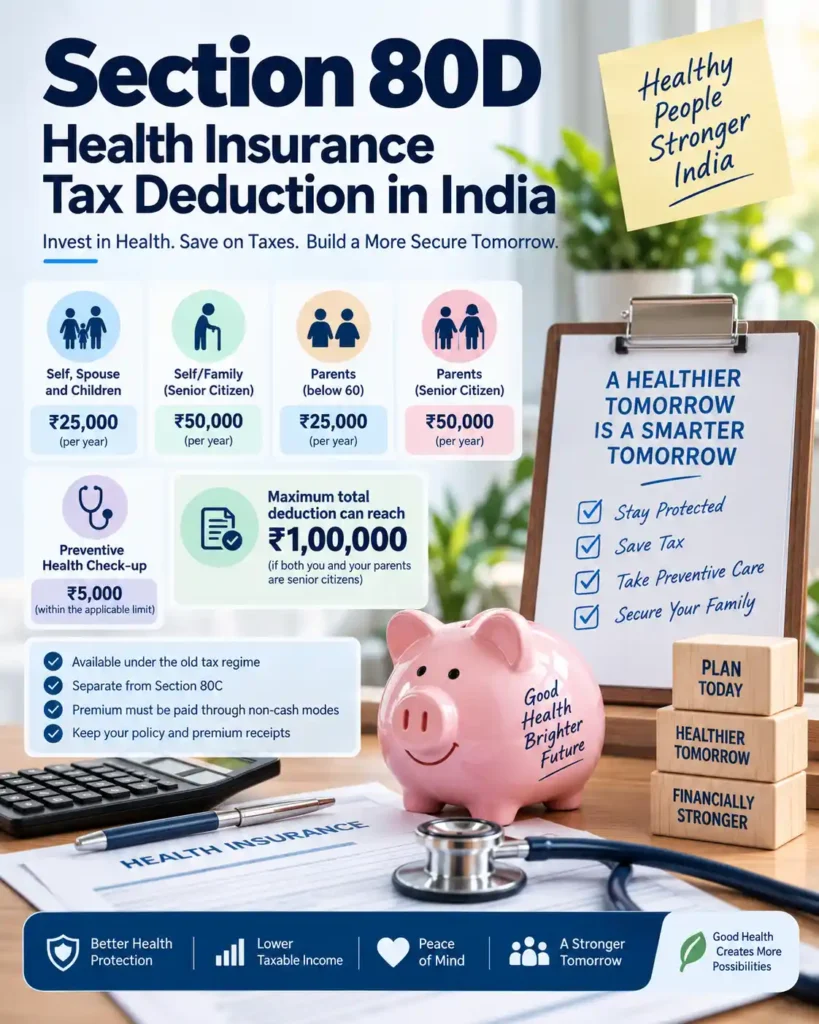
Section 80D provides a deduction for eligible health insurance premiums and preventive health check-ups.
For AY 2026-27, the Income Tax Department lists:
| Category | Maximum deduction |
|---|---|
| Self, spouse and dependent children | ₹25,000 |
| Self/family where senior-citizen limit applies | ₹50,000 |
| Parents below 60 | ₹25,000 |
| Senior-citizen parents | ₹50,000 |
| Preventive health check-up | ₹5,000 within the applicable limit |
The overall eligible deduction can reach ₹1 lakh when the relevant senior-citizen limits apply to both the self/family and parents categories. The Income Tax Department also states that the ₹5,000 preventive health check-up amount is included within the applicable limit.
Income Tax Department’s Section 80D guidance
Is Section 80D Available Under the New Tax Regime?
No.
Section 80D is available under the old tax regime. The Income Tax Department’s AY 2026-27 filing rules specify the 80D deduction under the old regime.
Therefore, don’t choose health insurance solely because you expect an 80D deduction without first checking which tax regime you are using.
If you are unsure which tax regime works better for your situation, use our Income Tax Calculator to compare the old and new regimes.
Is Health Insurance Premium GST-Free in 2026?
For individual health insurance, GST was exempted from September 22, 2025.
The Government’s GST Council announcement included individual health insurance policies, including family floater and senior-citizen policies.
This is an important difference from older health-insurance articles that still calculate premiums by adding 18% GST.
However, always check the premium shown on the insurer’s current quote because tax treatment can depend on the type of policy and applicable rules.
7 Mistakes to Avoid When Buying Health Insurance
Mistake 1: Choosing Only on Premium
The cheapest plan is not automatically the best plan.
A lower premium may come with higher restrictions.
Mistake 2: Looking Only at Claim Settlement Ratio
CSR is useful, but it should be considered alongside complaints, claim experience, policy terms and other insurer data.
Mistake 3: Ignoring Your Local Hospital Network
A national hospital count is less important than whether your preferred hospital accepts cashless treatment under the policy.
Mistake 4: Hiding Medical Information
Always disclose existing diseases, treatments, medications and relevant medical history accurately during the proposal process.
Mistake 5: Assuming Unlimited Restoration Means Unlimited Everything
Restoration benefits have conditions.
Read when the restored amount becomes available and what claims it can be used for.
Mistake 6: Buying a Huge Sum Insured Without Reading the Fine Print
₹1 crore cover does not automatically mean every ₹1 crore hospital bill will be paid.
Policy exclusions, waiting periods, deductibles, co-payments and sub-limits still matter.
Mistake 7: Buying for Tax Saving Alone
Tax saving should be a secondary consideration.
The primary purpose of health insurance is financial protection against eligible medical expenses.
For broader insurer-level information, readers can also refer to the IRDAI Handbook on Indian Insurance Statistics.
Frequently Asked Questions
Which is the best health insurance plan in India in 2026?
There is no single best plan for everyone.
HDFC ERGO Optima Secure+ is a strong all-round option to compare, while Care Supreme, Aditya Birla Activ One MAX and Niva Bupa ReAssure 3.0 stand out for different feature sets.
The right choice depends on your age, health, family structure, city, preferred hospitals and budget.
Which health insurance is best for a family?
For a young family, a family floater can be a practical option.
HDFC ERGO Optima Secure+, Care Supreme and Niva Bupa ReAssure 3.0 are among the products worth comparing, but the final choice should be based on policy terms rather than the brand name alone.
Which health insurance is best for diabetes?
There is no universal answer for every person with diabetes.
Products such as Aditya Birla Activ One MAX and specific ManipalCigna variants have features aimed at chronic conditions, while Niva Bupa ReAssure 3.0 offers an option for day-one PED coverage subject to eligibility, underwriting and policy terms.
Always disclose diabetes and ongoing medication when applying.
Is ₹10 lakh health insurance enough?
It can be enough for some individuals, but it may not be adequate for every family or city.
Consider a larger base cover or a base policy plus super top-up if your financial situation and healthcare requirements justify it.
Is ₹1 crore health insurance worth buying?
It can be useful for people who want very high protection, but the sum insured alone should not determine your purchase.
Check the policy’s room rules, exclusions, waiting periods, restoration and claim conditions.
Is family floater better than individual health insurance?
Neither is universally better.
A family floater can be convenient for a young family, while separate policies may make more sense for elderly parents or members with substantially different health risks.
Can I claim Section 80D in the new tax regime?
No. Section 80D is available under the old tax regime for eligible expenses and premiums.
Does health insurance have GST in 2026?
Individual health insurance policies have been exempt from GST from September 22, 2025, following the GST Council’s decision.
Should I buy health insurance if my employer already provides it?
For many employees, having personal health insurance in addition to employer cover can provide greater continuity and control.
The right amount of additional cover depends on your employer policy, family needs and financial situation.
Final Verdict: Which Health Insurance Plan Should You Choose?
There is no responsible way to say that one health insurance plan is the best for every Indian.
Instead, start with your requirement.
For a strong all-round option: Compare HDFC ERGO Optima Secure+.
For value and recharge features: Compare Care Supreme.
For wellness and chronic-care features: Compare Aditya Birla Activ One MAX.
For unlimited-coverage features: Compare Niva Bupa ReAssure 3.0.
For high-cover requirements: Compare SBI Super Health Platinum Infinite.
For flexible customisation: Compare Bajaj General My Health Care.
For restoration-focused coverage: Compare Tata AIG Medicare Select.
For multiple health-profile variants: Compare ManipalCigna ProHealth Prime.
Before buying, compare at least three policies using the same family profile and sum insured.
Most importantly, read the latest policy wording and Customer Information Sheet rather than relying only on comparison tables or marketing claims.
Health insurance is a long-term financial protection product. The best policy is not necessarily the one with the biggest number, the lowest premium or the highest advertised claim ratio.
It is the policy whose terms you understand and whose coverage fits your family’s actual needs.
Disclaimer: This article is for educational purposes only and does not constitute financial, tax, medical or insurance advice. Health insurance products, premiums, features, waiting periods, hospital networks and tax rules can change. Product information in this article was reviewed using information available in September 2026. Always verify the latest policy wording, prospectus, Customer Information Sheet, insurer quote and applicable tax rules before purchasing a policy.
Also Read on FinanceRead.in
- Section 80D Deduction Limit: Health Insurance Tax Benefit Explained
- Old vs New Tax Regime: Which Is Better for You in 2026?
- Best Term Insurance Plans in India 2026
- How to Save Income Tax in India for Salary Above ₹10 Lakh
- Health Insurance for Senior Citizens in India
- Health Insurance for Parents: What Should You Check?